如
| ||||||||
Translingual
| Stroke order | |||
|---|---|---|---|
 | |||
| Stroke order | |||
|---|---|---|---|
 | |||
Han character
如 (Kangxi radical 38, 女+3, 6 strokes, cangjie input 女口 (VR), four-corner 46400, composition ⿰女口)
Derived characters
References
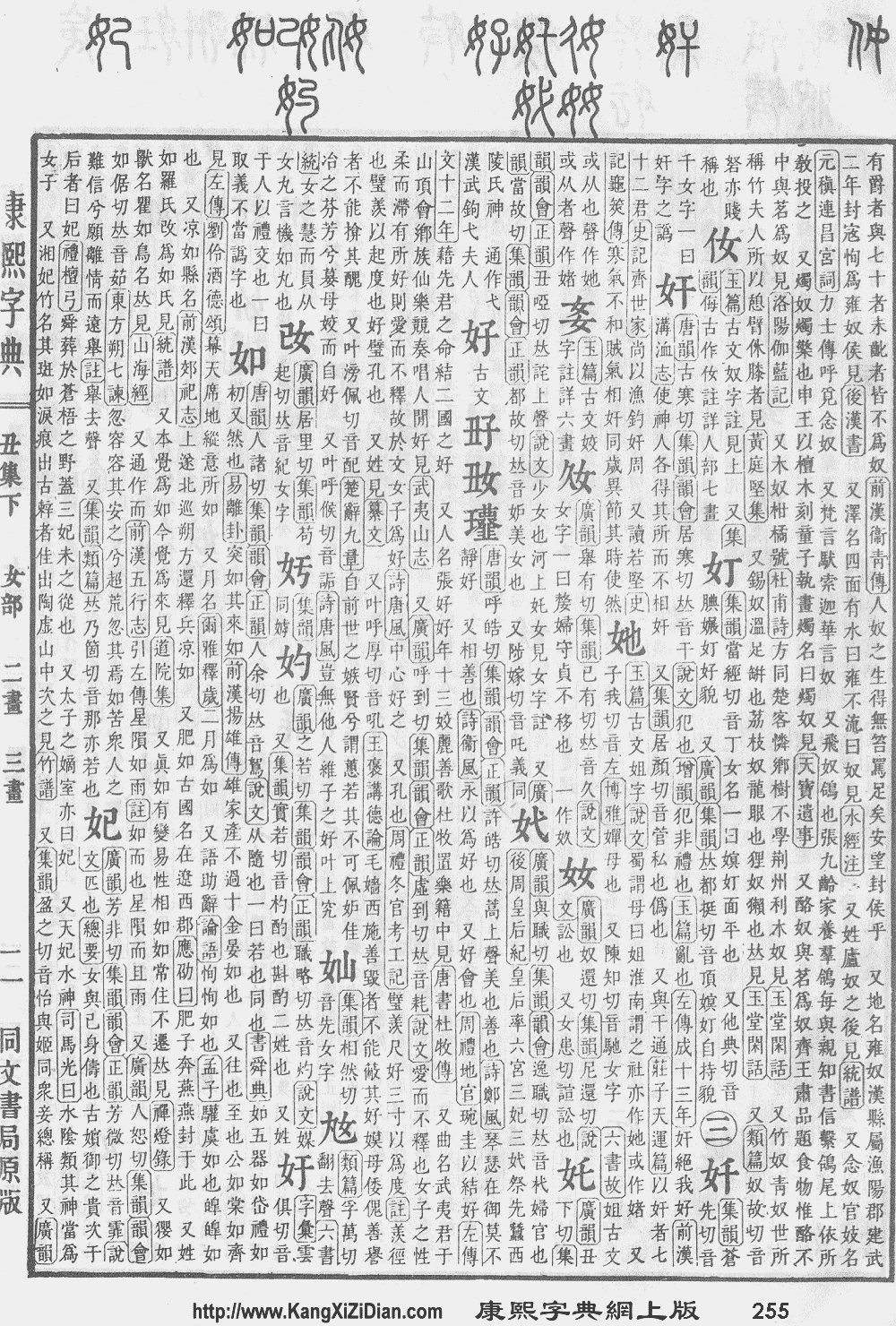
- KangXi: page 255, character 21
- Dai Kanwa Jiten: character 6060
- Hanyu Da Zidian (first edition): volume 2, page 1025, character 9
- Unihan data for U+5982
Chinese
| trad. | 如 | |
|---|---|---|
| simp. # | 如 | |
| alternative forms | ⿰女⿶凵人 clerical script | |
Glyph origin
| Historical forms of the character 如 | |||
|---|---|---|---|
| Shang | Western Zhou | Shuowen Jiezi (compiled in Han) | Liushutong (compiled in Ming) |
| Oracle bone script | Bronze inscriptions | Small seal script | Transcribed ancient scripts |
 |
 |
 |
 |
| Old Chinese | |
|---|---|
| 拿 | *rnaː |
| 拏 | *rnaː |
| 詉 | *rnaː |
| 蒘 | *rnaː, *na |
| 笯 | *rnaː, *naː, *naːs |
| 挐 | *rnaː, *na |
| 絮 | *rnaːs, *nas, *snas, *nas |
| 呶 | *rnaːw |
| 怓 | *rnaːw |
| 帑 | *n̥ʰaːŋʔ, *naː |
| 奴 | *naː |
| 砮 | *naː, *naːʔ |
| 駑 | *naː |
| 孥 | *naː |
| 努 | *naːʔ |
| 弩 | *naːʔ |
| 怒 | *naːʔ, *naːs |
| 袽 | *na |
| 帤 | *na |
| 女 | *naʔ, *nas |
| 籹 | *naʔ |
| 恕 | *hnjas |
| 如 | *nja, *njas |
| 茹 | *nja, *njaʔ, *njas |
| 洳 | *nja, *njas |
| 鴽 | *nja |
| 蕠 | *nja |
| 汝 | *njaʔ |
| 肗 | *njaʔ |
Ideogrammic compound (會意) and phono-semantic compound (形聲, OC *nja, *njas) : phonetic 女 (OC *naʔ, *nas, “woman”) + semantic 口 (“mouth”) – a woman obeying an order.
Etymology 1
Sino-Tibetan; compare Mru [script needed] (na, “to be so”), Mizo na nâ nâ (“it being so; since”) (Schuessler, 2007). Also compare Old Mon [script needed] (ñaṅ, “resembling; like”) (ibid.).
Pronunciation
Definitions
如
- to be like; as; as if; as though
- 遂為母子如初。 [Classical Chinese, trad.]
- From: Commentary of Zuo, c. 4th century BCE
- Suì wéi mǔzǐ rúchū. [Pinyin]
- Thus they were reconciled as mother and son just like before.
遂为母子如初。 [Classical Chinese, simp.]
- to comply with; to agree with; to fit
- 如此 ― rúcǐ ― accordingly; according to this
- 凡諸侯有命告則書,不然則否。師出臧否,亦如之。 [Classical Chinese, trad.]
- From: Commentary of Zuo, c. 4th century BCE
- Fán zhūhóu yǒu mìng gào zé shū, bùrán zé fǒu. Shī chū zāngfǒu, yì rú zhī. [Pinyin]
- As a general rule, the annals only keep the record of an event if a feudal prince legitimately announces such; otherwise no records are kept in the official annals. As for the result of a military expedition, it follows the same rule.
凡诸侯有命告则书,不然则否。师出臧否,亦如之。 [Classical Chinese, simp.]
- such as; for example; for instance
- 比如 ― bǐrú ― for instance
- 孔子序列古之仁聖賢人,如吳太伯、伯夷之倫,詳矣。 [Classical Chinese, trad.]
- From: The Records of the Grand Historian, by Sima Qian, c. 91 BCE
- Kǒngzǐ xùliè gǔ zhī rén shèng xián rén, rú Wú Tàibó, Bóyí zhī lún, xiáng yǐ. [Pinyin]
- Confucius has given detailed testimonials to ancient paragons of virtue and wisdom, such as Taibo of Wu, Boyi, and others of their kind.
孔子序列古之仁圣贤人,如吴太伯、伯夷之伦,详矣。 [Classical Chinese, simp.]
- (chiefly in the negative) to be as good as; to be comparable to
- than; more than
- 其民之親我也,歡若父母,好我芳如芝蘭。 [Classical Chinese, trad.]
- From: Xunzi, c. 3rd century BCE
- Qí mín zhī qīn wǒ yě, huān ruò fùmǔ, hào wǒ fāng rú zhǐlán. [Pinyin]
- Their people, who support me, delight in me as much as they delight in their parents. They, loving me, deem me more fragrant than angelicas and orchids. (A highly literal translation)
其民之亲我也,欢若父母,好我芳如芝兰。 [Classical Chinese, simp.]
- if; supposing
- † postposition indicating an appearance, a state, or a condition; having the characteristic of
- 突如其來/突如其来 ― tūrúqílái ― all of a sudden (literally, "it comes, like charging")
- 空空如也 ― kōngkōngrúyě ― empty
- 君召使擯,色勃如也,足躩如也。揖所與立,左右手,衣前後,襜如也。趨進,翼如也。 [Classical Chinese, trad.]
- From: The Analects of Confucius, c. 475 – 221 BCE, translated based on James Legge's version
- Jūn zhào shǐ bīn, sè bórú yě, zú juérú yě. Yī suǒyǔ lì, zuǒyòu shǒu, yī qiánhòu, chānrú yě. Qū jìn, yìrú yě. [Pinyin]
- When the prince called him to employ him in the reception of a visitor, his countenance appeared to change, and his legs to move forward with difficulty. He inclined himself to the other officers among whom he stood, moving his left or right arm, as their position required, but keeping the skirts of his robe before and behind evenly adjusted. He hastened forward, with his arms like the wings of a bird.
君召使摈,色勃如也,足躩如也。揖所与立,左右手,衣前后,襜如也。趋进,翼如也。 [Classical Chinese, simp.]
- (obsolete) you
- a surname
Synonyms
Etymology 2
May be related to 向 (OC *hljaŋs, *hlaŋs, “to face; to turn towards”) (Schuessler, 2007).
Pronunciation
Compounds
|
|
|
References
- Dictionary of Chinese Character Variants (教育部異體字字典), A00885
- “如”, in 漢語多功能字庫 (Multi-function Chinese Character Database), 香港中文大學 (the Chinese University of Hong Kong), 2014–
Japanese
Readings
Etymology 1
| Kanji in this term |
|---|
| 如 |
| にょ Grade: S |
| goon |
From Middle Chinese 如 (MC ȵɨʌ, “as if; as though”).
Pronunciation
- IPA(key): [ɲ̟o̞]
Compounds
Etymology 2
| Kanji in this term |
|---|
| 如 |
| じょ Grade: S |
| kan’on |
Pronunciation
- IPA(key): [d͡ʑo̞]
Korean
Old Korean
Glyph origin
A semantically adopted phonogram, or 훈가자(訓假字) (hun'gaja), representing the syllable *ta by matching the sense of the Chinese character ("to be like") with an otherwise unattested Old Korean root ancestral to Middle Korean 답다 (ta-p-ta, “to be like”) and 닿다 (ta-h-ta, “to be like”).
Etymology 1
First attested in the 신라촌락문서 / 新羅村落文書 (Silla village registers), 695 CE.
Alternative forms
- 之, 也 (possibly, logogramic forms attested in very early sources; may simply be misunderstandings of Chinese grammar)
- 多 (alternative phonogramic form found in some Silla sources)
Suffix
如 (*-ta)
- The declarative mood sentence-final verbal suffix.
- c. 750, 月明師 (Wolmyeongsa), “祭亡妹歌 (Jemangmae-ga)”, in 三國遺事 (Samguk Yusa) [Memorabilia of the Three Kingdoms]:
- 吾隱去內如
- *NA-n KA-no-ta
- I am going
-
Reconstruction notes
Conventionally reconstructed as *-ta after the Middle Korean reflex. There is no evidence in Old Korean of the Middle Korean [ta ~ ɾa] allomorphy; for more on this phenomenon, see Appendix:Koreanic reconstructions.
Descendants
Reconstruction notes
Sometimes reconstructed as *-te to match the Middle Korean form, but it is probably more prudent to take the Old Korean orthography at face value and reconstruct *-ta (Park 2018, p. 68). As with the declarative suffix, there is no evidence in Old Korean of the Middle Korean [tə ~ ɾə] allomorphy.
Descendants
References
- 박부자 (Park Bu-ja) (2018), “시상형태 {더}의 쟁점과 전망 [Points of discussion and prospective developments in the study of the tense/aspect-marking -te-]”, in Gugeosa yeon-gu, volume 27, pages 53—79
- 이병기 (Yi Byeong-gi) (2019), “고대국어 종결어미 연구의 현황과 과제 [The current situation and future tasks in the study of Old Korean sentence enders]”, in Gugyeol yeon-gu, volume 43, pages 5—53
Vietnamese
Han character
如: Hán Việt readings: như (
如: Nôm readings: nhơ[1][2][3][6], như[1][2][4][7], nhờ[1][2], nha[1], nhừ[3], dừ[3], rừ[3]
References
- Nguyễn (2014).
- Nguyễn et al. (2009).
- Trần (2004).
- Bonet (1899).
- Génibrel (1898).
- Hồ (1976).
- Taberd & Pigneau de Béhaine (1838).