鼻
| ||||||||
| ||||||||
| ||||||||
Translingual
| Stroke order | |||
|---|---|---|---|
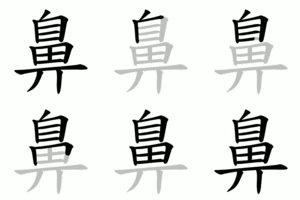 | |||
| Japanese | 鼻 |
|---|---|
| Simplified | 鼻 |
| Traditional | 鼻 |
Alternative forms
The form of this character differs slightly between China and Japan:
- in China: 鼻,
- in Japan: 鼻
That is, in China the bottom is 丌 (strokes T-junction), while in Japan the bottom is 廾 (strokes cross).
Due to Han unification, they share the same codepoint.
Han character
鼻 (Kangxi radical 209, 鼻+0, 14 strokes, cangjie input 竹山田一中 (HUWML), four-corner 26446, composition ⿱自畀)
- Kangxi radical #209, ⿐.
Derived characters
References
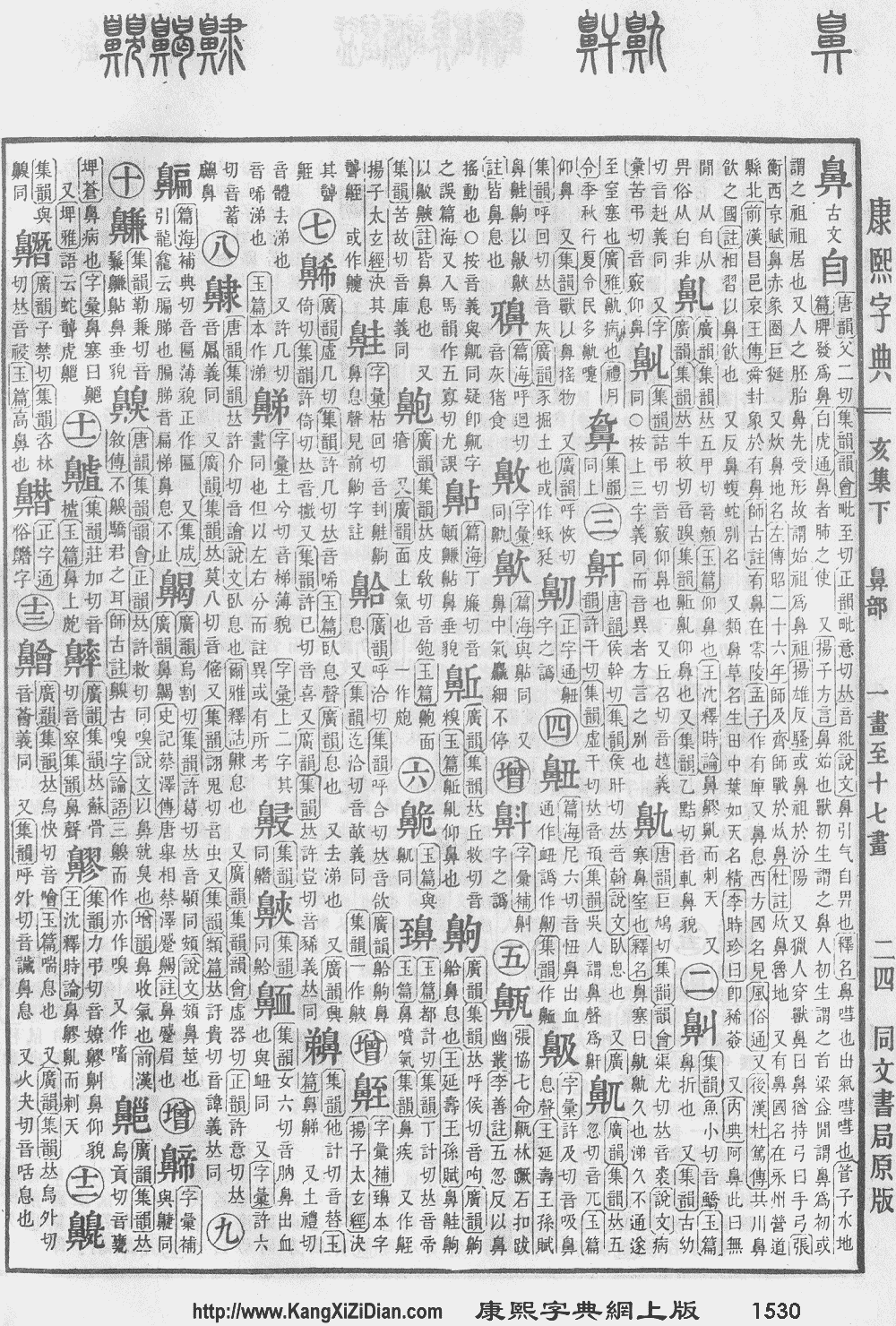
- KangXi: page 1530, character 1
- Dai Kanwa Jiten: character 48498
- Dae Jaweon: page 2066, character 15
- Hanyu Da Zidian (first edition): volume 7, page 4779, character 1
- Unihan data for U+9F3B
- Unihan data for U+2FA1C
Chinese
| simp. and trad. |
鼻 | |
|---|---|---|
| 2nd round simp. | 𢍂 | |
Glyph origin
| Historical forms of the character 鼻 |
|---|
| Shuowen Jiezi (compiled in Han) |
| Small seal script |
 |
Phono-semantic compound (形聲, OC *blids) : semantic 自 (“nose”) + phonetic 畀 (OC *pids).
自 (OC *ɦljids) originally meant “nose” but came to be used to mean “self”, so the sense of “nose” has been replaced by 鼻 (OC *blids). Some scholars interpret 鼻 (OC *blids) as a combination of a nose (自 (OC *ɦljids)) and two lungs (畀 (OC *pids)).
Etymology
From Proto-Sino-Tibetan *bi (“nose”); compare Sichuan Yi ꅳꁖ (hnap bbit, “nose; snot”).
Alternatively, it may be from Proto-Sino-Tibetan *s-brit (“sneeze; nose; swallow”), whence Tibetan སྦྲིད (sbrid, “sneeze”), but there is no trace of r in Chinese (Schuessler, 2007).
In some modern lects, including Mandarin, Gan, Jin, Wu, and Xiang, and even in the literary layer of some Min dialects, the word reflects a form with final *-t. For example, in standard Mandarin, the word is pronounced bí (implying an old entering tone) instead of bì (the expected reflex from the departing tone in Middle Chinese). This is due to a phonological phenomenon in the northwest, either an early loss of *-s in the *-ts cluster before regular final cluster simplification occurred (Baxter, 1992), or a dialectal change from *-s to *-t (Pulleybank, 1998).
Pronunciation
Definitions
鼻
Synonyms
| Variety | Location | Words |
|---|---|---|
| Formal (Written Standard Chinese) | 吻, 親, 親吻 | |
| Mandarin | Beijing | 吻, 親 |
| Taiwan | 吻, 親 | |
| Yantai (Muping) | 親 | |
| Wanrong | 親 | |
| Xi'an | 親 | |
| Yangzhou | 親 | |
| Singapore | 吻, 親 | |
| Cantonese | Guangzhou | 惜, 啜, 痛 |
| Hong Kong | 惜, 啜, 嘴 | |
| Taishan | 啜 | |
| Dongguan | 啜 | |
| Singapore (Guangfu) | 惜 | |
| Hakka | Meixian | 唚 |
| Miaoli (N. Sixian) | 唚 | |
| Pingtung (Neipu; S. Sixian) | 唚 | |
| Hsinchu County (Zhudong; Hailu) | 唚 | |
| Taichung (Dongshi; Dabu) | 唚 | |
| Hsinchu County (Qionglin; Raoping) | 唚 | |
| Yunlin (Lunbei; Zhao'an) | 唚 | |
| Jin | Taiyuan | 親 |
| Xinzhou | 親 | |
| Min Bei | Jian'ou | 蜜 |
| Songxi | 鼻 | |
| Zhenghe | 蜜 | |
| Jianyang | 蜜 | |
| Wuyishan | 敕 | |
| Pucheng (Shibei) | 鼻 | |
| Min Dong | Fuzhou | 唚 |
| Min Nan | Xiamen | 唚 |
| Xiamen (Tong'an) | 唚 | |
| Quanzhou | 唚 | |
| Shishi | 唚 | |
| Zhangzhou | 唚 | |
| Tainan | 唚 | |
| Penang (Hokkien) | 唚 | |
| Singapore (Hokkien) | 唚 | |
| Manila (Hokkien) | 唚 | |
| Chaozhou | 唚 | |
| Shantou | 唚 | |
| Singapore (Teochew) | 唚 | |
| Haikou | 惜 | |
| Wu | Shanghai | 香 |
| Shanghai (Chongming) | 香 | |
| Suzhou | 香 | |
| Hangzhou | 香 | |
| Ningbo | 親 | |
Compounds
|
|
|
References
- “Entry #10972”, in 臺灣閩南語常用詞辭典 [Dictionary of Frequently-Used Taiwan Minnan] (in Chinese and Min Nan), Ministry of Education, R.O.C., 2011.
Japanese
| Shinjitai | 鼻 | |
| Kyūjitai [1] |
鼻󠄁 鼻+ 󠄁?(Adobe-Japan1) |
 |
| 鼻󠄃 鼻+ 󠄃?(Hanyo-Denshi) (Moji_Joho) | ||
| The displayed kanji may be different from the image due to your environment. See here for details. | ||
Etymology
From pointing to one's nose to refer to oneself.
Derived terms
- 鼻様 (hanasama)
References
- “鼻”, in 漢字ぺディア (Kanjipedia) (in Japanese), 日本漢字能力検定協会, 2015—2023
- 1998, NHK日本語発音アクセント辞典 (NHK Japanese Pronunciation Accent Dictionary) (in Japanese), Tōkyō: NHK, →ISBN
Korean
Etymology
From Middle Chinese 鼻 (MC biɪH).
| Historical Readings | ||
|---|---|---|
| Dongguk Jeongun Reading | ||
| Dongguk Jeongun, 1448 | 삥〮 (Yale: ppí) | |
| Middle Korean | ||
| Text | Eumhun | |
| Gloss (hun) | Reading | |
| Hunmong Jahoe, 1527 | 고〮 (Yale: kwó) | 비〯 (Yale: pǐ) |
Pronunciation
- (SK Standard/Seoul) IPA(key): [pi(ː)]
- Phonetic hangul: [비(ː)]
- Though still prescribed in Standard Korean, most speakers in both Koreas no longer distinguish vowel length.
Compounds
Kunigami
Pronunciation
- IPA(key): /pʰanaː/
Miyako
Pronunciation
- IPA(key): /pana/
Okinawan
Pronunciation
- IPA(key): /hana/
References
- “ハナ” in Okinawa Center of Language Study, Shuri-Naha Dialect Dictionary.
Vietnamese
Yaeyama
Pronunciation
- IPA(key): /pana/