嘴
See also: 咀
| ||||||||
Translingual
| Stroke order | |||
|---|---|---|---|
 | |||
Han character
嘴 (Kangxi radical 30, 口+13, 16 strokes, cangjie input 口卜心月 (RYPB), four-corner 61027, composition ⿰口觜)
References
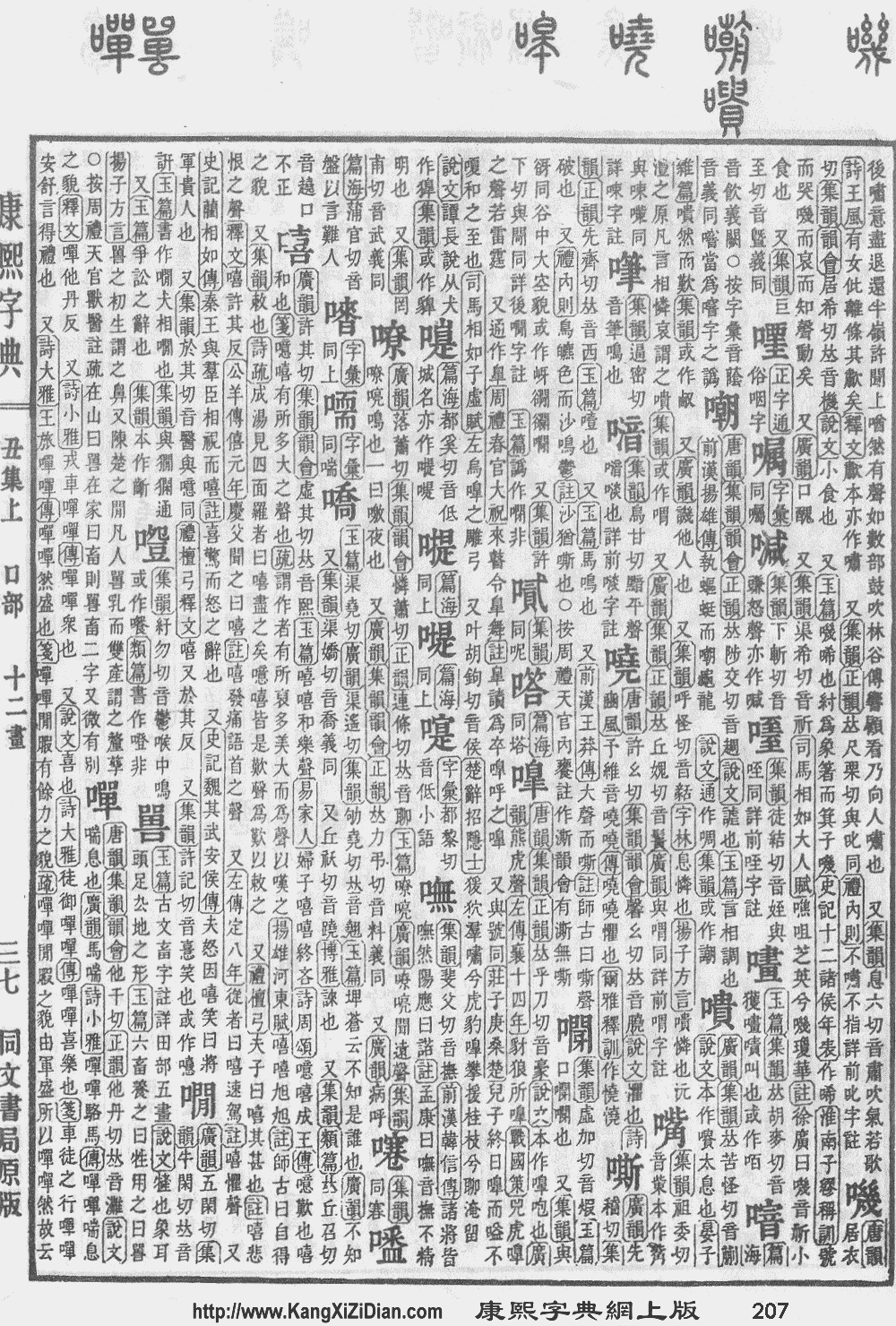
- KangXi: page 207, character 10
- Dai Kanwa Jiten: character 4256
- Dae Jaweon: page 430, character 8
- Hanyu Da Zidian (first edition): volume 1, page 689, character 15
- Unihan data for U+5634
Chinese
| trad. | 嘴 | |
|---|---|---|
| simp. # | 嘴 | |
| 2nd round simp. | 咀 | |
| alternative forms | 咀 觜 㭰 𭪿 | |
| See notes at 咀. | ||
Glyph origin
Characters in the same phonetic series (此) (Zhengzhang, 2003)
| Old Chinese | |
|---|---|
| 些 | *saːls, *sjaːl, *seːs |
| 跐 | *ʔsreːʔ, *ʔseʔ, *sʰeʔ, *ʔsreʔ |
| 柴 | *zreː |
| 祡 | *zreː |
| 茈 | *zreː, *ʔseʔ, *ze |
| 眦 | *zreːs |
| 砦 | *zraːds |
| 寨 | *zraːds, *slɯːɡ |
| 啙 | *ʔseː, *zeːʔ, *ʔseʔ |
| 泚 | *sʰeːʔ, *sʰeʔ |
| 玼 | *sʰeːʔ, *sʰeʔ, *ze |
| 皉 | *sʰeːʔ |
| 鮆 | *zeːʔ, *ʔse |
| 眥 | *zeːs, *zes |
| 貲 | *ʔse |
| 髭 | *ʔse |
| 頾 | *ʔse |
| 訾 | *ʔse, *ʔseʔ |
| 鴜 | *ʔse, *ze |
| 鈭 | *ʔse, *sʰe |
| 姕 | *ʔse, *sʰe, *ze |
| 觜 | *ʔse, *ʔse, *ʔseʔ |
| 紫 | *ʔseʔ |
| 訿 | *ʔseʔ |
| 呰 | *ʔseʔ |
| 嘴 | *ʔseʔ |
| 雌 | *sʰe |
| 此 | *sʰeʔ |
| 佌 | *sʰeʔ, *seʔ |
| 庛 | *sʰes |
| 疵 | *ze |
| 骴 | *ze, *zes |
| 胔 | *ze, *zes |
| 飺 | *ze |
| 齜 | *ʔsre |
Phono-semantic compound (形聲, OC *ʔseʔ) : semantic 口 + phonetic 觜 (OC *ʔse, *ʔse, *ʔseʔ).
Etymology
Related to 觜 (OC *ʔse, *ʔse, *ʔseʔ, “horn-like hair on the owl-head; beak of a bird; mouth”).
Further etymology is unknown. Schuessler (2007) relates it to Tibetan མཚུལ་པ (mtshul pa, “lower part of the face; muzzle; beak”), which is from Proto-Sino-Tibetan *m-ts(j)ul (“lip; beak”) (STEDT).
Pronunciation
Definitions
嘴
- beak
- (anatomy) mouth, especially the part of the face associated with the mouth (Classifier: 張/张 m)
- See also: 口
- (figurative) mouth-like object; beak, nozzle, spout (of teapot, etc.)
- (figurative) food
- (Cantonese) to kiss
- This term needs a translation to English. Please help out and add a translation, then remove the text
{{rfdef}}.
Synonyms
Dialectal synonyms of 嘴 (“mouth”) [map]
Dialectal synonyms of 吻 (“to kiss”) [map]
| Variety | Location | Words |
|---|---|---|
| Formal (Written Standard Chinese) | 吻, 親, 親吻 | |
| Mandarin | Beijing | 吻, 親 |
| Taiwan | 吻, 親 | |
| Yantai (Muping) | 親 | |
| Wanrong | 親 | |
| Xi'an | 親 | |
| Yangzhou | 親 | |
| Singapore | 吻, 親 | |
| Cantonese | Guangzhou | 惜, 啜, 痛 |
| Hong Kong | 惜, 啜, 嘴 | |
| Taishan | 啜 | |
| Dongguan | 啜 | |
| Singapore (Guangfu) | 惜 | |
| Hakka | Meixian | 唚 |
| Miaoli (N. Sixian) | 唚 | |
| Pingtung (Neipu; S. Sixian) | 唚 | |
| Hsinchu County (Zhudong; Hailu) | 唚 | |
| Taichung (Dongshi; Dabu) | 唚 | |
| Hsinchu County (Qionglin; Raoping) | 唚 | |
| Yunlin (Lunbei; Zhao'an) | 唚 | |
| Jin | Taiyuan | 親 |
| Xinzhou | 親 | |
| Min Bei | Jian'ou | 蜜 |
| Songxi | 鼻 | |
| Zhenghe | 蜜 | |
| Jianyang | 蜜 | |
| Wuyishan | 敕 | |
| Pucheng (Shibei) | 鼻 | |
| Min Dong | Fuzhou | 唚 |
| Min Nan | Xiamen | 唚 |
| Xiamen (Tong'an) | 唚 | |
| Quanzhou | 唚 | |
| Shishi | 唚 | |
| Zhangzhou | 唚 | |
| Tainan | 唚 | |
| Penang (Hokkien) | 唚 | |
| Singapore (Hokkien) | 唚 | |
| Manila (Hokkien) | 唚 | |
| Chaozhou | 唚 | |
| Shantou | 唚 | |
| Singapore (Teochew) | 唚 | |
| Haikou | 惜 | |
| Wu | Shanghai | 香 |
| Shanghai (Chongming) | 香 | |
| Suzhou | 香 | |
| Hangzhou | 香 | |
| Ningbo | 親 | |
Compounds
Derived terms from 嘴
|
|
|
Japanese
Readings
Etymology 1
| Kanji in this term |
|---|
| 嘴 |
| くちばし Hyōgaiji |
| kun’yomi |
From 口 (kuchi, “mouth”) + 端 (hashi, “tip; edge”). The kanji is composed of 口 (kuchi) and 觜 (hashi, “beak; bill”). See also 嘴#Etymology 2.
Alternative forms
Noun
嘴 • (kuchibashi)
- (anatomy) a beak; a bill
- 1999 March 1, “スピック [Spick]”, in BOOSTER 1, Konami:
- くちばしがとても大きく、大声で鳴き気の弱い相手を驚かせる。
- Kuchibashi ga totemo ōkiku, ōgoe de naki kinoyowai aite o odorokaseru.
- It frightens faint-hearted opponents with its blaring wails and massive bill.
- くちばしがとても大きく、大声で鳴き気の弱い相手を驚かせる。
- 1999 March 1, “ディッグ・ビーク [Dig Beak]”, in BOOSTER 1, Konami:
- ヘビのように長い体をまるめ、回転しながらくちばしで攻撃。
- Hebi no yō ni nagai karada o marume, kaiten shi nagara kuchibashi de kōgeki.
- It attacks with its beak as its long body coils like a snake.
- ヘビのように長い体をまるめ、回転しながらくちばしで攻撃。
- 1999 October 17, “くちばしヘビ [Beaked Snake]”, in BOOSTER 5, Konami:
- 相手を長い体で締め上げ、大きなくちばしでつついて攻撃。
- Aite o nagai karada de shimeage, ōkina kuchibashi de tsutsuite kōgeki.
- It attacks by pecking at its opponent with its huge beak while constricting them with its long body.
- 相手を長い体で締め上げ、大きなくちばしでつついて攻撃。
-
Alternative forms
Korean
Hanja
嘴 (eum 취 (chwi))
- This term needs a translation to English. Please help out and add a translation, then remove the text
{{rfdef}}.
Vietnamese
Han character
嘴: Hán Nôm readings: chủy/chuỷ
- This term needs a translation to English. Please help out and add a translation, then remove the text
{{rfdef}}.
This article is issued from Wiktionary. The text is licensed under Creative Commons - Attribution - Sharealike. Additional terms may apply for the media files.