剛

See also: 刚
剛 U+525B, 剛
CJK UNIFIED IDEOGRAPH-525B
← 剚
[U+525A]
CJK Unified Ideographs 剜 →
[U+525C]

Translingual

Han character

剛 (Kangxi radical 18, 刀+8, 10 strokes, cangjie input 月山中弓 (BULN), four-corner 72200, composition ⿰岡刂)

Derived characters

  • 𭡺, 𬌧, 𫅙, 𮢪, 𡬼, 𪮚, 𠠊

References

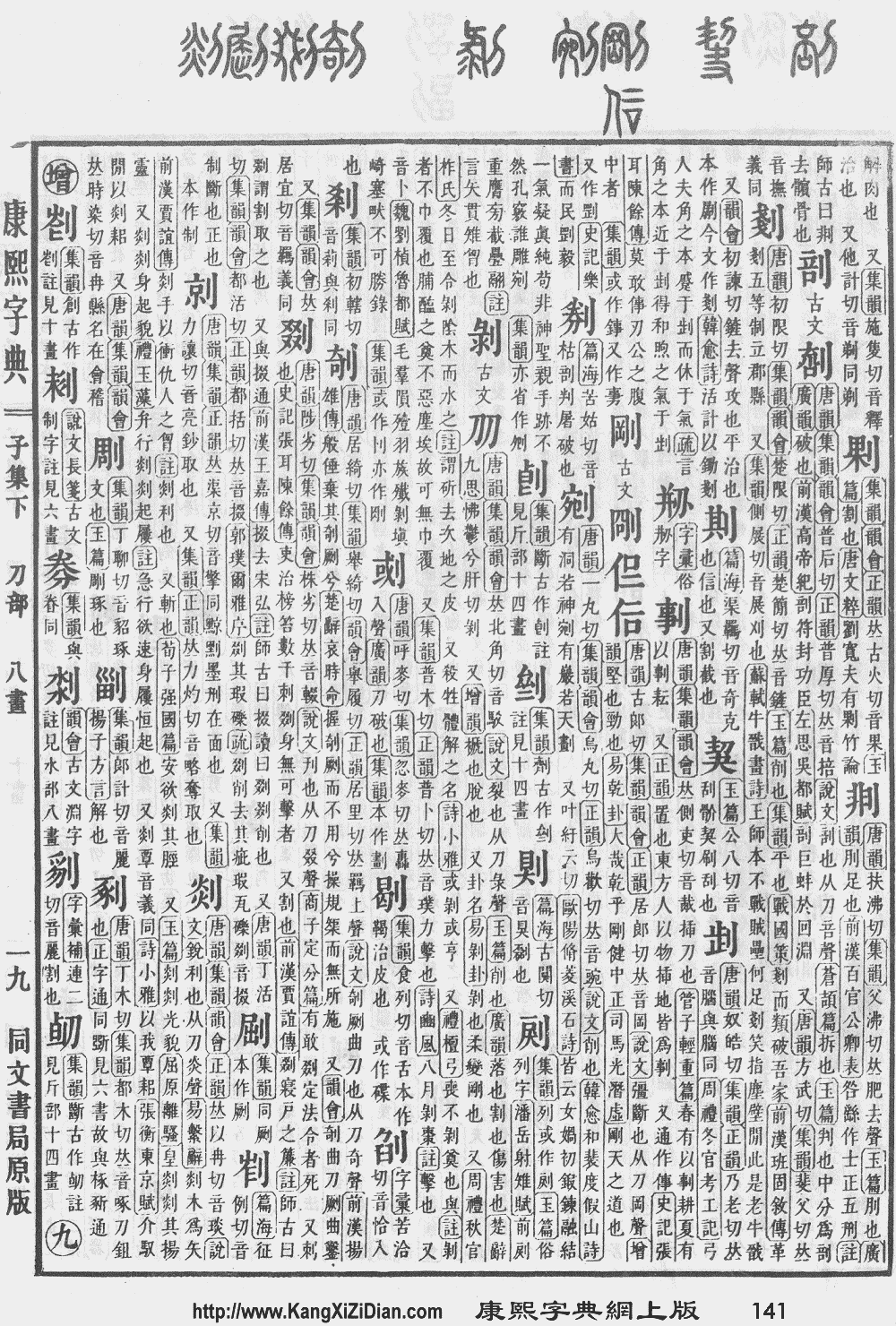
  • KangXi: page 141, character 11
  • Dai Kanwa Jiten: character 2042
  • Dae Jaweon: page 320, character 17
  • Hanyu Da Zidian (first edition): volume 1, page 344, character 10
  • Unihan data for U+525B

Chinese

Glyph origin

Phono-semantic compound (形聲, OC *klaːŋ) : phonetic 岡 (OC *klaːŋ) + semantic 刀 (“knife”).

Etymology 1

trad. 剛
simp. 刚

Cognate with Burmese ခိုင် (hkuing, “robust, strong”).

Pronunciation


Rime
Character 剛
Reading # 1/1
Initial (聲) 見 (28)
Final (韻) 唐 (101)
Tone (調) Level (Ø)
Openness (開合) Open
Division (等) I
Fanqie 古郎切
Baxter kang
Reconstructions
Zhengzhang
Shangfang
/kɑŋ/
Pan
Wuyun
/kɑŋ/
Shao
Rongfen
/kɑŋ/
Edwin
Pulleyblank
/kaŋ/
Li
Rong
/kɑŋ/
Wang
Li
/kɑŋ/
Bernard
Karlgren
/kɑŋ/
Expected
Mandarin
Reflex
gāng
Expected
Cantonese
Reflex
gong1
Baxter–Sagart system 1.1 (2014)
Character 剛
Reading # 1/1
Modern
Beijing
(Pinyin)
gāng
Middle
Chinese
‹ kang ›
Old
Chinese
/*kˁaŋ/
English strong; hard

Notes for Old Chinese notations in the Baxter–Sagart system:

* Parentheses "()" indicate uncertain presence;
* Square brackets "[]" indicate uncertain identity, e.g. *[t] as coda may in fact be *-t or *-p;
* Angle brackets "<>" indicate infix;
* Hyphen "-" indicates morpheme boundary;

* Period "." indicates syllable boundary.
Zhengzhang system (2003)
Character 剛
Reading # 1/1
No. 3713
Phonetic
component
岡
Rime
group
陽
Rime
subdivision
0
Corresponding
MC rime
岡
Old
Chinese
/*klaːŋ/

Definitions

剛

  1. firm; hard; stiff
  2. strong
    他的性格是剛與柔的結合。 [MSC, trad.]
    他的性格是刚与柔的结合。 [MSC, simp.]
    Tā de xìnggé shì gāng yǔ róu de jiéhé. [Pinyin]
    His character is a combination of strength and kindness.
  3. a surname

Compounds

Etymology 2

trad. 剛
simp. 刚
alternative forms 將/将 dialectal

(This etymology is missing or incomplete. Please add to it, or discuss it at the Etymology scriptorium.)

Pronunciation


Note: jion1 - colloquial.
Note: 1jian - colloquial (dated).

Definitions

剛

  1. just; exactly
    剛好/刚好  ―  gānghǎo  ―  just, exactly
  2. only a short while ago; just
    剛才/刚才  ―  gāngcái  ―  just now; a moment ago
    剛剛/刚刚  ―  gānggāng  ―  just now; only
    他剛回來。/他刚回来。  ―  Tā gāng huílái.  ―  He has just came back.
  3. barely; just
    一個月1000元的工資,剛夠他吃飯。 [MSC, trad.]
    一个月1000元的工资,刚够他吃饭。 [MSC, simp.]
    Yī ge yuè 1000 yuán de gōngzī, gāng gòu tā chīfàn. [Pinyin]
    He earns 1000 yuan a month, barely enough for food.
  4. as soon as; only at this moment
    他剛做完工作,鈴就響了 [MSC, trad.]
    他刚做完工作,铃就响了 [MSC, simp.]
    tā gāng zuòwán gōngzuò, líng jiù xiǎng le [Pinyin]
    The moment he finished his work, the bell rang.
Synonyms

Compounds

Japanese

Kanji

剛

(common “Jōyō” kanji)

  1. sturdy

Readings

Proper noun

剛(たけし) • (Takeshi) 

  1. a male given name

剛(つよし) • (Tsuyoshi) 

  1. a male given name

剛(ごう) • (Gō) 

  1. a male given name

Korean

Hanja

剛 (eum 강 (gang))

  1. This term needs a translation to English. Please help out and add a translation, then remove the text {{rfdef}}.

Vietnamese

Han character

剛: Hán Nôm readings: cương[1], cang[2]

  1. hard, strong, firm

References

  1. Trần (2004).
  2. Nguyễn et al. (2009).
This article is issued from Wiktionary. The text is licensed under Creative Commons - Attribution - Sharealike. Additional terms may apply for the media files.