就
| ||||||||
Translingual
| Stroke order | |||
|---|---|---|---|
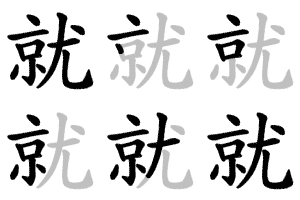 | |||
| Stroke order | |||
|---|---|---|---|
 | |||
Han character
就 (Kangxi radical 43, 尢+9, 12 strokes, cangjie input 卜火戈大山 (YFIKU), four-corner 03914, composition ⿰京尤)
References
- KangXi: page 299, character 5
- Dai Kanwa Jiten: character 7599
- Dae Jaweon: page 594, character 20
- Hanyu Da Zidian (first edition): volume 1, page 555, character 11
- Unihan data for U+5C31
Chinese
| simp. and trad. |
就 | |
|---|---|---|
Glyph origin
| Historical forms of the character 就 | |||||||||||||
|---|---|---|---|---|---|---|---|---|---|---|---|---|---|
| Shang | Western Zhou | Warring States | Shuowen Jiezi (compiled in Han) | Liushutong (compiled in Ming) | |||||||||
| Oracle bone script | Bronze inscriptions | Chu slip and silk script | Small seal script | Transcribed ancient scripts | |||||||||
 |
 |
 |
 |
 | |||||||||
||||
|
References: Mostly from Richard Sears' Chinese Etymology site (authorisation),
| |||||||||||||


Characters in the same phonetic series (就) (Zhengzhang, 2003)
Ideogrammic compound (會意) : 京 + 尤. Shuowen defines it as meaning "high" (“高也”), hence 京.
Etymology
Cognate with 造 (OC *skʰuːɡs, “to proceed to”) (Wang, 1982).
Pronunciation
Definitions
就
- to approach; to move towards
- to reach; to arrive at
- to undertake; to engage in
- to succeed; to complete
- to comply; to follow; to accept
- to suffer; to be subjected to
- (of food) to go with
- with regard to; concerning
- even if; even though
- at once; right away
- (Cantonese) almost; soon
- (used for emphasis) exactly; precisely; just
- only; merely; just
- 我工資就五千塊,他買件衣服就一萬塊。人和人的差距真是太大了。 [MSC, trad.]
- Wǒ gōngzī jiù wǔ qiān kuài, tā mǎi jiàn yīfú jiù yī wàn kuài. Rén hé rén de chājù zhēn shì tài dà le. [Pinyin]
- My salary is only five thousand yuan, and he buys clothes that are as much as ten thousand yuan. The disparity between people truly is too large.
我工资就五千块,他买件衣服就一万块。人和人的差距真是太大了。 [MSC, simp.]- Synonym: 只 (zhǐ)
- then
- (used to express earliness) as early as; as soon as
- as many as; as much as
- Used between two identical words to express indifference or resignation.
- Alternative form of 鷲/鹫 (jiù).
Synonyms
- (to approach):
- (to reach):
Synonyms of 就
- (to go with): 搭配 (dāpèi)
- (with regard to):
- (even if):
Synonyms of 就
- (to complete):
Compounds
Derived terms from 就
|
|
|
Japanese
Readings
Korean
Hanja
就 • (chwi) (hangeul 취)
- This term needs a translation to English. Please help out and add a translation, then remove the text
{{rfdef}}.
Vietnamese
Han character
就: Hán Nôm readings: tựu
- This term needs a translation to English. Please help out and add a translation, then remove the text
{{rfdef}}.
This article is issued from Wiktionary. The text is licensed under Creative Commons - Attribution - Sharealike. Additional terms may apply for the media files.