封
| ||||||||
Translingual
| Stroke order | |||
|---|---|---|---|
 | |||
Han character
封 (Kangxi radical 41, 寸+6, 9 strokes, cangjie input 土土木戈 (GGDI), four-corner 44100, composition ⿰圭寸)
References
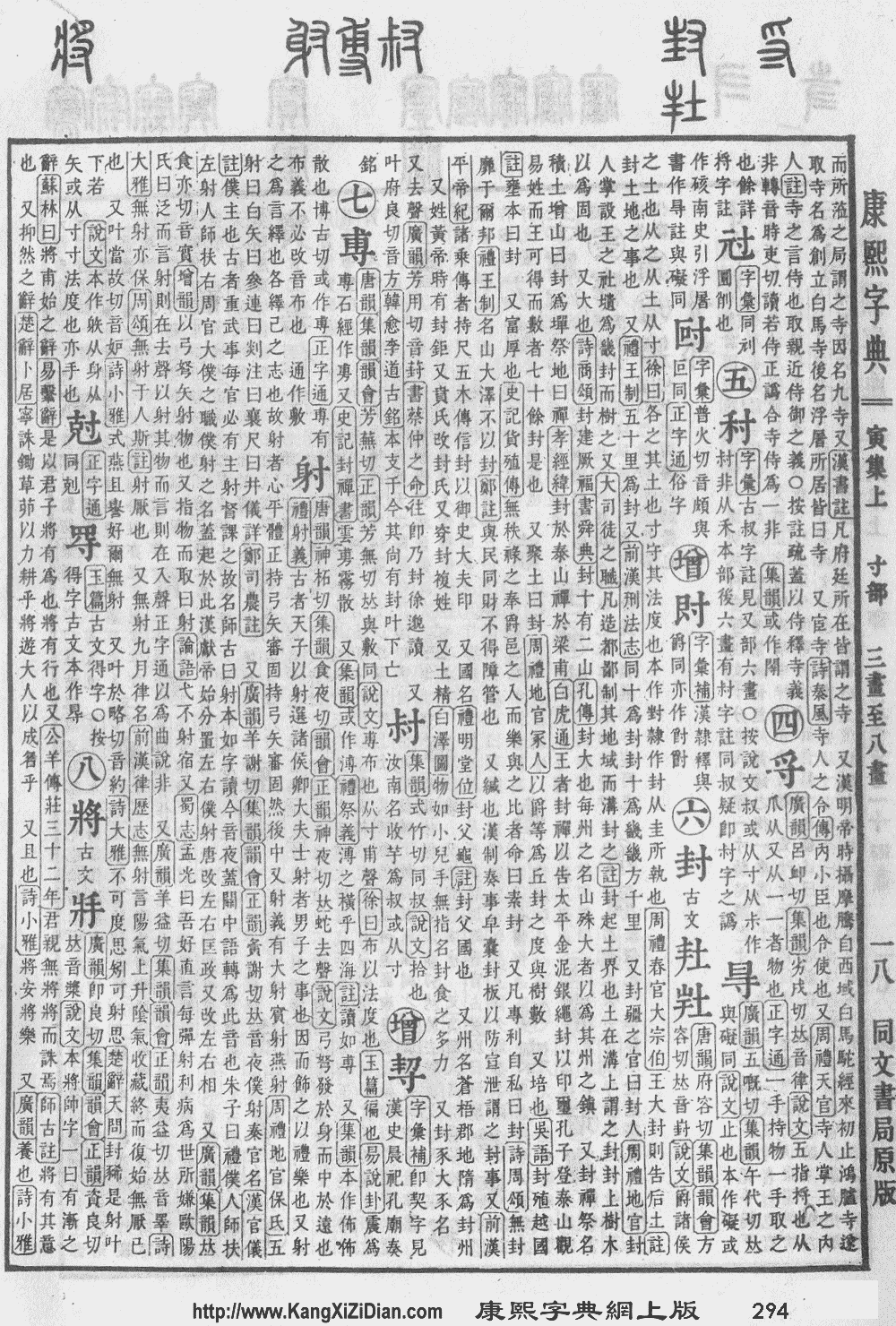
- KangXi: page 294, character 7
- Dai Kanwa Jiten: character 7426
- Dae Jaweon: page 581, character 21
- Hanyu Da Zidian (first edition): volume 1, page 504, character 14
- Unihan data for U+5C01
Chinese
| simp. and trad. |
封 | |
|---|---|---|
Glyph origin
Ideogrammic compound (會意) : 丰 (“field, ear of grass”) + 寸 (“control”).
In modern form, left component is written instead as 圭 (土土), with two vertical strokes, rather than as 丰 (one vertical stroke).
Etymology
Area etymon (Schuessler, 2007). Compare Tibetan ཕུང་པོ (phung po, “heap”), Tibetan སྤུང (spung, “heap”), Lepcha a-pŭŋ (“a heap; a stock”), Mizo [Term?] (puŋᴴ), [Term?] (punᴸ, “increase; assemble”), Mizo vûng (vuuŋᴴ), vûn (vuunᴸ, “swollen”), Mizo vûng (vuuŋᴿ, “heap; mound”), Chepang भुङ्हसा (bhuŋh-, “to be burst or peak of activity (flowering, field work etc.)”). Compare also Khmer ពោង (poong, “protuberances/bumps on an animal's head”), Khmer សំពោង (sɑmpoong, “puffed up; swollen”) and Burmese ဖောင်း (hpaung:, “swollen, puffed up, risen up”).
邦 (OC *proːŋ, “country”) may be the same etymon (Wang, 1982, Schuessler, 2007). Compare with Burmese ဘောင် (bhaung, “boundary, border, circle”).
Pronunciation
Definitions
封
- (literary) border; boundary
- (literary) to raise a mound
- to close; to seal; to bind
- to block (a website, a person on the Internet, etc.); to censor
- envelope; wrapper
- cover of a book
- Classifier for envelopes, letters and mail. ⇒ all nouns using this classifier
- to confer (a title) upon; to enfeoff
- 湯封夏之後,至周封於杞也。 [Classical Chinese, trad.]
- From: The Records of the Grand Historian, by Sima Qian, c. 91 BCE
- Tāng fēng Xià zhī hòu, zhì Zhōu fēng yú Qǐ yě. [Pinyin]
- Tang enfeoffed the descendants of the Xia dynasty; until the Zhou dynasty's time their fief was at Qi.
汤封夏之后,至周封于杞也。 [Classical Chinese, simp.]
- (literary, of emperors) to build an altar to worship heaven
- 封於泰山,禪於梁父。封禪之王,七十二家。 [Classical Chinese, trad.]
- From: Guanzi, 5th century BCE to 220 CE
- Fēng yú Tàishān, Shàn yú Liángfǔ. Fēngshàn zhī wáng, qīshí'èr jiā. [Pinyin]
- Some seventy-two kings performed the Feng sacrifice [to Heaven] on Mount Tai and the Shan sacrifice [to Earth] on Liangfu (translation based on Rickett, 1998)
封于泰山,禅于梁父。封禅之王,七十二家。 [Classical Chinese, simp.]- 是以封泰山而禪梁甫,朝諸侯而一天下。 [Classical Chinese, trad.]
- From: 《大戴禮記》 Records of Ritual Matters by Dai the Elder, Late Western Han
- Shìyǐ fēng Tàishān ér shàn Liángfǔ, cháo zhūhóu ér yī tiānxià. [Pinyin]
- So he offered sacrifices to Heaven at Mount Tai and offer sacrifices to Earth at Liangfu; he gathered the various princes and united All under Heaven.
是以封泰山而禅梁甫,朝诸侯而一天下。 [Classical Chinese, simp.]
- Short for 封建主義/封建主义 (fēngjiàn zhǔyì, “feudalism”).
- a surname
Compounds
|
|
|