上
| ||||||||
Translingual
| Stroke order | |||
|---|---|---|---|
 | |||
| Stroke order | |||
|---|---|---|---|
 | |||
Han character
上 (Kangxi radical 1, 一+2, 3 strokes, cangjie input 卜一 (YM), four-corner 21100, composition ⿱⺊一)
Derived characters
References
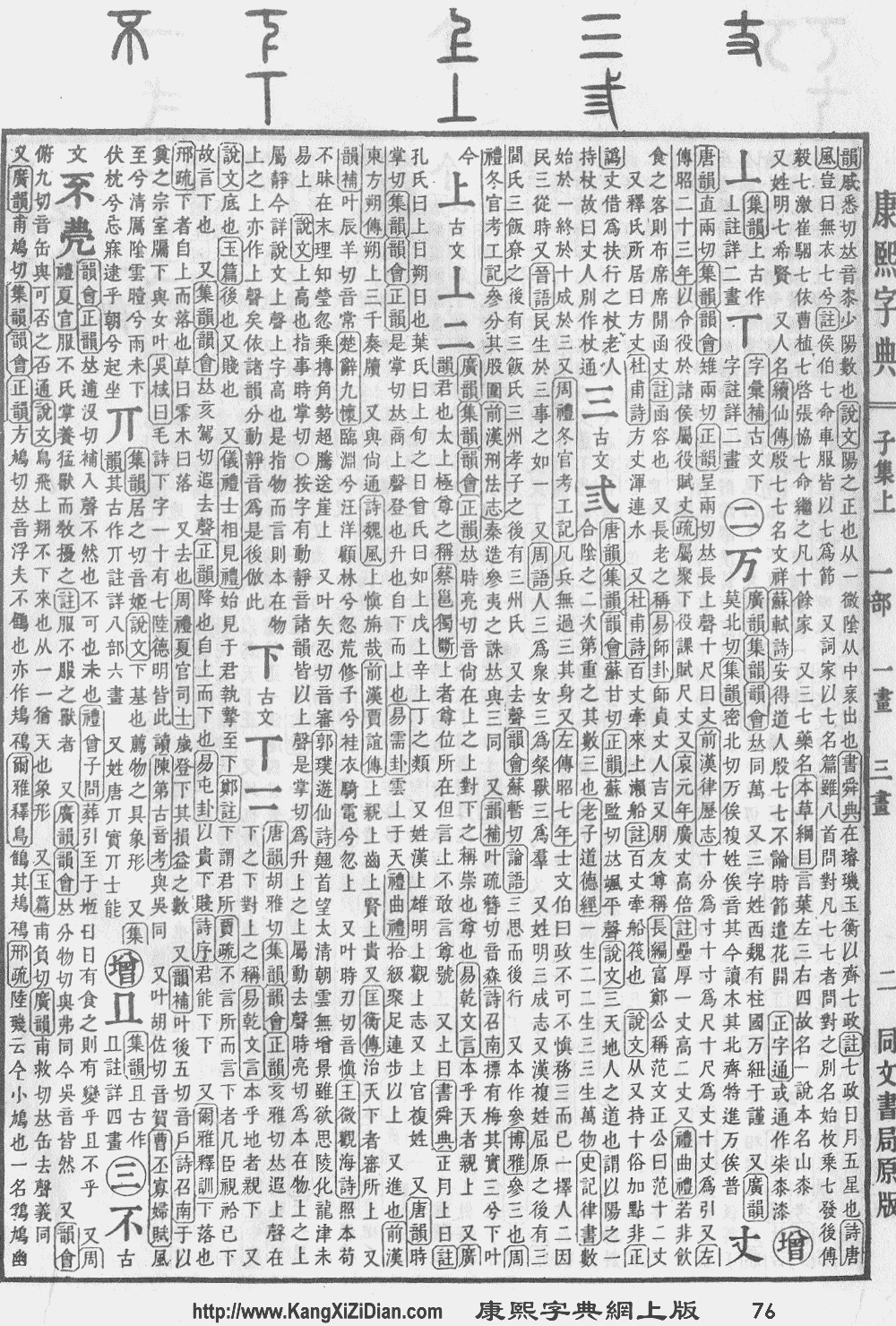
- KangXi: page 76, character 7
- Dai Kanwa Jiten: character 13
- Dae Jaweon: page 145, character 1
- Hanyu Da Zidian (first edition): volume 1, page 5, character 4
- Unihan data for U+4E0A
Chinese
Glyph origin
| Historical forms of the character 上 | |||||||||||||||||||||||||||||||||||||||||||||||||||||||||||||
|---|---|---|---|---|---|---|---|---|---|---|---|---|---|---|---|---|---|---|---|---|---|---|---|---|---|---|---|---|---|---|---|---|---|---|---|---|---|---|---|---|---|---|---|---|---|---|---|---|---|---|---|---|---|---|---|---|---|---|---|---|---|
| Shang | Western Zhou | Spring and Autumn | Warring States | Shuowen Jiezi (compiled in Han) | Liushutong (compiled in Ming) | Libian (compiled in Qing) | Kangxi Dictionary (compiled in Qing) | ||||||||||||||||||||||||||||||||||||||||||||||||||||||
| Oracle bone script | Bronze inscriptions | Bronze inscriptions | Bronze inscriptions | Chu slip and silk script | Qin slip script | Ancient script | Small seal script | Transcribed ancient scripts | Clerical script | Ming typeface | |||||||||||||||||||||||||||||||||||||||||||||||||||
 |
 |
 |
 |
 |
 |
 |
 |
 |
 |
 | |||||||||||||||||||||||||||||||||||||||||||||||||||
||||||||||
|
References: Mostly from Richard Sears' Chinese Etymology site (authorisation),
| |||||||||||||||||||||||||||||||||||||||||||||||||||||||||||||


Ideogram (指事) : a line above another (contrast 下) — up. Originally written as 𠄞, but changed to this form to prevent confusion with 二 (èr).
Etymology 1
| simp. and trad. |
上 | |
|---|---|---|
| alternative forms | 丄 ancient 𠄞 尚 Min Nan “most” | |
From Proto-Sino-Tibetan *s-tjaŋ (“top”). Cognate with Tibetan སྟེང (steng), Tibetan ཡང་རྩེ (yang rtse, “summit; pinnacle”) (Bodman, 1980), Mizo zo (“to be high”), zah (“to respect; to revere”) (STEDT).
Shijing rimes indicate occasional level tone for pronunciation 2 (Schuessler, 2007).
Pronunciation 1 is the exopassive of pronunciation 2 with suffix *-s, literally meaning "what has been raised" (Schuessler, 2007). The rising tone in Middle Chinese words with voiced stop initials regularly evolves into departing tone in Mandarin; pronunciation 3 results from 叶韻/叶韵 (xiéyùn), which artificially preserves classical poetry rhyming words' pronunciations.
Pronunciation 1
Definitions
上
- upper part; high position; up
- Antonym: 下 (xià)
- † emperor
- on; above
- superior; senior; top
- preceding; previous; last; former
- first of several (usually two or three) partitions
- within; in; from the standpoint of; according to
- (Min Nan) most; extremely
Synonyms
Pronunciation 2
Definitions
上
- to go up; to ascend
- to charge; to advance
- 上啊! ― Shàng a! ― Charge!
- to go to; to leave for (a place) (usually to a more developed place)
- 上省城 ― shàng xǐngchéng ― to go to the province capital
- to board; to get on
- to serve; to present; to offer
- to attend (class, work)
- to enter (a field); to appear (on stage, TV)
- to fit; to install; to apply
- 上油漆 ― shàng yóuqī ― to apply paint
- to screw; to tighten, to twist
- (colloquial) Short for 上線 (“to go online”).
- to connect to; browse (a website)
- 上谷歌 ― shàng Gǔgē ― to go on Google; to google
- (Cantonese) to go north
- (Min) to pull upwards or hang with a rope
- 上水 [Hokkien] ― chhiūⁿ-chúi [Pe̍h-ōe-jī] ― to draw water from a well
- (Min Nan) to grow and attach
- 上青苔 [Hokkien] ― chhiūⁿ chheⁿ-thî [Pe̍h-ōe-jī] ― to grow moss
- (Xiamen Min Nan) to pile up
- 上貨/上货 [Hokkien] ― chhiūⁿ-hòe [Pe̍h-ōe-jī] ― to pile up goods
- (vulgar, usually of a male) to fuck; to have intercourse (usually with a female)
- Particle following verbs, indicating direction or achievement.
- 7th tetragram of the Taixuanjing; "ascension" (𝌌)
- (mahjong, Cantonese) chow; to call a discarded tile to produce a chow
Usage notes
- When playing mahjong in Cantonese, a player may say this word as a call when forming a chowing another player's discard
Synonyms
| Variety | Location | Words |
|---|---|---|
| Formal (Written Standard Chinese) | 上 | |
| Mandarin | Beijing | 上 |
| Taiwan | 上 | |
| Malaysia | 上 | |
| Singapore | 上 | |
| Cantonese | Guangzhou | 上 |
| Hong Kong | 上 | |
| Kuala Lumpur (Guangfu) | 上 | |
| Singapore (Guangfu) | 上 | |
| Min Nan | Xiamen | 𬦰, 上, 起 |
| Quanzhou | 𬦰, 上, 起 | |
| Jinjiang | 𬦰 | |
| Zhangzhou | 𬦰, 上, 起 | |
| Tainan | 上, 起 | |
| Penang (Hokkien) | 起 | |
| Singapore (Hokkien) | 起 | |
| Manila (Hokkien) | 𬦰 | |
| Chaozhou | 起 | |
| Shantou | 上, 起 | |
| Singapore (Teochew) | 起 | |
| Wenchang | 上 | |
| Qionghai | 上 | |
| Singapore (Hainanese) | 上 | |
| Wu | Shanghai | 上 |
Pronunciation 3
See also
| The tones (of Chinese) in Chinese · 聲調/声调 (shēngdiào) (layout · text) | ||||||||||
|---|---|---|---|---|---|---|---|---|---|---|
| 平仄 (píngzè) | 平 平聲/平声 (píngshēng) |
仄 (zè) 仄聲/仄声 (zèshēng) | ||||||||
| 平上去入 四聲/四声 (sìshēng) 古四聲/古四声 |
平 平聲/平声 (píngshēng) |
上 上聲/上声 |
去 (qù) 去聲/去声 (qùshēng) |
入 (rù) 入聲/入声 (rùshēng) | ||||||
| 標調方法/标调方法 (biāodiào fāngfǎ) 標調法/标调法 |
四角標調法/四角标调法 | ꜀◌ | ꜂◌ | ◌꜄ | ◌꜆ | |||||
| [Term?] | ◌〪 | ◌〫 | ◌〬 | ◌〭 | ||||||
| 傍點/傍点 | ∅ | ◌〮 | ◌〯 | ∅ | ||||||
| ∅ | -X | -H | -p -t -k (-ʔ) | |||||||
| 四聲八調/四声八调 | 陰平/阴平 (yīnpíng) | 陽平/阳平 (yángpíng) | 陰上/阴上 (yīnshǎng) | 陽上/阳上 (yángshǎng) | 陰去/阴去 (yīnqù) | 陽去/阳去 (yángqù) | 陰入/阴入 (yīnrù) | 陽入/阳入 (yángrù) | ||
| 陰/阴 (yīn) | 陽/阳 (yáng) | |||||||||
| 標調方法/标调方法 (biāodiào fāngfǎ) 標調法/标调法 |
四角標調法/四角标调法 | ꜀◌ | ꜁◌ | ꜂◌ | ꜃◌ | ◌꜄ | ◌꜅ | ◌꜆ | ◌꜇ | |
| The tones (of Standard Mandarin) in Chinese · 聲調/声调 (shēngdiào) (layout · text) | ||||||||||
|---|---|---|---|---|---|---|---|---|---|---|
| 四聲/四声 (sìshēng) | 陰平/阴平 (yīnpíng) 第一聲/第一声 |
陽平/阳平 (yángpíng) 第二聲/第二声 |
上聲/上声 第三聲/第三声 |
去聲/去声 (qùshēng) 第四聲/第四声 |
輕聲/轻声 (qīngshēng) | |||||
Compounds
|
|
|
Descendants
Pronunciation
Definitions
上
Etymology 3
| For pronunciation and definitions of 上 – see 緔 (“to sole a shoe”). (This character, 上, is the second-round simplified form of 緔.) |
Notes:
|
Etymology 4
| For pronunciation and definitions of 上 – see 鞝 (“the piece of leather used for soles on Chinese shoes; a patch of leather”). (This character, 上, is the second-round simplified form of 鞝.) |
Notes:
|
Further reading
- “Entry #174”, in 臺灣閩南語常用詞辭典 [Dictionary of Frequently-Used Taiwan Minnan] (in Chinese and Min Nan), Ministry of Education, R.O.C., 2011.
Japanese
Kanji
Readings
- Go-on: じょう (jō, Jōyō)←じやう (zyau, historical)
- Kan-on: しょう (shō, Jōyō †)←しやう (syau, historical)
- Sō-on: しゃん (shan)←しやん (syan, historical)
- Kun: うえ (ue, 上, Jōyō)←うへ (ufe, 上, historical); うわ (uwa, 上, Jōyō †)←うは (ufa, 上, historical); かみ (kami, 上, Jōyō); あげる (ageru, 上げる, Jōyō); あがる (agaru, 上がる, Jōyō); あがり (agari, 上がり); のぼる (noboru, 上る, Jōyō); のぼり (nobori, 上り); のぼせる (noboseru, 上せる, Jōyō); のぼす (nobosu, 上す, Jōyō); たてまつる (tatematsuru, 上る); ほとり (hotori, 上)
- Nanori: あおい (aoi); あげ (age); い (i); か (ka); かき (kaki); かず (kazu); かん (kan); こう (kō); のぼり (nobori); ほつ (hotsu)
Compounds
- 上上 (jōjō), 上々 (jōjō)
- 上位 (jōi)
- 上映 (jōei)
- 上演 (jōen)
- 上官 (jōkan)
- 上機 (jōki)
- 上級 (jōkyū)
- 上京 (jōkyō)
- 上空 (jōkū)
- 上下 (jōge)
- 上戸 (jōgo)
- 上告 (jōkoku)
- 上司 (jōshi)
- 上州 (Jōshū)
- 上旬 (jōjun)
- 上声 (jōshō)
- 上昇 (jōshō)
- 上場 (jōjō)
- 上手 (jōzu)
- 上声 (jōsei)
- 上船 (jōsen)
- 上層 (jōsō)
- 上奏 (jōsō)
- 上代 (jōdai)
- 上達 (jōtatsu)
- 上段 (jōdan)
- 上等 (jōtō)
- 上人 (shōnin)
- 上納 (jōnō)
- 上品 (jōhin)
- 上部 (jōbu)
- 上陸 (jōriku)
- 上流 (jōryū)
- 上林 (jōrin)
- 上石 (ageishi)
- 平上去入 (hyōjōkyonyū)
- 上手い (umai)
- 上海 (Shanhai, “Shanghai”)
- 逆上せる (noboseru)
- 上枝 (hotsue)
- 嶺上開花 (rinshan kaihō)
- 嶺上牌 (rinshanpai)
Etymology 1
| Kanji in this term |
|---|
| 上 |
| うえ Grade: 1 |
| kun’yomi |
⟨upe2⟩ → /*upai̯/ → /upe/ → /ufe/ → /uwe/ → /ue/
From Old Japanese, from Proto-Japonic *upay.
Unbound apophonic form of uwa, ancient upa (see below), possibly by fusion with an emphatic nominal particle い (i).
Noun
Idioms
- 上に立つ (ue ni tatsu)
- 上には上がある (ue ni wa ue ga aru)
- 上見ぬ鷲 (ue minu washi)
- 上を行く (ue o iku)
- 上を下へ (ue o shita e)
- 上を見る (ue o miru)
Etymology 2
| Kanji in this term |
|---|
| 上 |
| うわ Grade: 1 |
| kun’yomi |
/upa/ → /ufa/ → /uwa/
From Old Japanese, from Proto-Japonic *upa. The combining form of ue, ancient upe (see above).[1]
Pronunciation
- IPA(key): [ɯ̟ᵝɰᵝa̠]
Derived terms
- 上上 (uwauwa), 浮浮 (uwauwa)
- 上顎 (uwaago)
- 上臼 (uwausu)
- 上絵 (uwae)
- 上枝 (uwaeda)
- 上襟 (uwaeri), 上衿 (uwaeri), 上領 (uwaeri)
- 上帯 (uwaobi)
- 上掛 (uwagake), 上掛け (uwagake)
- 浮気 (uwaki)
- 上着 (uwagi)
- 上衣 (uwagi)
- 噂 (uwasa)
- 上棚 (uwadana), 上枻 (uwadana)
- 上手 (uwate)
- 上剥げ (uwahage)
- 後妻 (uwanari)
- 上荷 (uwani)
- 上値 (uwane)
- 上歯 (uwaba)
- 上履 (uwabaki), 上履き (uwabaki)
- 上張 (uwabari), 上張り (uwabari)
- 上翳 (uwahi)
- 上辺 (uwabe)
- 上目 (uwame)
- 上屋 (uwaya)
Etymology 3
| Kanji in this term |
|---|
| 上 |
| へ Grade: 1 |
| kun’yomi |
| Kanji in this term |
|---|
| 上 |
| え Grade: 1 |
| irregular |
⟨upe2⟩ → ⟨pe2⟩ → */pe/ → /fe/ → /he/
Short-form of or shift from ue, ancient upe (see above). Realized as -e in some compounds.
Pronunciation
- IPA(key): [he̞]
- IPA(key): [e̞]
Usage notes
The senses are the same with ue.
Derived terms
- ⦃⦃ja-r¦尾上¦おのえ⦄⦄
Etymology 4
| Kanji in this term |
|---|
| 上 |
| かみ Grade: 1 |
| kun’yomi |
⟨kami1⟩ → */kamʲi/ → /kami/
From Old Japanese. Already apparent in ancient texts such as the Kojiki (c. 712 CE) and the Man'yōshū (c. 759 CE).[1][4]
Derived terms
- 上する (kamisuru)
- 守 (kami)
- 上泉 (kamīzumi)
- 上一段活用 (kami ichidan katsuyō)
- 上一人 (kami ichinin), 上御一人 (kami go-ichinin)
- 上女 (kami-onna)
- 上掛 (kami-gakari)
- 上方 (kamigata)
- 上御所 (kami gosho)
- 上様 (kami-zama), 上方 (kami-zama)
- 上下 (kamishimo), 裃 (kamishimo)
- 上毛野 (Kamitsukeno), 上野 (Kōzuke)
- 上総 (Kamitsufusa), 上総 (Kazusa)
- 上つ世 (kami tsu yo), 上つ代 (kami tsu yo)
- 上問屋 (kami-doiya)
- 上長押 (kami nageshi)
- 上二段活用 (kami nidan katsuyō)
- 上の戸 (kami no to)
- 上の間 (kami no ma)
- 上の町 (kami no machi)
- 上機 (kamihata)
- 上辺 (kamibe)
- 上無 (kami mu)
- 上無調 (kami muchō)
- 石上 (Isonokami)
- 氏の上 (Uji no Kami)
- 兄 (konokami), 首 (konokami), 氏上 (konokami)
Idioms
- 上漏り下潤う (kami mori shimo uruou)
- 上を学ぶ下 (kami o manabu shimo)
Etymology 5
| Kanji in this term |
|---|
| 上 |
| かん Grade: 1 |
| kun’yomi |
/kami/ → /kamʉ/ → /kaɴ/
Contraction of Old Japanese ⟨kami1⟩. Spelled in ancient works as ⦃⦃ja-r¦かむ⦄⦄ prior to the development of the ⦃⦃ja-r¦ん⦄⦄ kana.[1][4][5]
Pronunciation
- IPA(key): [kã̠ɴ]
Usage notes
Generally only found when followed by the genitive / possessive particles の (no) or つ (tsu).
Derived terms
- 上達部 (kandachibe), 上達部 (kandachime)
- 上林 (Kanbayashi)
- 上牧 (Kanmaki)
Etymology 6
| Kanji in this term |
|---|
| 上 |
| じょう Grade: 1 |
| goon |
/d͡ʑɨau/ → /d͡ʑɔː/ → /d͡ʑoː/
From Middle Chinese 上 (MC d͡ʑɨɐŋX, d͡ʑɨɐŋH).
Pronunciation
- Pitch accent for suffix unknown.
Suffix
Derived terms
References
- 2006, 大辞林 (Daijirin), Third Edition (in Japanese), Tōkyō: Sanseidō, →ISBN
- 1974, 新明解国語辞典 (Shin Meikai Kokugo Jiten), Second Edition (in Japanese), Tōkyō: Sanseidō
- 1998, NHK日本語発音アクセント辞典 (NHK Japanese Pronunciation Accent Dictionary) (in Japanese), Tōkyō: NHK, →ISBN
- 1988, 国語大辞典(新装版) (Kokugo Dai Jiten, Revised Edition) (in Japanese), Tōkyō: Shogakukan
- 1995, 大辞泉 (Daijisen) (in Japanese), Tōkyō: Shogakukan, →ISBN
Korean
Vietnamese
Compounds
- 皇上 (hoàng thượng)
- 上游 (thượng du)
- 上頂 (thượng đỉnh)
- 上行 (thượng hạng)
- 上流 (thượng lưu)
- 上議士 (thượng nghị sĩ)
- 上議院 (thượng nghị viện)
- 上士 (thượng sĩ)
- 上佐 (thượng tá)
- 上層 (thượng tầng)
- 上將 (thượng tướng)
- 上尉 (thượng uý)
- 上院 (thượng viện)
References
- Nguyễn et al. (2009).
- Trần (2004).
- Bonet (1899).
- Génibrel (1898).
- Taberd & Pigneau de Béhaine (1838).