家
| ||||||||
Translingual
| Stroke order | |||
|---|---|---|---|
 | |||
| Stroke order | |||
|---|---|---|---|
 | |||
Han character
家 (Kangxi radical 40, 宀+7, 10 strokes, cangjie input 十一尸人 (JMSO), four-corner 30232, composition ⿱宀豕)
Descendants
References
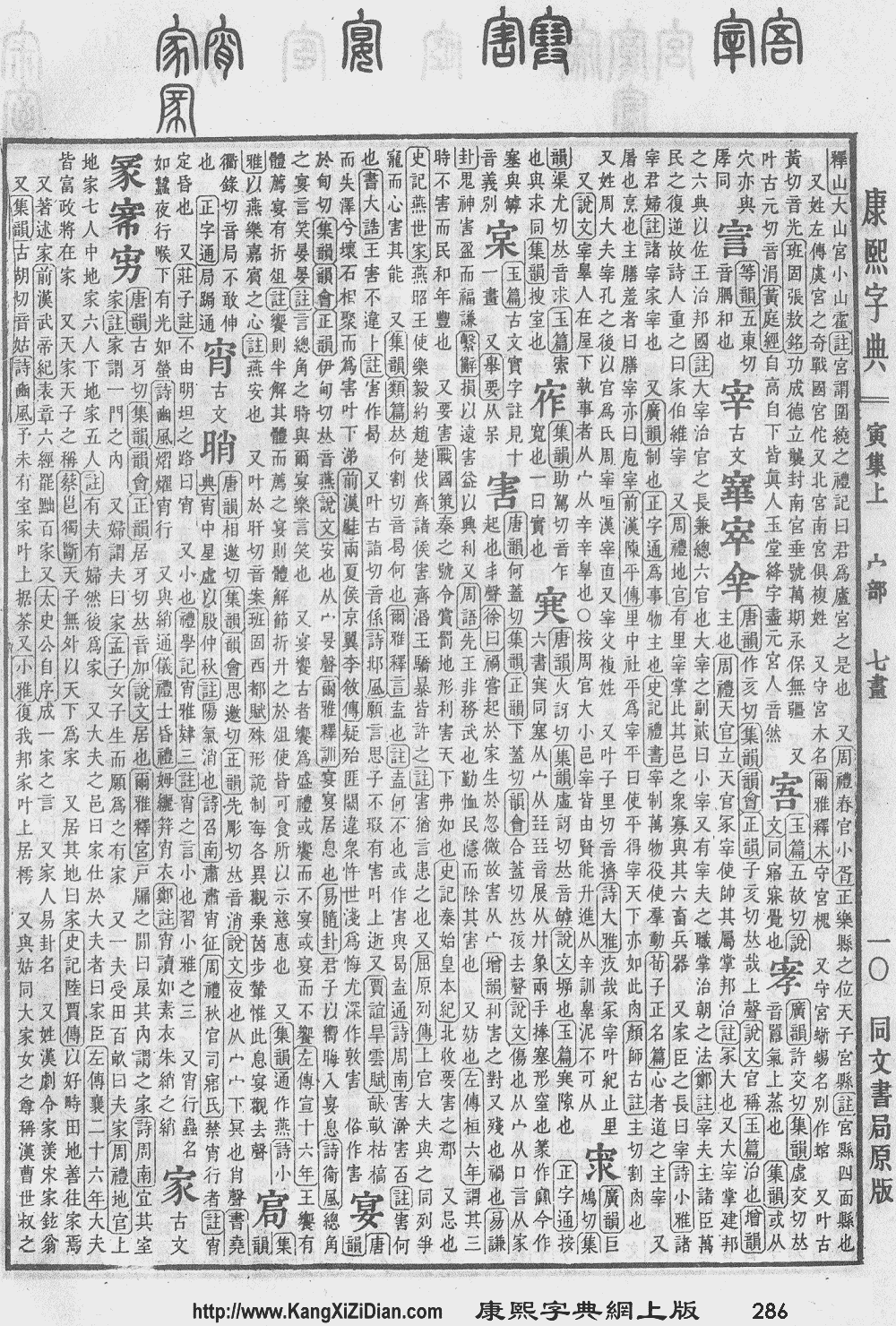
- KangXi: page 286, character 17
- Dai Kanwa Jiten: character 7169
- Dae Jaweon: page 566, character 3
- Hanyu Da Zidian (first edition): volume 2, page 930, character 15
- Unihan data for U+5BB6
Chinese
Glyph origin
| Historical forms of the character 家 | |||
|---|---|---|---|
| Shang | Western Zhou | Shuowen Jiezi (compiled in Han) | Liushutong (compiled in Ming) |
| Oracle bone script | Bronze inscriptions | Small seal script | Transcribed ancient scripts |
 |
 |
 |
 |
Phono-semantic compound (形聲, OC *kraː) : semantic 宀 (“roof”) + phonetic 豕 (“pig”).
豕 is an abbreviation of 豭 (OC *kraː, “male pig, boar”) (Shuowen Jiezi), a homophone of 家 (jiā) in Old Chinese. See 豭 for more on the glyph composition.
Etymology 1
| simp. and trad. |
家 | |
|---|---|---|
| 2nd round simp. | 𡦼 | |
| alternative forms | ||

Cognate with Tibetan མཁར (mkhar, “castle; house”) (Schuessler, 2007).
嫁 (OC *kraːs, “to give a girl in marriage”) is the exoactive of 家 (OC *kraː, “house; household; family”).
Pronunciation 1
Definitions
家
- home
- family; household
- (polite, for family member) my
- 家父 ― jiāfù ― my father
- domesticated; domestic
- Classifier for families, businesses and companies.
- school of thought; philosophical school
- (historical, obsolete) fief of ministers or senior officials
- 若使天下兼相愛,愛人若愛其身:……猶有大夫之相亂家、諸侯之相攻國者乎?視人家若其家,誰亂?視人國若其國,誰攻?故大夫之相亂家、諸侯之相攻國者亡有。 [Classical Chinese, trad.]
- From: Mozi, c. 4th century BCE, translated based on Y. P. Mei's version
- Ruòshǐ tiānxià jiān xiàng'ài, àirén ruò ài qí shēn:...... Yóu yǒu dàfū zhī xiàng luàn jiā, zhūhóu zhī xiàng gōng guó zhě hū? Shì rénjiā ruò qí jiā, shéi luàn? Shì rénguó ruò qí guó, shéi gōng? Gù dàfū zhī xiàng luàn jiā, zhūhóu zhī xiàng gōng guó zhě wáng yǒu. [Pinyin]
- Suppose everybody in the world loves universally, loving others as one's self: [...] Will there be mutual disturbance among the houses of the ministers and invasion among the states of the feudal lords? When every one regards the houses of others as one's own, who will be disturbing? When every one regards the states of others as one's own, who will invade? Therefore there will be neither disturbances among the houses of the ministers nor invasion among the states of the feudal lords.
若使天下兼相爱,爱人若爱其身:……犹有大夫之相乱家、诸侯之相攻国者乎?视人家若其家,谁乱?视人国若其国,谁攻?故大夫之相乱家、诸侯之相攻国者亡有。 [Classical Chinese, simp.]- 王曰『何以利吾國』?大夫曰『何以利吾家』?士庶人曰『何以利吾身』?上下交征利而國危矣。 [Classical Chinese, trad.]
- From: Mencius, c. 4th century BCE
- Wáng yuē ‘héyǐ lì wúguó’? Dàfū yuē ‘héyǐ lì wújiā’? Shì shùrén yuē ‘héyǐ lì wúshēn’? Shàngxià jiāo zhēng lì ér guó wēi yǐ. [Pinyin]
- If Your Majesty says, ‘Whereby may I profit my state?’ your grandees shall say, ‘Whereby may I profit my household?’ and your gentlemen and common people shall say, ‘Whereby may I profit myself?’ When those higher and lower compete with one another for profit, the state will be in danger.
王曰‘何以利吾国’?大夫曰‘何以利吾家’?士庶人曰‘何以利吾身’?上下交征利而国危矣。 [Classical Chinese, simp.]
- Suffix denoting a person with a certain occupation or social standing. -er
- Suffix denoting specialist in a certain activity or field. -ist; -er
- (in a game) party; side
- Suffix used after a noun to specify a type of person.
- a surname
Synonyms
- (family):
Compounds
|
|
|
Pronunciation 2
Pronunciation 3
Etymology 2
| For pronunciation and definitions of 家 – see 傢 (“stubborn, obstinate, intransigent”). (This character, 家, is the simplified form of 傢.) |
Notes:
|
Pronunciation
Definitions
家
- This term needs a translation to English. Please help out and add a translation, then remove the text
{{rfdef}}.
Etymology 4
Cognate with 姑 (gū).
Pronunciation
References
- 家 in ZDIC
Japanese
Readings
Compounds
Etymology 1
| Kanji in this term |
|---|
| 家 |
| いえ Grade: 2 |
| kun’yomi |
⟨ipe1⟩ → */ipʲe/ → /iɸe/ → /iwe/ → /ie/
From Old Japanese.
Noun
- a house
- one's own home
- a home, household
- Yamazaki, Kore, “第1篇 April showers bring May flowers. [Composition 1: April showers bring May flowers.]”, in 魔法使いの嫁 [The Ancient Magus’ Bride], volume 1 (fiction), Tokyo: Mag Garden, page 17:
- ここが僕の家 そして今日から君が暮らす家でもある
- Koko ga boku no ie Soshite kyō kara kimi ga kurasu ie de mo aru
- This is my home. From now on, you will live here, too.
- ここが僕の家 そして今日から君が暮らす家でもある
-
- a family
Etymology 2
| Kanji in this term |
|---|
| 家 |
| や Grade: 2 |
| kun’yomi |
(This etymology is missing or incomplete. Please add to it, or discuss it at the Etymology scriptorium.)
Alternative forms
Suffix
家 • (-ya)
- house of something, place where some business is conducted
- person who does that thing
Descendants
- → English: hooch
Etymology 4
| Kanji in this term |
|---|
| 家 |
| Grade: 2 |
| irregular |
Contraction of uchi above.
Often following the genitive case marker の (no) which contracts to -n.
Etymology 5
| Kanji in this term |
|---|
| 家 |
| か Grade: 2 |
| kan’on |
From Middle Chinese 家 (MC kˠa).
The 漢音 (kan'on, literally “Han sound”), so likely a latter borrowing from Middle Chinese.
Etymology 6
| Kanji in this term |
|---|
| 家 |
| け Grade: 2 |
| goon |
The 呉音 (goon, literally “Wu sound”), so likely the initial borrowing from Middle Chinese.
Korean
Compounds
Okinawan
Compounds
- 家内 (chinē, “household”)
- 家鴨 (ahiru), 家鴨 (ahirā), 家鴨 (afirā, “domestic duck”)
Derived terms
- 新家 (mīyā, “new house”)
- 家人衆 (yāninju, “family”)
Vietnamese
Han character
References
- Trần (1999).
- Trần (2004).