市
| ||||||||
Translingual
| Stroke order | |||
|---|---|---|---|
 | |||
Alternative forms
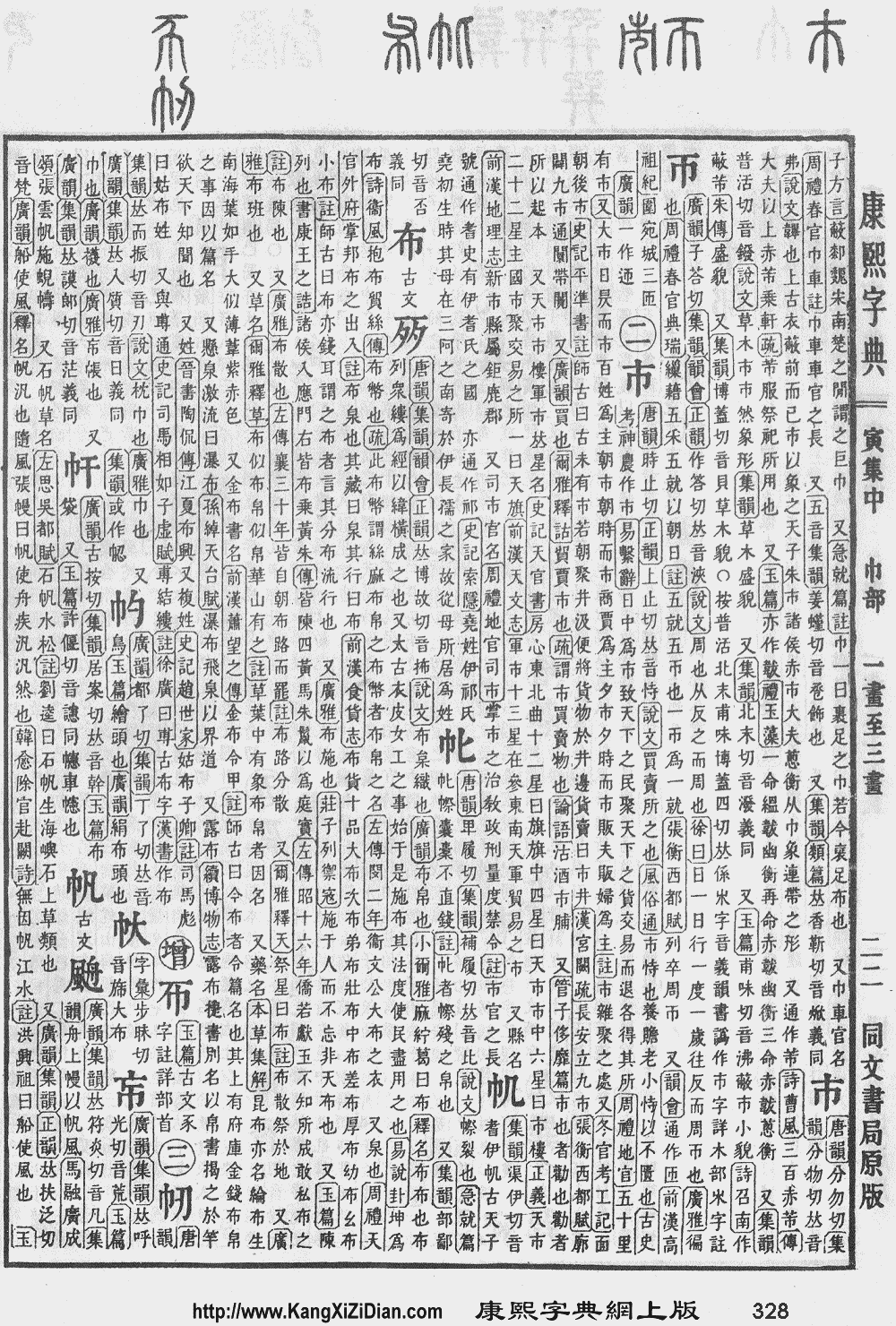
Note that the Ming typeface used in Japan and Korea as well as the Kangxi dictionary uses a vertical dot for the upper component of 亠 which is slightly different from modern Chinese scripts which uses a slanting 丶 dot for the upper component of 亠 in 市.
Han character
市 (Kangxi radical 50, 巾+2, 5 strokes, cangjie input 卜中月 (YLB), four-corner 00227, composition ⿱丶帀 or ⿱亠巾)
References
- KangXi: page 328, character 3
- Dai Kanwa Jiten: character 8775
- Dae Jaweon: page 632, character 13
- Hanyu Da Zidian (first edition): volume 1, page 729, character 5
- Unihan data for U+5E02
Chinese
| simp. and trad. |
市 | |
|---|---|---|
Glyph origin
| Historical forms of the character 市 | ||
|---|---|---|
| Western Zhou | Shuowen Jiezi (compiled in Han) | Liushutong (compiled in Ming) |
| Bronze inscriptions | Small seal script | Transcribed ancient scripts |
 |
 |
 |
Oracle bone script and bronze inscriptions: Phono-semantic compound (形聲, OC *djɯʔ) : semantic 兮 (“bustling”) + phonetic 之 (OC *tjɯ).
Etymology
Possibly related to Proto-Tai *z.ɟɯːꟲ (“to buy”), whence Thai ซื้อ (sʉ́ʉ) (Schuessler, 2007).
Pronunciation
Definitions
市
Compounds
|
|
|
Japanese
Compounds
Etymology 1
| Kanji in this term |
|---|
| 市 |
| いち Grade: 2 |
| kun’yomi |
From Old Japanese 市 (ichi). Found in the Kojiki of 712 CE.[1]
Noun
市 • (ichi)
Etymology 2
| Kanji in this term |
|---|
| 市 |
| し Grade: 2 |
| on’yomi |
Usage notes
When compounding, similar to 都 (-to), 道 (-dō), 府 (-fu), 県 (-ken) and 町 (chō), makes the accent fall on the 自立拍 (jiritsuhaku, “autonomous mora”) immediately before itself. For example:
- 大阪 (おおさか) + 市 → 大阪市 (おおさかꜜし)
- 佐久 (さく) + 市 → 佐久市 (さくꜜし)
- 仙台 (せꜜんだい) + 市 → 仙台市 (せんだꜜいし; い is a 特殊拍 (tokushuhaku, “special mora”), therefore accentless)
- 五條 (ごꜜじょう) + 市 → 五條市 (ごじょꜜうし; う is a 特殊拍 (tokushuhaku, “special mora”), therefore accentless)
- 日進 (にꜜっしん) + 市 → 日進市 (にっしꜜんし; ん is a 特殊拍 (tokushuhaku, “special mora”), therefore accentless)
References
- 1988, 国語大辞典(新装版) (Kokugo Dai Jiten, Revised Edition) (in Japanese), Tōkyō: Shogakukan
- 2006, 大辞林 (Daijirin), Third Edition (in Japanese), Tōkyō: Sanseidō, →ISBN
Korean
Etymology
From Middle Chinese 市 (MC d͡ʑɨX).
| Historical readings |
|---|
|
Pronunciation
- (SK Standard/Seoul) IPA(key): [ɕʰi(ː)]
- Phonetic hangul: [시(ː)]
- Though still prescribed in Standard Korean, most speakers in both Koreas no longer distinguish vowel length.
Compounds
Vietnamese
Han character
- This term needs a translation to English. Please help out and add a translation, then remove the text
{{rfdef}}.