掠
| ||||||||
| ||||||||
Translingual
Han character
掠 (Kangxi radical 64, 手+8, 11 strokes, cangjie input 手卜口火 (QYRF), four-corner 50096, composition ⿰扌京)
References
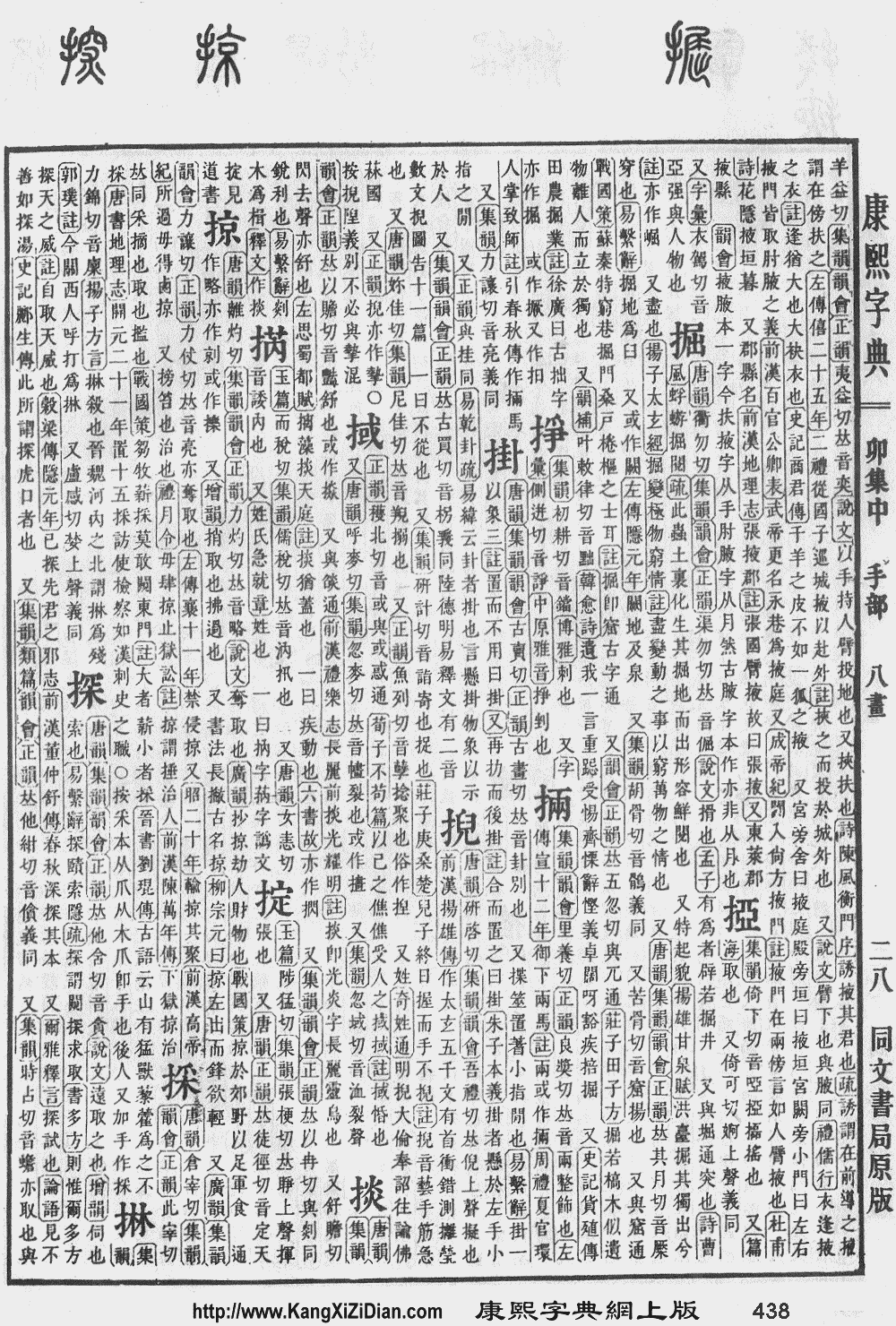
- KangXi: page 438, character 11
- Dai Kanwa Jiten: character 12273
- Dae Jaweon: page 788, character 8
- Hanyu Da Zidian (first edition): volume 3, page 1903, character 2
- Unihan data for U+63A0
- Unihan data for U+F975
Chinese
| simp. and trad. |
掠 | |
|---|---|---|
Glyph origin
| Historical forms of the character 掠 |
|---|
| Shuowen Jiezi (compiled in Han) |
| Small seal script |
 |
Characters in the same phonetic series (京) (Zhengzhang, 2003)
Phono-semantic compound (形聲, OC *ɡ·raŋs, *ɡ·raɡ) : semantic 手 (“insect”) + phonetic 京 (OC *kraŋ).
Etymology 1
See 略 (lüè, “to plunder, to pillage”)
Pronunciation
Definitions
掠
- to rob; to loot
- to sweep through
- (Min Nan) to catch, to capture
- 員外見了氣昂昂 叱聲家丁人一衆 與我掠住二個人 [Teochew, trad.]
- From: Late Qing/early Republic, anonymous, 古板一世報全歌 book 3 page 10
- ueng5 ghua7 gin3 liou2 ki3 ngang1 ngang1, ceg4 sian1 ge1 deng1 nang5 zeg8 zeng3, e2 ua2 liah8 zu6 no6 gai5 nang5 [Peng'im]
- The master of the house was filled with rage on seeing this, and called to the group of servants: “capture [those] two for me”
员外见了气昂昂 叱声家丁人一众 与我掠住二个人 [Teochew, simp.]
- (Min Nan) to arrest
- (obsolete) to flog; to beat
- 趙高治斯,榜掠千餘,不勝痛,自誣服。 [Classical Chinese, trad.]
- From: The Records of the Grand Historian, by Sima Qian, c. 91 BCE
- Zhào Gāo zhì Sī, bàng lüè qiān yú, bùshēng tòng, zì wū fú. [Pinyin]
- Zhao Gao, as inquisitor, gave Li Si over a thousand flogs by the rod. Si, unable to bear the pain, false pleaded guilty.
赵高治斯,榜掠千余,不胜痛,自诬服。 [Classical Chinese, simp.]
Synonyms
Dialectal synonyms of 捉 (“to catch; to capture”) [map]
| Variety | Location | Words |
|---|---|---|
| Formal (Written Standard Chinese) | 捉, 抓, 捕, 捕捉 | |
| Mandarin | Taiwan | 抓, 捉 |
| Malaysia | 捉 | |
| Singapore | 捉, 抓 | |
| Cantonese | Guangzhou | 捉 |
| Hong Kong | 捉 | |
| Kuala Lumpur (Guangfu) | 捉 | |
| Singapore (Guangfu) | 捉 | |
| Hakka | Meixian | 捉 |
| Miaoli (N. Sixian) | 捉 | |
| Pingtung (Neipu; S. Sixian) | 捉 | |
| Hsinchu County (Zhudong; Hailu) | 捉 | |
| Taichung (Dongshi; Dabu) | 捉 | |
| Hsinchu County (Qionglin; Raoping) | 捉 | |
| Yunlin (Lunbei; Zhao'an) | 捉 | |
| Min Nan | Xiamen | 掠 |
| Xiamen (Tong'an) | 掠 | |
| Quanzhou | 掠 | |
| Zhangzhou | 掠 | |
| Zhangzhou (Longhai) | 掠 | |
| Tainan | 掠 | |
| Penang (Hokkien) | 掠 | |
| Singapore (Hokkien) | 掠 | |
| Manila (Hokkien) | 掠 | |
| Chaozhou | 掠 | |
| Raoping | 掠 | |
| Shantou | 掠 | |
| Singapore (Teochew) | 掠 | |
| Wenchang | 掠 | |
| Qionghai | 掠 | |
| Wu | Shanghai | 捉 |
Dialectal synonyms of 逮捕 (“to arrest”) [map]
| Variety | Location | Words |
|---|---|---|
| Formal (Written Standard Chinese) | 逮捕, 拘捕, 捕捉, 緝捕, 捉拿 | |
| Mandarin | Beijing | 逮, 抓 |
| Taiwan | 捉, 抓 | |
| Singapore | 捉, 抓 | |
| Cantonese | Guangzhou | 拉 |
| Hong Kong | 拉 | |
| Singapore (Guangfu) | 拉 | |
| Hakka | Meixian | 捉 |
| Min Nan | Xiamen | 緝掠 |
| Quanzhou | 網, 網董 | |
| Tainan | 掠 | |
| Penang (Hokkien) | 掠 | |
| Singapore (Hokkien) | 掠 | |
| Manila (Hokkien) | 掠 | |
| Singapore (Teochew) | 掠 | |
| Wu | Ningbo | 揢 |
| Wenzhou | 拔 | |
Compounds
Descendants
- → Proto-Tai: *C̬.lakᴰ (“to steal”)
- Thai: ลัก (lák, “to steal”)
Pronunciation
Compounds
|
Japanese
Hypernyms
- 永字八法 (eiji happō, “the Eight Principles of Yong”)
Coordinate terms
- 側 (soku, “the first of the Eight Principles of Yong”)
- 勒 (roku, “the second of the Eight Principles of Yong”)
- 努 (do, “the third of the Eight Principles of Yong”)
- 趯 (teki, “the fourth of the Eight Principles of Yong”)
- 策 (saku, “the fifth of the Eight Principles of Yong”)
- 啄 (taku, “the seventh of the Eight Principles of Yong”)
- 磔 (taku, “the eighth of the Eight Principles of Yong”)
Korean
Hanja
掠 (eumhun 노략질할 략 (noryakjilhal ryak), South Korea 노략질할 약 (noryakjilhal yak))
掠 (eumhun 볼기칠 량 (bolgichil ryang), South Korea 볼기칠 양 (bolgichil yang))
See also
Vietnamese
This article is issued from Wiktionary. The text is licensed under Creative Commons - Attribution - Sharealike. Additional terms may apply for the media files.