李
| ||||||||
| ||||||||
Translingual
| Stroke order | |||
|---|---|---|---|
 | |||
Han character
李 (Kangxi radical 75, 木+3, 7 strokes, cangjie input 木弓木 (DND), four-corner 40407, composition ⿱木子)
Derived characters
- 𭇶, 𣵎, 𣒶, 𦁝, 𪴏, 𦰁
References
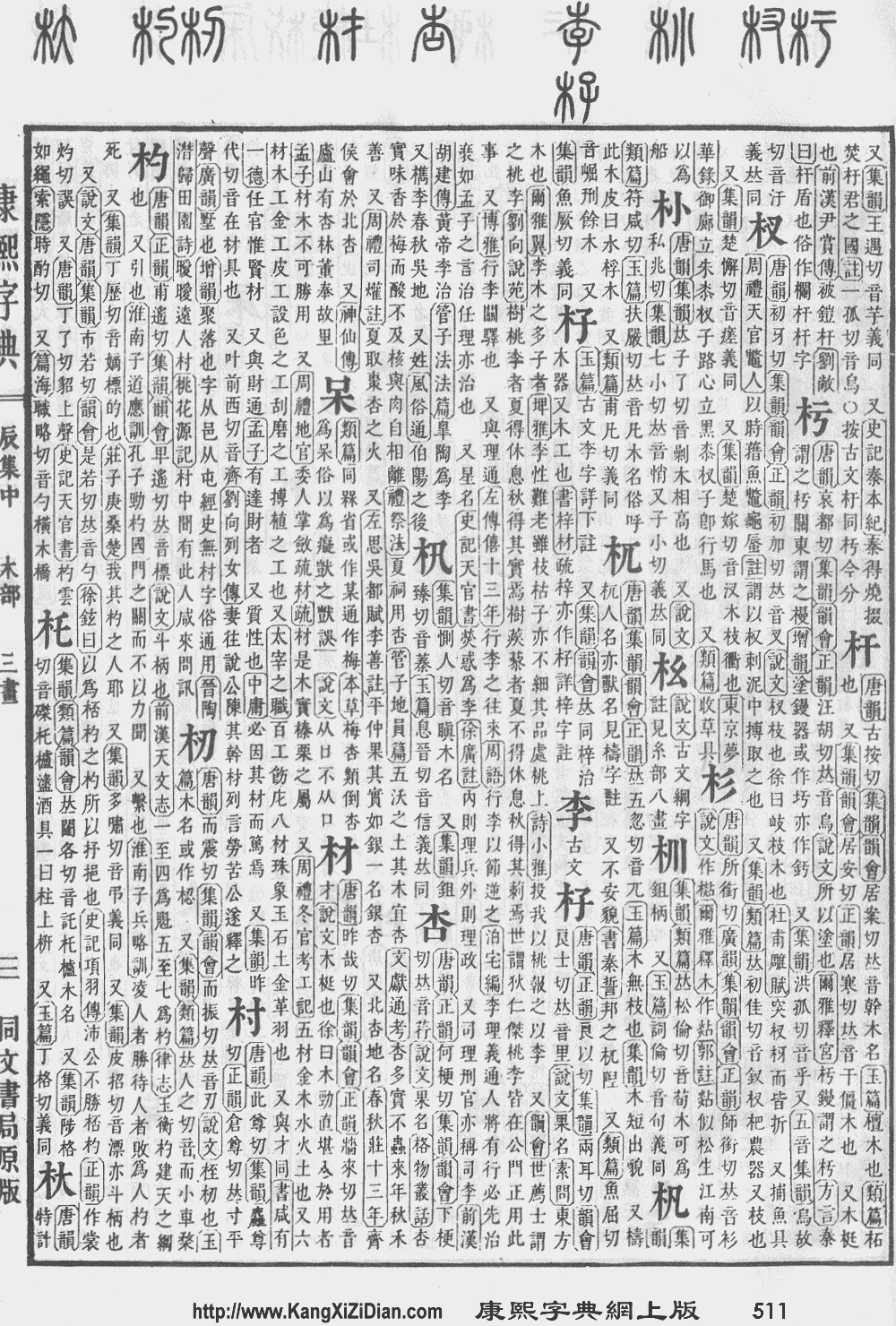
- KangXi: page 511, character 11
- Dai Kanwa Jiten: character 14459
- Dae Jaweon: page 895, character 9
- Hanyu Da Zidian (first edition): volume 2, page 1162, character 8
- Unihan data for U+674E
- Unihan data for U+F9E1
Chinese
| trad. | 李 | |
|---|---|---|
| simp. # | 李 | |
Glyph origin
| Historical forms of the character 李 | ||
|---|---|---|
| Western Zhou | Shuowen Jiezi (compiled in Han) | Liushutong (compiled in Ming) |
| Bronze inscriptions | Small seal script | Transcribed ancient scripts |
 |
 |
 |
Oracle bone script: Phono-semantic compound (形聲, OC *rɯʔ) : phonetic 來 (OC *m·rɯːɡ, “wheat”) + semantic 子. The phonetic part 來 became gradually corrupted to yield 木 (“tree”).
Shuowen erroneously remarks that this is a phono-semantic compound (形聲, OC *rɯʔ) : semantic 木 (“tree”) + phonetic 子 (OC *ʔslɯʔ).
Pronunciation
Definitions
李
- plum (tree and fruit)
- † Alternative form of 理 (lǐ, “judge; justice”).
- a surname, listed fourth in the Baijiaxing
- 李白 ― Lǐ Bái ― Li Bai (Li Bo) (Tang dynasty poet)
- 李連杰/李连杰 [Cantonese] ― lei5 lin4 git6 [Jyutping] ― Jet Li (Li Lianjie or Li Yangzhong)
Usage notes
In mainland China and among its expatriates, this surname is generally romanized as "Li" in accordance with the Hanyu Pinyin system. Although an identical transliteration is used in Wade-Giles, similarity in pronunciation to the English surname makes the romanization "Lee" more common in Hong Kong, Singapore, Taiwan and elsewhere. A notable example of this is Bruce Lee.
Synonyms
Compounds
|
References
- “李”, in 漢語多功能字庫 (Multi-function Chinese Character Database), 香港中文大學 (the Chinese University of Hong Kong), 2014–
- “Entry #3231”, in 臺灣閩南語常用詞辭典 [Dictionary of Frequently-Used Taiwan Minnan] (in Chinese and Min Nan), Ministry of Education, R.O.C., 2011.
Japanese
Compounds
- 行李 (kōri)
Etymology 1
| Kanji in this term |
|---|
| 李 |
| Jinmeiyō |
| kun’yomi |
| Alternative spelling |
|---|
| 酸桃 |
Compound of 酸 (su, “vinegar; sour”) + 桃 (momo, “peach”).[1][2]
Usage notes
As with many terms that name organisms, this term is often spelled in katakana, especially in biological contexts (where katakana is customary), as スモモ.
Derived terms
Etymology 2
From Middle Chinese 李 (MC lɨX).
Pronunciation
- IPA(key): [ɾʲi]
Proper noun
李 • (Ri)
- Japanese reading of the Chinese or Korean surname
李 • (Rī)
- Japanese reading of the Chinese surname
李 • (I)
- Japanese reading of the South Korean surname
Derived terms
- 李朝 (Richō)
- 李詩 (rishi)
References
- 1988, 国語大辞典(新装版) (Kokugo Dai Jiten, Revised Edition) (in Japanese), Tōkyō: Shogakukan
- 2006, 大辞林 (Daijirin), Third Edition (in Japanese), Tōkyō: Sanseidō, →ISBN
Further reading
- Entry at Nihon Jiten (in Japanese)
- Entry at Gogen Allguide (in Japanese)
Korean
Etymology
From Middle Chinese 李 (MC lɨX).
| Historical readings |
|---|
|
Pronunciation
- (initial position)
- (SK Standard/Seoul) IPA(key): [i(ː)]
- Phonetic hangul: [이(ː)]
- Though still prescribed in Standard Korean, most speakers in both Koreas no longer distinguish vowel length.
- (non-initial position)
- (SK Standard/Seoul) IPA(key): [ɾi]
- Phonetic hangul: [리]
Compounds
Vietnamese
Han character
- chữ Hán form of Lí (“a surname from Chinese.”).
- a unisex given name