仔
| ||||||||
Translingual
| Stroke order | |||
|---|---|---|---|
 | |||
Han character
仔 (Kangxi radical 9, 人+3, 5 strokes, cangjie input 人弓木 (OND), four-corner 27247, composition ⿰亻子)
References
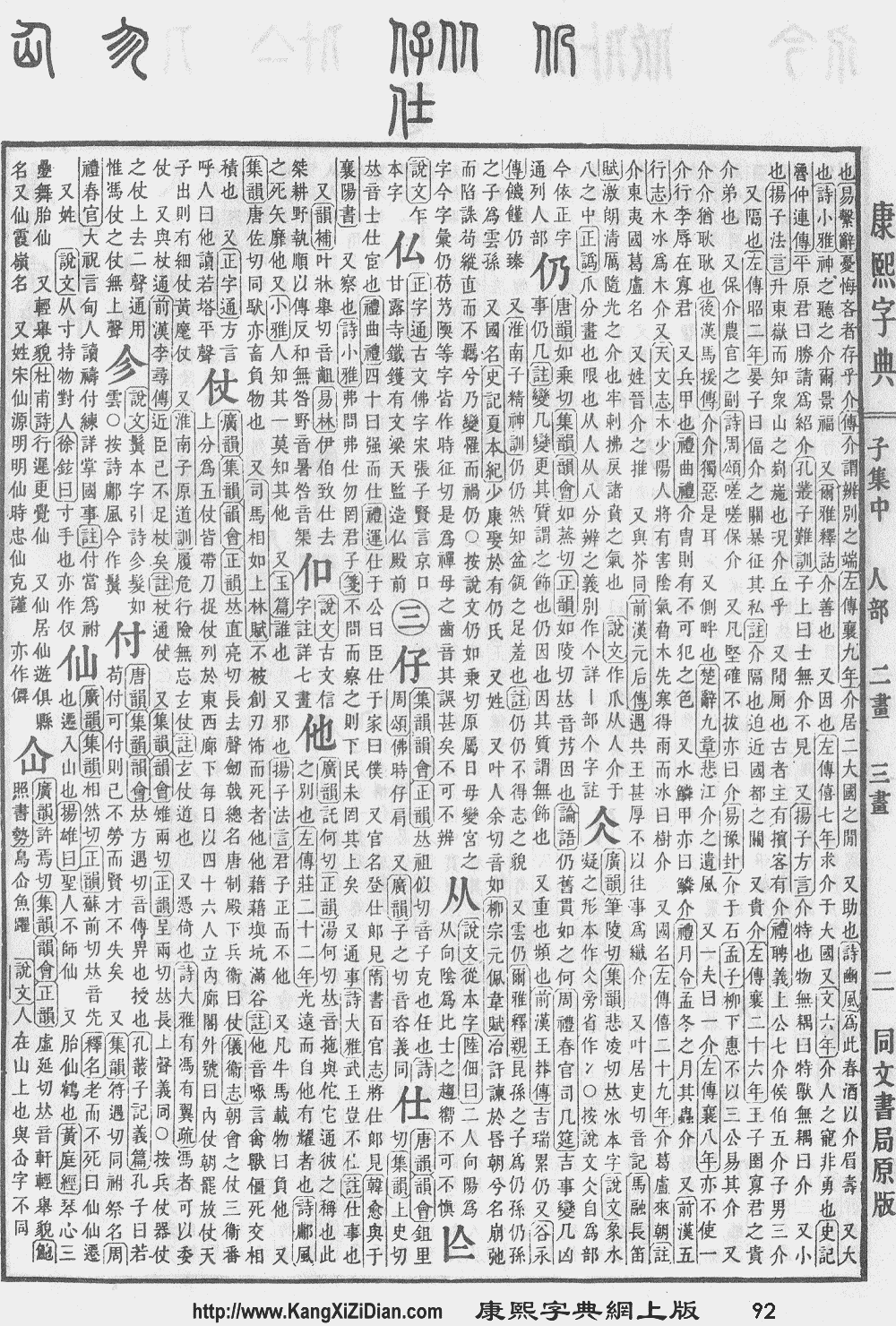
- KangXi: page 92, character 6
- Dai Kanwa Jiten: character 367
- Dae Jaweon: page 195, character 9
- Hanyu Da Zidian (first edition): volume 1, page 115, character 5
- Unihan data for U+4ED4
Chinese
Glyph origin
| Historical forms of the character 仔 | |||
|---|---|---|---|
| Shuowen Jiezi (compiled in Han) | |||
| Small seal script | |||
 | |||
| |||
|
References: Mostly from Richard Sears' Chinese Etymology site (authorisation),
|


Phono-semantic compound (形聲, OC *ʔslɯ, *ʔslɯʔ) : semantic 人 (“person”) + phonetic 子 (OC *ʔslɯʔ)
Etymology 1
| simp. and trad. |
仔 | |
|---|---|---|
Cognate with 子 (OC *ʔslɯʔ) and 崽 (OC *ʔslɯːʔ, *srɯː, *srɯː). (Can this(+) etymology be sourced?)
Pronunciation 1
Definitions
仔
Definitions
仔
- (Cantonese, dialectal Hakka, Shehua) son (Classifier: 個/个 c; 粒 c)
- (Cantonese) child
- (Cantonese, slang) boyfriend (Classifier: 條/条 c)
- (Cantonese, slang) (young) male (Classifier: 條/条 c; 隻/只 c)
- (Cantonese, dialectal Hakka, Min Bei) Diminutive suffix.
- Denotes a young male of a particular trait.
- Denotes a young male of a particular occupation or background, often demeaningly.
- Used to call somebody affectionately. (For names, it is only used for males.)
- Demeaningly denotes somebody of a particular occupation or position.
- Denotes a young animal.
- Denotes something that is small in size.
- Denotes the younger sibling of one's spouse.
- Used with single-syllable nouns without denoting a specific meaning.
- (Cantonese) Used after a classifier to indicate that something is small in size and/or quantity.
- (Cantonese, slang, neologism) Suffix placed after a verb or adjective to sound cute and affectionate.
Synonyms
| Variety | Location | Words |
|---|---|---|
| Formal (Written Standard Chinese) | 男朋友, 男友 | |
| Mandarin | Taiwan | 男朋友, 男友 |
| Ürümqi | 男朋友 | |
| Chengdu | 蓋蓋兒, 蓋蓋 | |
| Nanjing | 男朋友 | |
| Singapore | 男朋友 | |
| Cantonese | Guangzhou | 男朋友 |
| Hong Kong | 男朋友, 男友, 仔, 男仔 | |
| Dongguan | 芒啟 | |
| Singapore (Guangfu) | 男朋友 | |
| Hakka | Miaoli (N. Sixian) | 男朋友 |
| Pingtung (Neipu; S. Sixian) | 男朋友 | |
| Hsinchu County (Zhudong; Hailu) | 男朋友 | |
| Taichung (Dongshi; Dabu) | 男朋友 | |
| Hsinchu County (Qionglin; Raoping) | 男朋友 | |
| Yunlin (Lunbei; Zhao'an) | 男朋友 | |
| Min Nan | Xiamen | 男朋友 |
| Shishi | 男朋友 | |
| Penang (Hokkien) | 丈夫朋友 | |
| Singapore (Hokkien) | 丈夫朋友 | |
| Manila (Hokkien) | 男朋友, 丈夫朋友 | |
| Singapore (Teochew) | 丈夫朋友 | |
| Wu | Shanghai | 男朋友 |
| Shanghai (Chongming) | 男朋友 | |
| Variety | Location | Words |
|---|---|---|
| Formal (Written Standard Chinese) | 子 | |
| Mandarin | Beijing | 子 |
| Taiwan | 子 | |
| Singapore | 子 | |
| Cantonese | Guangzhou | 仔1 |
| Hong Kong | 仔1 | |
| Kuala Lumpur (Guangfu) | 仔1 | |
| Singapore (Guangfu) | 仔1 | |
| Hakka | Meixian | 仔6 |
| Miaoli (N. Sixian) | 仔6 | |
| Pingtung (Neipu; S. Sixian) | 仔6 | |
| Hsinchu County (Zhudong; Hailu) | 仔6 | |
| Senai (Huiyang) | 仔1 | |
| Min Dong | Fuzhou | 囝 |
| Min Nan | Xiamen | 仔2 |
| Quanzhou | 仔2 | |
| Jinjiang | 仔2 | |
| Zhangzhou | 仔2 | |
| Zhangpu | 仔2 | |
| Tainan | 仔2 | |
| Penang (Hokkien) | 囝 | |
| Singapore (Hokkien) | 囝, 仔2 | |
| Manila (Hokkien) | 仔2 | |
| Shantou | 囝 | |
| Shantou (Chenghai) | 囝 | |
| Jieyang | 囝 | |
| Haifeng | 仔2 | |
| Bangkok (Teochew) | 囝 | |
| Johor Bahru (Teochew) | 囝 | |
| Singapore (Teochew) | 囝 | |
| Wenchang | 囝 | |
| Singapore (Hainanese) | 囝 | |
Compounds
Etymology 2
| simp. and trad. |
仔 | |
|---|---|---|
| alternative forms | ||
Pronunciation 1 is a weak form of 囝 (kiáⁿ, káⁿ). (Mandarin and Cantonese pronunciations in words borrowed from Min Nan are from etymology 1.)
Pronunciation 1
Definitions
仔 (chiefly Min Nan)
- a diminutive suffix for nouns, adjectives or quantities
- 囡仔 [Hokkien] ― gín-á [Pe̍h-ōe-jī] ― child
- 小叔仔 [Hokkien] ― sió-chek-á [Pe̍h-ōe-jī] ― brother-in-law (husband's younger brother)
- 勻勻仔/匀匀仔 [Hokkien] ― ûn-ûn-á [Pe̍h-ōe-jī] ― slowly
- 小可仔 [Hokkien] ― sió-khóa-á [Pe̍h-ōe-jī] ― a little bit
- 歌仔戲/歌仔戏 [Hokkien] ― koa-á-hì [Pe̍h-ōe-jī] ― Taiwanese opera
- a suffix that converts a verb or adjective into a noun
- 抿仔 [Hokkien] ― bín-á [Pe̍h-ōe-jī] ― brush
- 矮仔 [Hokkien] ― é-á [Pe̍h-ōe-jī] ― shorty
- a suffix placed after a name or title, used endearingly, humorously or pejoratively
Synonyms
| Variety | Location | Words |
|---|---|---|
| Formal (Written Standard Chinese) | 子 | |
| Mandarin | Beijing | 子 |
| Taiwan | 子 | |
| Singapore | 子 | |
| Cantonese | Guangzhou | 仔1 |
| Hong Kong | 仔1 | |
| Kuala Lumpur (Guangfu) | 仔1 | |
| Singapore (Guangfu) | 仔1 | |
| Hakka | Meixian | 仔6 |
| Miaoli (N. Sixian) | 仔6 | |
| Pingtung (Neipu; S. Sixian) | 仔6 | |
| Hsinchu County (Zhudong; Hailu) | 仔6 | |
| Senai (Huiyang) | 仔1 | |
| Min Dong | Fuzhou | 囝 |
| Min Nan | Xiamen | 仔2 |
| Quanzhou | 仔2 | |
| Jinjiang | 仔2 | |
| Zhangzhou | 仔2 | |
| Zhangpu | 仔2 | |
| Tainan | 仔2 | |
| Penang (Hokkien) | 囝 | |
| Singapore (Hokkien) | 囝, 仔2 | |
| Manila (Hokkien) | 仔2 | |
| Shantou | 囝 | |
| Shantou (Chenghai) | 囝 | |
| Jieyang | 囝 | |
| Haifeng | 仔2 | |
| Bangkok (Teochew) | 囝 | |
| Johor Bahru (Teochew) | 囝 | |
| Singapore (Teochew) | 囝 | |
| Wenchang | 囝 | |
| Singapore (Hainanese) | 囝 | |
Usage notes
Tone sandhi before 仔 differ from the normal rules in some dialects of Hokkien. In Taiwanese Hokkien, only the rules for tones 1, 2, 4 (-p/t/k) and 8 (-p/t/k) remain unchanged:
Compounds
- (Min Nan) 一目𥍉仔 (chi̍t-ba̍k-nih-á)
- 三七仔 (sānqīzǐ)
- 匏仔 (pû-á)
- 印仔 (ìn-á)
- 囡仔
- 圓仔湯/圆仔汤
- 嬰仔/婴仔 (eⁿ-á)
- (Min Nan) 寬寬仔/宽宽仔 (khoaⁿ-khoaⁿ-á)
- (Min Nan) 小鬼仔殼/小鬼仔壳 (siáu-kúi-á-khak)
- 尪仔 (ang-á)
- 尪仔標/尪仔标
- 巷仔 (hāng-á)
- 店仔 (tiàm-á)
- (Min Nan) 手電仔/手电仔 (chhiú-tiān-á)
- 搖囝仔歌/摇囝仔歌
- 搓圓仔/搓圆仔
- 搓圓仔湯/搓圆仔汤
- 擔仔/担仔 (tàⁿ-á)
- 擔仔麵/担仔面 (dànzǎimiàn)
- (Min Nan) 文文仔笑 (bûn-bûn-á-chhiò)
- 早起時仔/早起时仔 (chá-khí-sî-á)
- 柑仔 (kam-á)
- 欲晝仔/欲昼仔 (beh-tàu-á)
- 欲暗仔 (beh-àm-á)
- 歌仔戲/歌仔戏 (gēzǎixì)
- 水筆仔/水笔仔
- (Min Nan) 沓沓仔 (ta̍uh-ta̍uh-á)
- 泂蛤仔
- 淡薄仔 (tām-po̍h-á)
- (Min Nan) 溪仔 (khe-á)
- 煙仔魚/烟仔鱼 (ian-á-hî)
- 煞尾仔囝 (soah-bóe-á-kiáⁿ)
- (Min Nan) 物仔 (mih-á)
- 牽猴仔/牵猴仔 (khan-kâu-á)
- 白賊七仔/白贼七仔 (pe̍h-tsha̍t-tshit-á)
- (Min Nan) 短褲節仔/短裤节仔 (té-khò͘-chat-á)
- 矸仔 (kan-á)
- 箱仔 (siông-é)
- (Min Nan) 𥰔仔 (phín-á)
- (Min Nan) 𥴊仔 (kám-á)
- 絃仔/弦仔
- 罐仔 (koàn-á)
- (Min Nan) 肚胿仔 (tō͘-koai-á)
- 芋仔
- 芋仔冰
- 草仔
- 草仔粿
- 菜市仔 (chhài-chhī-á)
- 落翅仔
- 藥仔/药仔 (io̍h-á)
- (Min Nan) 蚶仔 (ham-á)
- 蚵仔
- 蚵仔煎
- 蚵仔麵線/蚵仔面线
- (Min Nan) 蜊仔 (lâ-á)
- (Min Nan) 蠓捽仔 (báng-sut-á)
- 街仔 (ke-á)
- 袋仔
- 襪仔/袜仔 (be̍h-á)
- 諞仙仔/谝仙仔 (pián-sian-á)
- 邊仔/边仔 (piⁿ-á)
- 銀角仔/银角仔 (gîn-kak-á)
- 錶仔/表仔 (pió-á)
- (Min Nan) 阿共仔 (a-kiōng-á)
- 阿啄仔 (a-tok-á)
- 鵝仔/鹅仔 (giâ-á)
- 麥仔/麦仔 (be̍h-á)
Pronunciation 2
Pronunciation
Definitions
仔
- (Min Nan) An interfix placed between two nouns to show the relationship between the two objects.
- 翁仔某 [Hokkien] ― ang-á-bó͘ [Pe̍h-ōe-jī] ― husband and wife
Pronunciation
Definitions
仔
- (Min Nan) An interfix placed between two numbers to denote the value of 100, i.e. x 仔 y = 100x + 10y.
- 三仔五 [Hokkien] ― saⁿ-á-gō͘ [Pe̍h-ōe-jī] ― three hundred fifty
Pronunciation
Definitions
仔
- (Min Nan) An interfix used limitedly in certain temporal location adverbs.
- 今仔日 [Hokkien] ― kin-á-ji̍t [Pe̍h-ōe-jī] ― today
- 明仔載/明仔载 [Hokkien] ― bîn-á-chài [Pe̍h-ōe-jī] ― tomorrow
Etymology 6
| simp. and trad. |
仔 | |
|---|---|---|
| alternative forms | 兒/儿 欸 | |
(This etymology is missing or incomplete. Please add to it, or discuss it at the Etymology scriptorium.)
Pronunciation
Definitions
仔 (Hakka)
- a suffix used after nouns
- 樹仔/树仔 [Sixian Hakka] ― su-é [Pha̍k-fa-sṳ] ― tree
- a suffix that makes a derogatory slur
- 阿山仔 [Sixian Hakka] ― â-sân-é [Pha̍k-fa-sṳ] ― Mainlander
Synonyms
| Variety | Location | Words |
|---|---|---|
| Formal (Written Standard Chinese) | 子 | |
| Mandarin | Beijing | 子 |
| Taiwan | 子 | |
| Singapore | 子 | |
| Cantonese | Guangzhou | 仔1 |
| Hong Kong | 仔1 | |
| Kuala Lumpur (Guangfu) | 仔1 | |
| Singapore (Guangfu) | 仔1 | |
| Hakka | Meixian | 仔6 |
| Miaoli (N. Sixian) | 仔6 | |
| Pingtung (Neipu; S. Sixian) | 仔6 | |
| Hsinchu County (Zhudong; Hailu) | 仔6 | |
| Senai (Huiyang) | 仔1 | |
| Min Dong | Fuzhou | 囝 |
| Min Nan | Xiamen | 仔2 |
| Quanzhou | 仔2 | |
| Jinjiang | 仔2 | |
| Zhangzhou | 仔2 | |
| Zhangpu | 仔2 | |
| Tainan | 仔2 | |
| Penang (Hokkien) | 囝 | |
| Singapore (Hokkien) | 囝, 仔2 | |
| Manila (Hokkien) | 仔2 | |
| Shantou | 囝 | |
| Shantou (Chenghai) | 囝 | |
| Jieyang | 囝 | |
| Haifeng | 仔2 | |
| Bangkok (Teochew) | 囝 | |
| Johor Bahru (Teochew) | 囝 | |
| Singapore (Teochew) | 囝 | |
| Wenchang | 囝 | |
| Singapore (Hainanese) | 囝 | |
Derived terms
- 例仔 (li-é)
- 信仔 (sin-é)
- 倈仔/俫仔 (lai-é)
- 傳仔/传仔 (chhon-é)
- 兔仔 (thu-é)
- 凳仔 (ten-é)
- 刷仔 (sot-é)
- 包仔 (pâu-é)
- 名仔 (miàng-é)
- 哪仔 (nai-é)
- 啞仔/哑仔 (á-é)
- 塞仔 (set-é)
- 外仔 (ngoi-é)
- 夾仔/夹仔 (kiap-é)
- 妹仔 (moi-é)
- 姪仔/侄仔 (chhṳ̍t-é)
- 孫仔/孙仔 (sûn-é)
- 寮仔 (liàu-é)
- 屋仔 (vuk-é)
- 屐仔 (khia̍k-é)
- 差仔 (chhâi-é)
- 巷仔 (hong-é)
- 帶仔/带仔 (tai-é)
- 帽仔 (mo-é)
- 弦仔 (hièn-é)
- 扇仔 (san-é)
- 拖仔 (thô-é)
- 插仔 (chhap-é)
- 搓仔 (chho-é)
- 撐仔/撑仔 (chhang-é)
- 旗仔 (khì-é)
- 日仔 (ngit-é)
- 星仔 (sên-é)
- 李仔 (lí-é)
- 杯仔 (pî-é)
- 枋仔 (piông-é)
- 柚仔 (yu-é)
- 柿仔 (chhṳ-é)
- 柑仔 (kâm-é)
- 栗仔 (li̍t-é)
- 桃仔 (thò-é)
- 桌仔 (chok-é)
- 桁仔 (hàng-é)
- 梨仔 (lì-é)
- 梭仔 (sô-é)
- 梯仔 (thôi-é)
- 梅仔 (mòi-é)
- 梳仔 (sṳ̂-é)
- 棍仔 (kun-é)
- 棕仔 (chûng-é)
- 椰仔 (yà-é)
- 槓仔/杠仔 (kong-é)
- 樣仔/样仔 (yong-é)
- 模仔 (mù-é)
- 樹仔/树仔 (su-é)
- 橘仔 (kit-é)
- 沙仔 (sâ-é)
- 漏仔 (leu-é)
- 燕仔 (yen-é)
- 牌仔 (phài-é)
- 狗仔 (kiéu-é)
- 猴仔 (hèu-é)
- 獅仔/狮仔 (sṳ̂-é)
- 珠仔 (chû-é)
- 瓜仔 (kôa-é)
- 瓠仔 (phù-é)
- 番仔 (fân-é)
- 癧仔/疬仔 (li̍t-é)
- 盒仔 (ha̍p-é)
- 盤仔/盘仔 (phàn-é)
- 碟仔 (thia̍p-é)
- 磚仔/砖仔 (chôn-é)
- 禾仔 (vò-é)
- 秧仔 (yông-é)
- 秤仔 (chhṳn-é)
- 稟仔/禀仔 (pín-é)
- 窟仔 (fut-é)
- 竹仔 (chuk-é)
- 笛仔 (tha̍k-é)
- 筷仔 (khoai-é)
- 篦仔 (pi-é)
- 簿仔 (phû-é)
- 粽仔 (chung-é)
- 糕仔 (kâu-é)
- 糠仔 (hông-é)
- 索仔 (sok-é)
- 網仔/网仔 (mióng-é)
- 綢仔/绸仔 (chhù-é)
- 縫仔/缝仔 (phung-é)
- 羊仔 (yòng-é)
- 耙仔 (phà-é)
- 腰仔 (yêu-é)
- 船仔 (sòn-é)
- 艾仔 (ngie-é)
- 芋仔 (vu-é)
- 苧仔/苎仔 (chhû-é)
- 茄仔 (khiò-é)
- 莊仔/庄仔 (chông-é)
- 落仔 (lap-é)
- 葉仔/叶仔 (ya̍p-é)
- 蒜仔 (son-é)
- 蓋仔/盖仔 (koi-é)
- 蔥仔/葱仔 (chhûng-é)
- 薸仔 (phêu-é)
- 藠仔 (khiêu-é)
- 藥仔/药仔 (yo̍k-é)
- 虻仔 (máng-é)
- 蚊仔 (mûn-é)
- 蛄仔 (kû-é)
- 𧊅仔 (koái-é)
- 蜆仔/蚬仔 (hán-é)
- 蜂仔 (phûng-é)
- 表仔 (péu-é)
- 袋仔 (thoi-é)
- 襪仔/袜仔 (mat-é)
- 豆仔 (theu-é)
- 豬仔/猪仔 (chû-é)
- 貓仔/猫仔 (meu-é)
- 賊仔/贼仔 (chhe̍t-é)
- 車仔/车仔 (chhâ-é)
- 遮仔 (châ-é)
- 金仔 (kîm-é)
- 鈕仔/钮仔 (néu-é)
- 鉋仔/刨仔 (phàu-é)
- 鋸仔/锯仔 (ki-é)
- 阿山仔 (â-sân-é)
- 靴仔 (hiô-é)
- 領仔/领仔 (liâng-é)
- 頭仔/头仔 (thèu-é)
- 餅仔/饼仔 (piáng-é)
- 鬼仔 (kúi-é)
- 魚仔/鱼仔 (ǹg-é)
- 鳥仔/鸟仔 (tiâu-é)
- 鴨仔/鸭仔 (ap-é)
- 鹿仔 (lu̍k-é)
- 麥仔/麦仔 (ma̍k-é)
- 鼓仔 (kú-é)
- 龜仔/龟仔 (kûi-é)
Pronunciation
Pronunciation
Definitions
仔 (Wu)
- Used to show a verb has been completed before the last verb of a sentence, often in a sequence of events.
- 一清早豁腳,拉伊頭吃仔中飯,搭朋友白話仔歇,就朝屋裡跑,六點鐘到仔渡口,到屋裡已經有六點半鐘哉。 [Shanghainese, trad.]
- From: 2010, Qian Nairong, 《從〈滬語便商〉所見的老上海話時態》 (Tenses and Aspects? Old Shanghainese as Found in the Book Huyu Bian Shang)
- Early in the morning [I] washed [my] feet, then [I] had lunch there, then had a chat with friends, then started going home, [I] got to the pier at six, and by the time I arrive home it's six-thirty.
一清早豁脚,拉伊头吃仔中饭,搭朋友白话仔歇,就朝屋里跑,六点钟到仔渡口,到屋里已经有六点半钟哉。 [Shanghainese, simp.]
- Used to indicate the present perfective.
Usage notes
In some lects, such as Shanghainese, 了 is a lot more common nowadays. To distinguish between it, 脫了, and 脫, see 脫了#Usage notes
See also
References
- “仔”, in 漢語多功能字庫 (Multi-function Chinese Character Database), 香港中文大學 (the Chinese University of Hong Kong), 2014–
- Chinese Linguipedia (中華語文知識庫): zǐ, zǎi, zī
- Dictionary of Frequently-Used Taiwan Hakka (臺灣客家語常用詞辭典): é, chṳ́
- Min Nan Lexicon (閩南語字彙)
- Revised Mandarin Chinese Dictionary (重編國語辭典修定本): zī, zǐ, zǎi
- (Min Nan) “Entry #1310”, in 臺灣閩南語常用詞辭典 [Dictionary of Frequently-Used Taiwan Minnan] (in Chinese and Min Nan), Ministry of Education, R.O.C., 2011.
- (Min Nan) Zhou, Changji (周长楫) (ed.). Minnan Fangyan Da Cidian (闽南方言大词典) (Chinese). Fuzhou: Fujian People's Publishing House, 2006. →ISBN.
- (Min Nan) “臺灣閩南語按呢寫 (Tâi-oân Bân-lâm-gí Án-ne Siá) #267”, in 臺灣閩南語常用詞辭典 [Dictionary of Frequently-Used Taiwan Minnan], Ministry of Education, R.O.C., 2011.
- (Min Nan) “臺灣閩南語按呢寫 (Tâi-oân Bân-lâm-gí Án-ne Siá) #317”, in 臺灣閩南語常用詞辭典 [Dictionary of Frequently-Used Taiwan Minnan], Ministry of Education, R.O.C., 2011.
- Medhurst, Walter Henry (1832) A Dictionary of the Hok-këèn Dialect of the Chinese Language: According to the Reading and Colloquial Idioms: Containing about 12,000 Characters (in English & Hokkien), Macau: East India Press, page 736
- Dictionario Hispanico Sinicum, volume 1-2, Manila: University of Santo Tomás Archives, 1604
Japanese
Korean
Hanja
仔 (eum 자 (ja))
- This term needs a translation to English. Please help out and add a translation, then remove the text
{{rfdef}}.
Vietnamese
Han character
- This term needs a translation to English. Please help out and add a translation, then remove the text
{{rfdef}}.