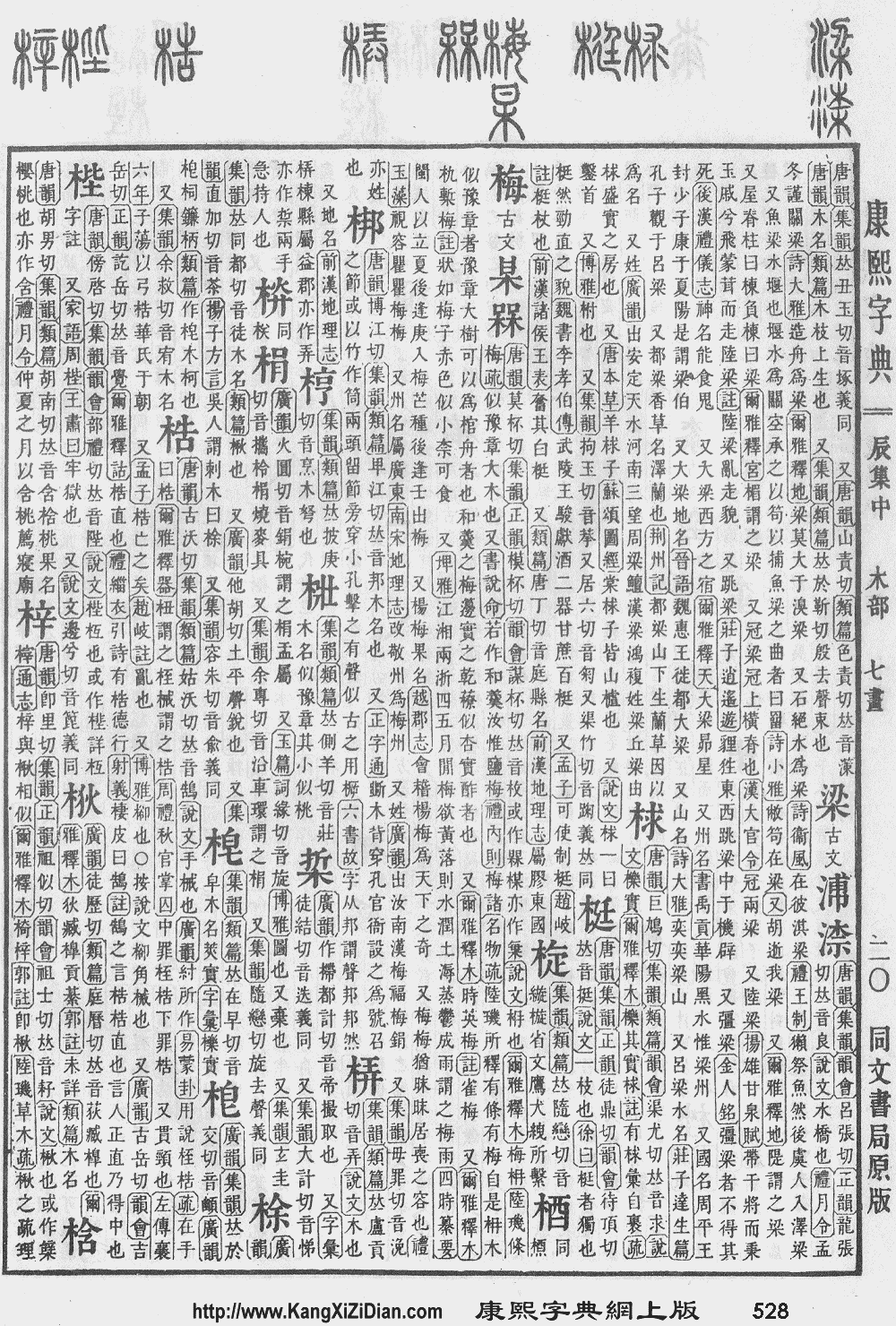
梁

See also: 粱 and 樑
梁 U+6881, 梁
CJK UNIFIED IDEOGRAPH-6881
← 梀
[U+6880]
CJK Unified Ideographs 梂 →
[U+6882]
梁 U+F97A, 梁
CJK COMPATIBILITY IDEOGRAPH-F97A
← 凉
[U+F979]
CJK Compatibility Ideographs 糧 →
[U+F97B]

Translingual

Traditional 梁
Simplified 梁
Japanese 梁
Korean 梁

Han character

梁 (Kangxi radical 75, 木+7, 11 strokes, cangjie input 水金木 (ECD) or 水戈木 (EID), four-corner 33904, composition ⿱⿰氵刅ホ)

Derived characters

References

Chinese

trad. 梁
simp. # 梁
alternative forms 鿄
𣸑
渿
𣹷

Glyph origin

Historical forms of the character 梁
Western Zhou Warring States Shuowen Jiezi (compiled in Han) Liushutong (compiled in Ming)
Bronze inscriptions Chu slip and silk script Small seal script Transcribed ancient scripts

Phono-semantic compound (形聲, OC *raŋ) : semantic 水 (“water”) + phonetic 刅 (OC *sʰraŋ) + semantic 木 (“wood”) — a bridge.

Etymology

(This etymology is missing or incomplete. Please add to it, or discuss it at the Etymology scriptorium. Particularly: “Are the noun senses related to the proper noun senses?”)

Pronunciation


Note:
  • niû/niô͘ - vernacular (incl. surname);
  • liông/liâng - literary.
    • (Teochew)
      • Peng'im: nion5 / niên5 / liang5
      • Pe̍h-ōe-jī-like: niôⁿ / niêⁿ / liâng
      • Sinological IPA (key): /nĩõ⁵⁵/, /nĩẽ⁵⁵/, /liaŋ⁵⁵/
Note:
  • nion5, niên5 - vernacular, incl. surname (niên5 - Chaozhou);
  • liang5 - literary.

Rime
Character 梁
Reading # 1/1
Initial (聲) 來 (37)
Final (韻) 陽 (105)
Tone (調) Level (Ø)
Openness (開合) Open
Division (等) III
Fanqie 呂章切
Reconstructions
Zhengzhang
Shangfang
/lɨɐŋ/
Pan
Wuyun
/liɐŋ/
Shao
Rongfen
/liɑŋ/
Edwin
Pulleyblank
/lɨaŋ/
Li
Rong
/liaŋ/
Wang
Li
/lĭaŋ/
Bernard
Karlgren
/li̯aŋ/
Expected
Mandarin
Reflex
liáng
Expected
Cantonese
Reflex
loeng4
Baxter–Sagart system 1.1 (2014)
Character 梁
Reading # 1/1
Modern
Beijing
(Pinyin)
liáng
Middle
Chinese
‹ ljang ›
Old
Chinese
/*raŋ/
English beam; bridge

Notes for Old Chinese notations in the Baxter–Sagart system:

* Parentheses "()" indicate uncertain presence;
* Square brackets "[]" indicate uncertain identity, e.g. *[t] as coda may in fact be *-t or *-p;
* Angle brackets "<>" indicate infix;
* Hyphen "-" indicates morpheme boundary;

* Period "." indicates syllable boundary.
Zhengzhang system (2003)
Character 梁
Reading # 1/1
No. 1648
Phonetic
component
刅
Rime
group
陽
Rime
subdivision
0
Corresponding
MC rime
良
Old
Chinese
/*raŋ/

Definitions

梁

  1. Alternative form of 樑 (“bridge; roof beam; ridge”);also the simplified form.
  2. (historical) state of Liang
    1. An ancient Chinese state during the Spring and Autumn period
    2. An ancient Chinese state of Wei after moving its capital to Daliang
    3. An ancient Chinese state during the Han dynasty
    4. An ancient Chinese state during the Jin (晉/晋 (jìn)) dynasty
    5. One of two ancient Chinese states during the end of the Sui dynasty
  3. (historical) Liang dynasty
    1. Southern Liang, one of the Southern Dynasties
    2. Later Liang of the Five Dynasties
  4. a surname
    梁山伯  ―  Liáng Shānbó  ―  Liang Shanbo (in the legend of Butterfly Lovers)
    梁啟超/梁启超  ―  Liáng Qǐchāo  ―  Liang Qichao (Chinese intellectual and politician who lived during the late Qing dynasty and the early Republic of China)

Synonyms

See also

Dynasties (朝代) in Chinese history
NameTime periodDivisions
Xia
夏 (~朝, ~代)
2070 – 1600 BCE
Shang
商 (~朝, ~代)
殷 (~朝, ~代)
1600 – 1046 BCE
Zhou
周 (~朝, ~代)
1046 – 256 BCEWestern Zhou
西周
Eastern Zhou
東周/东周
Spring and Autumn period
春秋
Warring States period
戰國/战国
Qin
秦 (~朝, ~代)
221 – 206 BCE
Han
漢/汉 (~朝, ~代)
206 BCE – 220 C.E.Western Han
西漢/西汉
Xin
新 (~朝)
Eastern Han
東漢/东汉
Three Kingdoms
三國/三国
220 – 280 C.E.Wei
魏
Shu Han
蜀漢/蜀汉
Wu
吳/吴
Jin
晉/晋 (~朝, ~代)
265 – 420 C.E.Western Jin
西晉/西晋
Eastern Jin
東晉/东晋
Southern and Northern dynasties
南北朝
420 – 589 C.E.Northern dynasties
北朝
Northern Wei
北魏
Western Wei
西魏
Eastern Wei
東魏/东魏
Northern Zhou
北周
Northern Qi
北齊/北齐
Southern dynasties
南朝
Liu Song
劉宋/刘宋
Southern Qi
南齊/南齐
Liang
梁 (~朝, ~代)
Chen
陳/陈 (~朝, ~代)
Sui
隋 (~朝, ~代)
581 – 618 C.E.
Tang
唐 (~朝, ~代)
618 – 907 C.E.
Five Dynasties and Ten Kingdoms
五代十國/五代十国
907 – 960 C.E.
Liao
遼/辽 (~朝, ~代)
907 – 1125 C.E.
Song
宋 (~朝, ~代)
960 – 1279 C.E.Northern Song
北宋
Southern Song
南宋
Western Xia
西夏
1038 – 1227 C.E.
Jin
金 (~朝, ~代)
1115 – 1234 C.E.
Western Liao
西遼/西辽
1124 – 1218 C.E.
Yuan
元 (~朝, ~代)
1271 – 1368 C.E.
Ming
明 (~朝, ~代)
1368 – 1644 C.E.
Qing
清 (~朝, ~代)
1636 – 1912 C.E.

Descendants

Sino-Xenic (梁):
  • → Korean: 양(梁) (Yang)
  • → Vietnamese: Lương (梁)

Others:

Compounds

Japanese

Kanji

梁

(“Jinmeiyō” kanji used for names)

Readings

Noun

梁(はり) • (hari) 

  1. beam, joist

梁(やな) • (yana) 

  1. fish trap, fish weir

Korean

Etymology

From Middle Chinese 梁 (MC lɨɐŋ). Recorded as Middle Korean 랴ᇰ (lyang) (Yale: lyang) in Hunmong Jahoe (訓蒙字會 / 훈몽자회), 1527.

Hanja

Wikisource 梁 (eumhun 들보 량 (deulbo ryang), South Korea 들보 양 (deulbo yang))

  1. Hanja form? of 량/양 (“beam; bridge”).

Compounds

References

  • 국제퇴계학회 대구경북지부 (國際退溪學會 大邱慶北支部) (2007). Digital Hanja Dictionary, 전자사전/電子字典.

Vietnamese

Han character

梁: Hán Nôm readings: lương

  1. chữ Hán form of Lương (“a surname from Chinese.”).
This article is issued from Wiktionary. The text is licensed under Creative Commons - Attribution - Sharealike. Additional terms may apply for the media files.