畫

See also: 画, 劃, 划, 晝, and 書
畫 U+756B, 畫
CJK UNIFIED IDEOGRAPH-756B
← 番
[U+756A]
CJK Unified Ideographs 畬 →
[U+756C]

Translingual

Traditional 畫
Simplified 画
Japanese 画
Korean 畵

Han character

畫 (Kangxi radical 102, 田+7, 12 strokes, cangjie input 中土田一 (LGWM), four-corner 50106, composition ⿳⿱𦘒一田一)

Derived terms

References

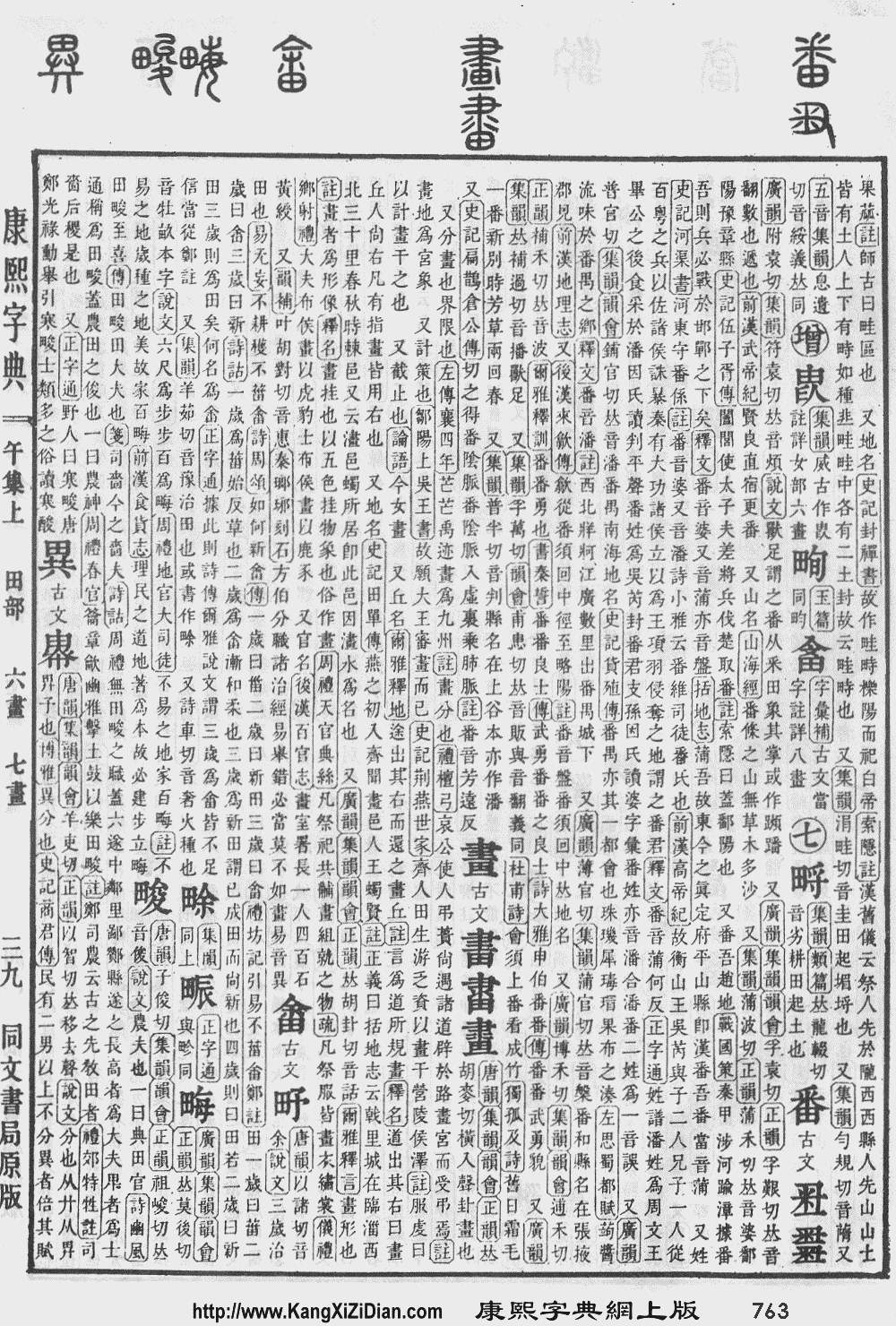
  • KangXi: page 763, character 8
  • Dai Kanwa Jiten: character 21859
  • Dae Jaweon: page 1172, character 18
  • Hanyu Da Zidian (first edition): volume 4, page 2544, character 2
  • Unihan data for U+756B

Chinese

trad. 畫
simp. 画
alternative forms
 
畵
𠚇
𡇍
𤰱
𨽶
畵
𠚇
𡇍
𤰱
𨽶
𤲯
𤲿
𦘕
𦘚
𤱪

Glyph origin

Historical forms of the character 畫
Shang Western Zhou Shuowen Jiezi (compiled in Han) Liushutong (compiled in Ming)
Oracle bone script Bronze inscriptions Small seal script Transcribed ancient scripts

Ideogrammic compound (會意) : 聿 (“pen brush”) + 画 (“a field (田) enclosed on four sides”). Meaning of "field boundaries recorded with a brush".

Pronunciation 1


Note:
  • vak5 - verb;
  • vak5-4 - noun.
Note:
  • fa - literary;
  • va̍k - vernacular.
Note:
  • uăh - vernacular;
  • uâ - literary;
  • hĕk - when sense is covered by 劃 (“to divide by a line; to devise; stroke”).
Note:
  • ūi/ōa/ōe/ǒe - vernacular;
  • hōa - literary (rare).
Note:
  • uê7 - literary ("to write / to draw / to paint");
  • uêh8 - vernacular ("to divide by a line / to devise / stroke").
  • Wu
    • (Shanghainese)
      • Wiktionary: 3hho; 3hhua
      • Sinological IPA (key): /ɦo²³/, /ɦɯa̱²³/
Note:
  • 3hho - vernacular;
  • 3hhua - literary.
  • Xiang
    • (Changsha)
      • Wiktionary: fa5 / fa4
      • Sinological IPA (key): /ɸa̠²¹/, /ɸa̠⁴⁵/
Note:
  • fa5 - vernacular;
  • fa4 - literary.

  • Dialectal data
Variety Location 畫
Mandarin Beijing /xua⁵¹/
Harbin /xua²⁴/ 筆~兒
/xua⁵³/ 年~兒
Tianjin /xuɑ⁵³/
Jinan /xua²¹/
Qingdao /xua⁴²/
Zhengzhou /xua³¹²/
Xi'an /xua⁴⁴/
Xining /xua²¹³/
Yinchuan /xua¹³/
Lanzhou /xua¹³/
Ürümqi /xua²¹³/
Wuhan /xua³⁵/
Chengdu /xua¹³/
Guiyang /xua²¹³/
Kunming /xua̠²¹²/
Nanjing /xuɑ⁴⁴/
Hefei /xua⁵³/
Jin Taiyuan /xua⁴⁵/
Pingyao /xuɑ³⁵/
Hohhot /xua⁵⁵/
Wu Shanghai /ɦo²³/
/ɦua²³/
Suzhou /ɦo³¹/
Hangzhou /ɦuɑ¹³/
Wenzhou /ɦo²²/
Hui Shexian /xua²²/
/ua²²/
Tunxi /xuːə¹¹/
Xiang Changsha /fa⁵⁵/
/fa¹¹/
Xiangtan /ɦuɒ²¹/
Gan Nanchang /fɑ²¹/
Hakka Meixian /fa⁵³/
Taoyuan /fɑ⁵⁵/
Cantonese Guangzhou /wa²²/ 動
/wa³⁵/ 名
Nanning /wa³³/
Hong Kong /wa²²/
Min Xiamen (Min Nan) /hua²²/
/ue²²/
/ui²²/
Fuzhou (Min Dong) /uɑ²⁴²/
Jian'ou (Min Bei) /ua⁴²/ 動
/xua⁴⁴/ 名
Shantou (Min Nan) /ue³¹/
Haikou (Min Nan) /ue²³/

Rime
Character 畫
Reading # 2/2
Initial (聲) 匣 (33)
Final (韻) 耕 (120)
Tone (調) Checked (Ø)
Openness (開合) Closed
Division (等) II
Fanqie 胡麥切
Reconstructions
Zhengzhang
Shangfang
/ɦˠwɛk̚/
Pan
Wuyun
/ɦʷᵚæk̚/
Shao
Rongfen
/ɣuɐk̚/
Edwin
Pulleyblank
/ɦwəɨjk̚/
Li
Rong
/ɣuɛk̚/
Wang
Li
/ɣwæk̚/
Bernard
Karlgren
/ɣwæk̚/
Expected
Mandarin
Reflex
huó
Expected
Cantonese
Reflex
wak6
Baxter–Sagart system 1.1 (2014)
Character 畫
Reading # 2/2
Modern
Beijing
(Pinyin)
huà
Middle
Chinese
‹ hwɛk ›
Old
Chinese
/*ɡʷˁrek/
English draw (v.)

Notes for Old Chinese notations in the Baxter–Sagart system:

* Parentheses "()" indicate uncertain presence;
* Square brackets "[]" indicate uncertain identity, e.g. *[t] as coda may in fact be *-t or *-p;
* Angle brackets "<>" indicate infix;
* Hyphen "-" indicates morpheme boundary;

* Period "." indicates syllable boundary.
Zhengzhang system (2003)
Character 畫
Reading # 2/2
No. 5335
Phonetic
component
畫
Rime
group
錫
Rime
subdivision
0
Corresponding
MC rime
獲
Old
Chinese
/*ɡʷreːɡ/

Definitions

畫

  1. to write; to draw; to paint
  2. to divide by a line
  3. Alternative form of 劃/划 (huá, “to devise”).
  4. stroke of Chinese character
Synonyms
  • (to draw): (literary, or in compounds) 繪/绘 (huì)

Pronunciation 2


Note: huàr - drawing.
Note: waa6 - chiefly in compounds.
Note: va5 - chiefly in compounds.
Note:
  • fa - literary;
  • va̍k - vernacular.
Note:
  • uăh - vernacular;
  • uâ - literary.
Note:
  • ūi/ōa/ōe/ǒe - vernacular;
  • hōa - literary (rare).

Rime
Character 畫
Reading # 1/2
Initial (聲) 匣 (33)
Final (韻) 佳 (32)
Tone (調) Departing (H)
Openness (開合) Closed
Division (等) II
Fanqie 胡卦切
Reconstructions
Zhengzhang
Shangfang
/ɦˠuɛH/
Pan
Wuyun
/ɦʷᵚæH/
Shao
Rongfen
/ɣuæiH/
Edwin
Pulleyblank
/ɦwaɨjH/
Li
Rong
/ɣuɛH/
Wang
Li
/ɣwaiH/
Bernard
Karlgren
/ɣwaiH/
Expected
Mandarin
Reflex
huà
Expected
Cantonese
Reflex
waai6
Baxter–Sagart system 1.1 (2014)
Character 畫
Reading # 1/2
Modern
Beijing
(Pinyin)
huà
Middle
Chinese
‹ hwɛH ›
Old
Chinese
/*C-ɡʷˁrek-s/
English drawing (n.)

Notes for Old Chinese notations in the Baxter–Sagart system:

* Parentheses "()" indicate uncertain presence;
* Square brackets "[]" indicate uncertain identity, e.g. *[t] as coda may in fact be *-t or *-p;
* Angle brackets "<>" indicate infix;
* Hyphen "-" indicates morpheme boundary;

* Period "." indicates syllable boundary.
Zhengzhang system (2003)
Character 畫
Reading # 1/2
No. 5330
Phonetic
component
畫
Rime
group
賜
Rime
subdivision
0
Corresponding
MC rime
畫
Old
Chinese
/*ɡʷreːɡs/

Definitions

畫

  1. drawing; painting; picture (Classifier: 幅 m c mn)
    畫幅畫/画幅画 [Cantonese]  ―  waak6 fuk1 waa6-2 [Jyutping]  ―  to draw a drawing
  2. decorated with paintings

Compounds

References

Japanese

Shinjitai

画

Kyūjitai

畫

Kanji

畫

(uncommon “Hyōgai” kanji, kyūjitai kanji, shinjitai form 画)

  1. Kyūjitai form of 画 (picture)

Readings

Definitions

For pronunciation and definitions of 畫 – see the following entry.
【画が】2
[noun] picture, drawing, painting
[noun] movie, film, video
[suffix] genre or style of painting
【画かく】2
[noun] delimiter, demarcation, stopping point
[noun] plan, strategy
[noun] stroke (the individual lines and dots that comprise a kanji character)
[noun] a line in the divinatory trigrams of the I Ching: "—" (陽) and "- -" (陰)
[counter] number of strokes in a kanji
Alternative spelling
劃
(This term, 畫, is an alternative spelling of the above terms.)

Korean

Alternative forms

Etymology 1

From Middle Chinese 畫 (MC ɦˠuɛH).

Historical Readings
Dongguk Jeongun Reading
Dongguk Jeongun, 1448ᅘᅫᆼ〮 (Yale: hhwáy)
Middle Korean
TextEumhun
Gloss (hun)Reading
Hunmong Jahoe, 1527그〮릴〮 (Yale: kúlíl)화〯 (Yale: hwǎ)

Pronunciation

  • (SK Standard/Seoul) IPA(key): [ɸwa̠(ː)]
  • Phonetic hangul: [화(ː)]
    • Though still prescribed in Standard Korean, most speakers in both Koreas no longer distinguish vowel length.

Hanja

Wikisource 畫 (eumhun 그림 화 (geurim hwa))

  1. Hanja form? of 화 (“picture; drawing; painting”).

Compounds

Etymology 2

From Middle Chinese 畫 (MC ɦˠwɛk̚).

Hanja

畫 (eumhun 그을 획 (geueul hoek))

  1. Alternative form of 劃 (“Hanja form? of 획 (“to draw a line; to mark”).”)

Compounds

References

  • 국제퇴계학회 대구경북지부 (國際退溪學會 大邱慶北支部) (2007). Digital Hanja Dictionary, 전자사전/電子字典.

Vietnamese

Han character

畫: Hán Nôm readings: họa/hoạ, hoạch, vạch, vệt, dạch, vệch

  1. This term needs a translation to English. Please help out and add a translation, then remove the text {{rfdef}}.
This article is issued from Wiktionary. The text is licensed under Creative Commons - Attribution - Sharealike. Additional terms may apply for the media files.