索
| ||||||||
| ||||||||
Translingual
Han character
索 (Kangxi radical 120, 糸+4, 10 strokes, cangjie input 十月女戈火 (JBVIF), four-corner 40903, composition ⿳十冖糸)
References
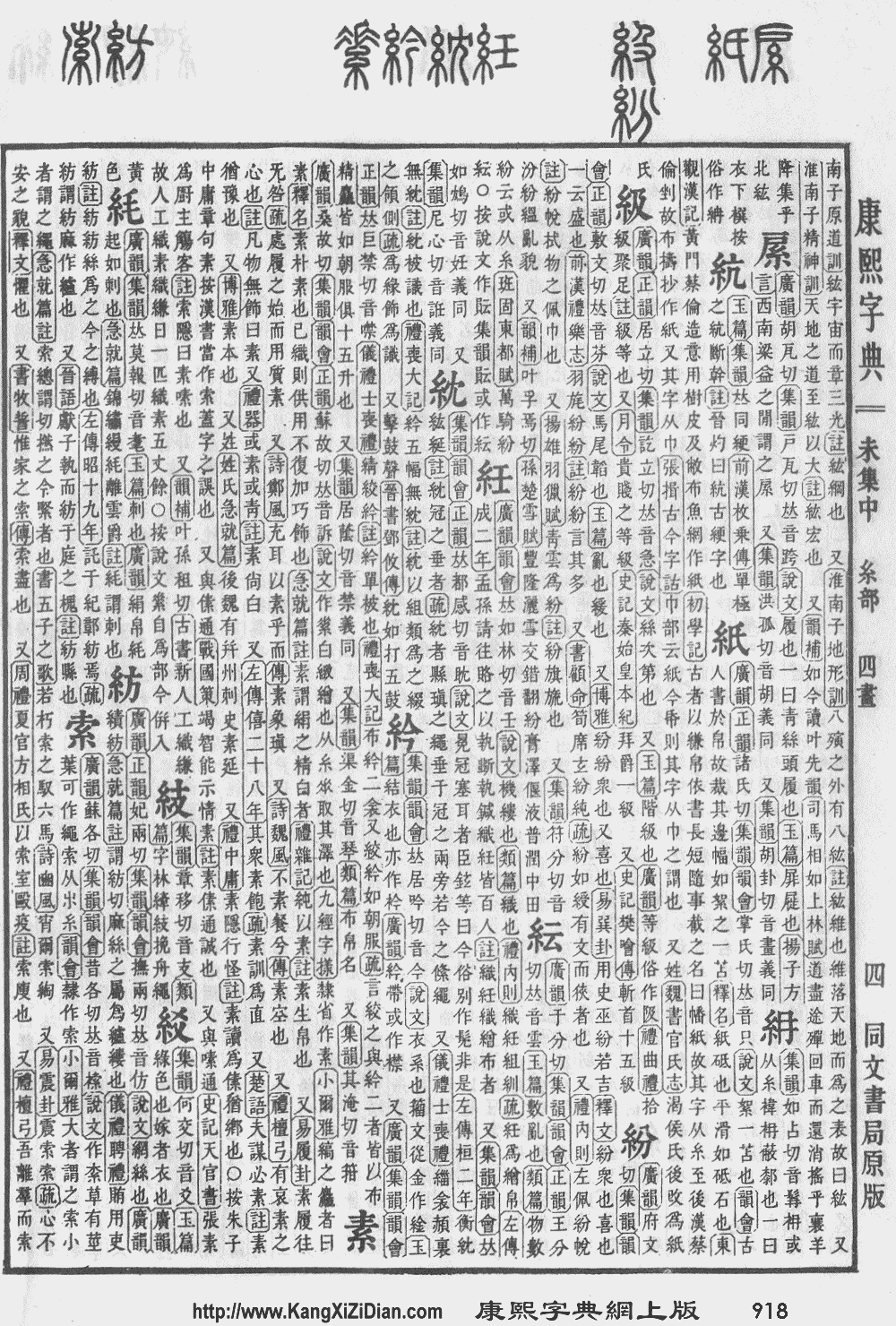
- KangXi: page 918, character 16
- Dai Kanwa Jiten: character 27306
- Dae Jaweon: page 1349, character 5
- Hanyu Da Zidian (first edition): volume 5, page 3369, character 9
- Unihan data for U+7D22
- Unihan data for U+F96A
Chinese
Glyph origin
Etymology 1
| simp. and trad. |
索 | |
|---|---|---|
From Austroasiatic; compare Proto-Vietic *ɟaːk (“rope”) (> Vietnamese chạc), Mon ဇုက် (“string; cord; rope; lashing; creeper”) (Schuessler, 2007).
Pronunciation
Synonyms
| Variety | Location | Words |
|---|---|---|
| Mandarin | Beijing | 條子 |
| Taiwan | 條子 | |
| Tianjin | 條子 | |
| Langfang | 條子 | |
| Tangshan | 條子 | |
| Cangzhou | 條子 | |
| Baoding | 條子 | |
| Shijiazhuang | 條子 | |
| Daming | 條子 | |
| Chifeng | 條兒 | |
| Hulunbuir (Hailar) | 條子 | |
| Harbin | 條子, 條 | |
| Shenyang | 條子, 索子 | |
| Qingdao | 條子 | |
| Jinan | 條子 | |
| Zhengzhou | 條 | |
| Xi'an | 條, 索 | |
| Yinchuan | 條子 | |
| Lanzhou | 條子, 索子 | |
| Xining | 條子 | |
| Ürümqi | 條子 | |
| Huanggang | 條子, 索子 | |
| Chengdu | 條子 | |
| Chongqing | 條子, 索子 | |
| Guiyang | 條子 | |
| Kunming | 條子, 索子 | |
| Guilin | 索子 | |
| Liuzhou | 條子 | |
| Xuzhou | 條 | |
| Yangzhou | 條子 | |
| Nanjing | 條子 | |
| Hefei | 條子 | |
| Nantong | 條 | |
| Singapore | 索子 | |
| Cantonese | Hong Kong | 索子 |
| Gan | Nanchang | 索子, 條子 |
| Lichuan | 索子 | |
| Huizhou | Shexian | 條, 索 |
| Jin | Taiyuan | 條子, 棍子 |
| Xinzhou | 棍子 | |
| Linhe | 條子 | |
| Jining | 條子 | |
| Hohhot | 條子, 棍子 | |
| Zhangjiakou | 條子 | |
| Handan | 條, 條子 | |
| Wu | Shanghai | 索 |
Etymology 2
| simp. and trad. |
索 | |
|---|---|---|
| alternative forms | 𡩡 | |
Ultimately Austroasiatic; compare Khmer ស (sɑɑ, “white; to show something clearly”); cognate with 素 (OC *saːs, “colourless; plain”) (Schuessler, 2007).
Pronunciation
Definitions
索
Etymology 3
| simp. and trad. |
索 | |
|---|---|---|
(This etymology is missing or incomplete. Please add to it, or discuss it at the Etymology scriptorium.)
Pronunciation
Pronunciation
Etymology 5
| simp. and trad. |
索 | |
|---|---|---|
(This etymology is missing or incomplete. Please add to it, or discuss it at the Etymology scriptorium. Particularly: “From 嗍, 欶?”)
Pronunciation
Compounds
|
|
|
References
- “Entry #6503”, in 臺灣閩南語常用詞辭典 [Dictionary of Frequently-Used Taiwan Minnan] (in Chinese and Min Nan), Ministry of Education, R.O.C., 2011.
Japanese
Readings
Korean
Etymology 1
From Middle Chinese 索 (MC ʃˠiæk̚, ʃˠɛk̚). Recorded as Middle Korean ᄉᆡᆨ〮 (Yale: sóyk) in Dongguk Jeongun (東國正韻 / 동국정운), 1448.
Pronunciation
- (SK Standard/Seoul) IPA(key): [sʰɛk̚] ~ [sʰe̞k̚]
- Phonetic hangul: [색/섹]
Compounds
Etymology 2
From Middle Chinese 索 (MC sɑk̚). Recorded as Middle Korean 삭〮 (sák) (Yale: sák) in Hunmong Jahoe (訓蒙字會 / 훈몽자회), 1527.
Pronunciation
- (SK Standard/Seoul) IPA(key): [sʰa̠k̚]
- Phonetic hangul: [삭]