絲

See also: 丝, 糸, and 𢇁
絲 U+7D72, 絲
CJK UNIFIED IDEOGRAPH-7D72
← 統
[U+7D71]
CJK Unified Ideographs 絳 →
[U+7D73]

Translingual

Traditional 絲
Shinjitai 糸
Simplified 丝

Han character

絲 (Kangxi radical 120, 糸+6, 12 strokes, cangjie input 女火女戈火 (VFVIF), four-corner 22993, composition ⿰糹糸)

Derived characters

See also

  • Chinese Numeral 絲

References

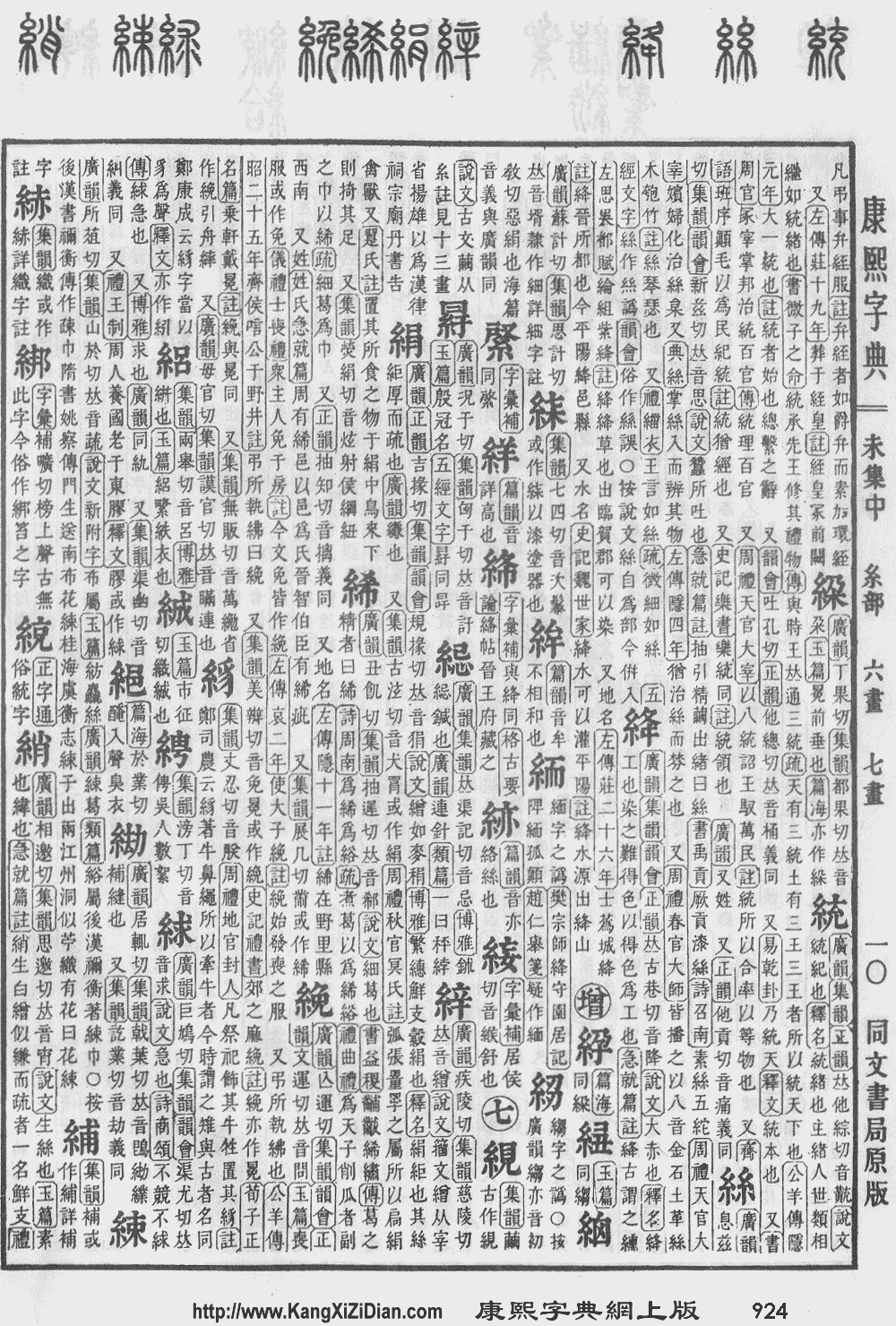
  • KangXi: page 924, character 3
  • Dai Kanwa Jiten: character 27448
  • Dae Jaweon: page 1359, character 1
  • Hanyu Da Zidian (first edition): volume 5, page 3401, character 1
  • Unihan data for U+7D72

Chinese

trad. 絲
simp. 丝
alternative forms 𢇁
𢇃
糸

Glyph origin

Ideogrammic compound (會意) : 糸 + 糸.

Etymology

(This etymology is missing or incomplete. Please add to it, or discuss it at the Etymology scriptorium.)

Pronunciation


Rime
Character 絲
Reading # 1/1
Initial (聲) 心 (16)
Final (韻) 之 (19)
Tone (調) Level (Ø)
Openness (開合) Open
Division (等) III
Fanqie 息兹切
Baxter si
Reconstructions
Zhengzhang
Shangfang
/sɨ/
Pan
Wuyun
/sɨ/
Shao
Rongfen
/sie/
Edwin
Pulleyblank
/sɨ/
Li
Rong
/siə/
Wang
Li
/sĭə/
Bernard
Karlgren
/si/
Expected
Mandarin
Reflex
sī
Expected
Cantonese
Reflex
si1
Baxter–Sagart system 1.1 (2014)
Character 絲
Reading # 1/1
Modern
Beijing
(Pinyin)
sī
Middle
Chinese
‹ si ›
Old
Chinese
/*[s]ə/
English silk

Notes for Old Chinese notations in the Baxter–Sagart system:

* Parentheses "()" indicate uncertain presence;
* Square brackets "[]" indicate uncertain identity, e.g. *[t] as coda may in fact be *-t or *-p;
* Angle brackets "<>" indicate infix;
* Hyphen "-" indicates morpheme boundary;

* Period "." indicates syllable boundary.
Zhengzhang system (2003)
Character 絲
Reading # 1/1
No. 12003
Phonetic
component
絲
Rime
group
之
Rime
subdivision
0
Corresponding
MC rime
思
Old
Chinese
/*slɯ/

Definitions

絲

  1. silk
  2. items made from woven silk
  3. silk-like object; fine thread; thin strip; thin shred
  4. (music) string instrument
    絲竹/丝竹  ―  sīzhú  ―  string and wind instruments; music
  5. Classifier for extremely small quantities.
    一絲希望/一丝希望  ―  yī sī xīwàng  ―  a glimmer of hope
    一絲風都沒有/一丝风都没有  ―  yī sī fēng dōu méiyǒu  ―  There is not even a breath of wind.
  6. (Buddhism, obsolete) the number 10–4

Compounds

Descendants

  • → Ancient Greek: Σήρ (Sḗr, “Chinese; silkworm”)
    • → Latin: Sēres
    (see sēricus for descendants of this)
  • → Aramaic:
    • Classical Syriac: ܫܺܐܪܳܐ‎ (šērā), ܫܺܐܪܳܝܳܐ‎ (šērāyā), ܫܻܝܪܳܝܳܐ‎ (šērāyā, “silk; silk garment”)
    • Jewish Babylonian Aramaic: שִׁירָאָה‎ (šērāʾā), שִּׁירָא‎ (šērā, “silk; silk garment”)
    • Mandaic: ࡔࡉ࡚ࡓࡀࡉࡀ‎ (/šērāyā/)
    • → Arabic: سِيرَاء‎ (sīrāʔ, “a kind of silk garment”)
    • → Ge'ez: ሢራይ, ሥራይ, ሤራይ (śiray, śəray, śeray, “silk; silk garment”)
  • →? Old Korean: 糸利 (*SIli, “thread”)
    • Middle Korean: 실〯 (sǐl, “id.”)
      • Korean: 실 (sil, “id.”)

Japanese

Shinjitai

糸

Kyūjitai

絲

Kanji

絲

(uncommon “Hyōgai” kanji, kyūjitai kanji, shinjitai form 糸)

  1. Kyūjitai form of 糸: thread

Readings

  • Go-on: し (shi)
  • Kan-on: し (shi)
  • Kun: いと (ito, 絲)

Compounds

Etymology 1

Kanji in this term
絲
いと
Hyōgaiji
kun’yomi
For pronunciation and definitions of 絲 – see the following entry.
【糸いと】1
[noun] thread
(This term, 絲, is an alternative spelling of the above term.)

Proper noun

絲(いと) • (Ito) 

  1. a female given name
  2. a surname

Korean

Hanja

絲 • (sa) (hangeul 사)

  1. (명주): silk
  2. (실): thread

See also

Vietnamese

Han character

絲: Hán Nôm readings: tơ, tưa, ty, ti

  1. This term needs a translation to English. Please help out and add a translation, then remove the text {{rfdef}}.
This article is issued from Wiktionary. The text is licensed under Creative Commons - Attribution - Sharealike. Additional terms may apply for the media files.