育
See also: 毓
| ||||||||
| ||||||||
Translingual
| Stroke order | |||
|---|---|---|---|
 | |||
Alternative forms
- In Taiwan, the upper component of the character contains ⿻一厶 (3 strokes) while in other regions, the upper component contains ⿱亠厶 (4 strokes).
- In Taiwan, the bottom component of the character contains ⺼ (meat radical) while in other regions, the bottom component contains ⺝ (similar to 月 but with a vertical left stroke).
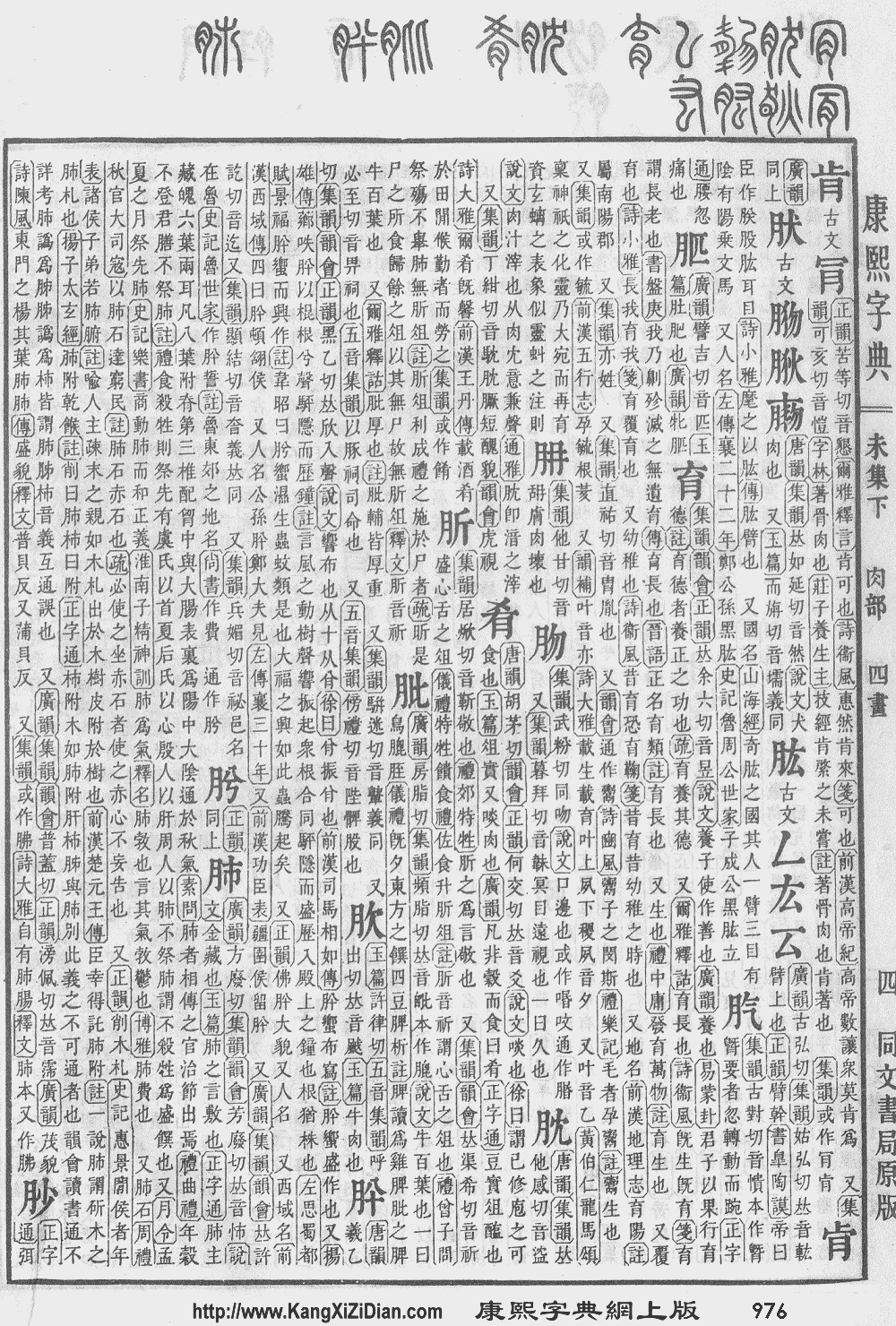
- The historical Kangxi dictionary records two character forms, ⿳亠厶⺝ (8 strokes) and ⿱⿻一厶⺝ (7 strokes). The alternative form with 7 strokes (page 974, character 10) is based on Zhengzitong which claims that it is the original form (本字 (běnzì)).
- A CJK compatibility ideograph exists at
U+2F982for the alternative Taiwan form which contains ⿱亠厶 (4 strokes) as the upper component and ⺼ as the bottom component.
Han character
育 (Kangxi radical 130, 肉+3 in traditional Chinese (Taiwan), 肉+4 in Chinese (mainland China, Hong Kong), Japanese and Korean, 7 strokes in traditional Chinese (Taiwan), 8 strokes in mainland China and Japanese and Korean, cangjie input 卜戈月 (YIB) or 大戈月 (KIB), four-corner 00227, composition ⿳亠厶⺝(GHJKV) or ⿱⿻一厶⺼(T) or ⿳亠厶⺼(U+2F982))
Derived characters
References
- KangXi: page 976, character 14
- Dai Kanwa Jiten: character 29318
- Dae Jaweon: page 1427, character 27
- Hanyu Da Zidian (first edition): volume 3, page 2052, character 5
- Unihan data for U+80B2
- Unihan data for U+2F982
Chinese
| trad. | 育 | |
|---|---|---|
| simp. # | 育 | |
| alternative forms | 毓 𣫺 袬 𠫓 | |
Glyph origin
| Historical forms of the character 育 | |||
|---|---|---|---|
| Shang | Western Zhou | Shuowen Jiezi (compiled in Han) | Liushutong (compiled in Ming) |
| Oracle bone script | Bronze inscriptions | Small seal script | Transcribed ancient scripts |
 |
 |
 |
 |
Characters in the same phonetic series (育) (Zhengzhang, 2003)
A later alternative form of 毓 (yù). Phono-semantic compound (形聲, OC *luɡ) : semantic 𠫓 (“upside-down baby, being born”) + phonetic 肉 (OC *njuɡ).
See 毓 (yù) for the earlier glyph.
Pronunciation 1
Compounds
Derived terms from 育
|
|
|
Pronunciation 2
Pronunciation 3
References
- “育”, in 漢語多功能字庫 (Multi-function Chinese Character Database), 香港中文大學 (the Chinese University of Hong Kong), 2014–
Vietnamese
This article is issued from Wiktionary. The text is licensed under Creative Commons - Attribution - Sharealike. Additional terms may apply for the media files.