謝

See also: 谢
謝 U+8B1D, 謝
CJK UNIFIED IDEOGRAPH-8B1D
← 謜
[U+8B1C]
CJK Unified Ideographs 謞 →
[U+8B1E]

Translingual

Han character

謝 (Kangxi radical 149, 言+10, 17 strokes, cangjie input 卜口竹竹戈 (YRHHI), four-corner 04600, composition ⿰訁射)

Derived characters

  • 𫌗

References

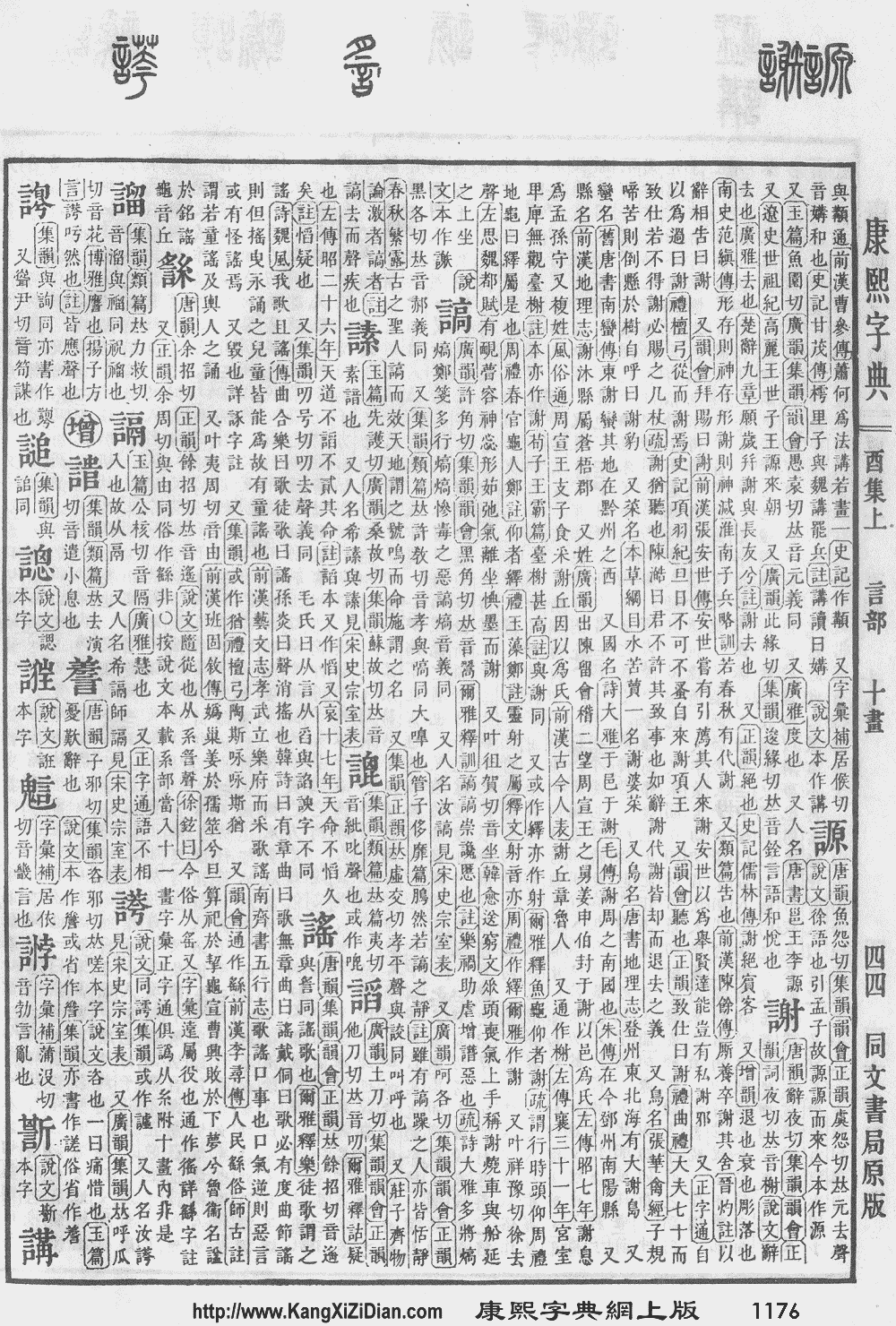
  • KangXi: page 1176, character 2
  • Dai Kanwa Jiten: character 35827
  • Dae Jaweon: page 1640, character 5
  • Hanyu Da Zidian (first edition): volume 6, page 4005, character 21
  • Unihan data for U+8B1D

Chinese

trad. 謝
simp. 谢

Glyph origin

Phono-semantic compound (形聲, OC *ljaːɡs) : semantic 言 (“word; speech”) + phonetic 射 (OC *ɢljaːɡs, *laːɡs, *ɢljaːɡ, *laːɡ).

Pronunciation


Note:
  • Zhangzhou, southern Taiwan:
    • siā - literary (all other senses);
    • chiā - vernacular (surname).
  • Sanxia:
    • siā - literary (all senses, including surname);
    • chiā - vernacular (also used for surname).
Note:
  • sia7 - literary (all other senses);
  • zia7 - vernacular (surname).

  • Dialectal data
Variety Location 謝
Mandarin Beijing /ɕiɛ⁵¹/
Harbin /ɕiɛ⁵³/
Tianjin /ɕie⁵³/
Jinan /ɕiə²¹/
Qingdao /siə²¹³/
Zhengzhou /siɛ³¹²/
Xi'an /ɕiɛ⁴⁴/
Xining /ɕi²¹³/
Yinchuan /ɕie¹³/
Lanzhou /ɕiə¹³/
Ürümqi /ɕiɤ²¹³/
Wuhan /ɕie³⁵/
Chengdu /ɕie¹³/
Guiyang /ɕie²¹³/
Kunming /ɕiɛ²¹²/
Nanjing /sie⁴⁴/
Hefei /ɕi⁵³/
/se⁵³/
Jin Taiyuan /ɕie⁴⁵/
Pingyao /ɕie̞³⁵/
Hohhot /ɕie⁵⁵/
Wu Shanghai /ʑia²³/
Suzhou /ziɑ³¹/
Hangzhou /d͡ʑi¹³/
Wenzhou /zei²²/
Hui Shexian /t͡sʰe²²/
Tunxi /t͡sʰiɛ¹¹/
Xiang Changsha /sie⁵⁵/
/t͡sia¹¹/
Xiangtan /d͡ziɒ²¹/
Gan Nanchang /ɕiɑ²¹/
/t͡ɕʰiɑ²¹/ 地名
Hakka Meixian /t͡sʰia⁵³/
Taoyuan /t͡sʰiɑ⁵⁵/
Cantonese Guangzhou /t͡sɛ²²/
Nanning /t͡sɛ²²/
Hong Kong /t͡sɛ²²/
Min Xiamen (Min Nan) /sia²²/
/t͡sia²²/
Fuzhou (Min Dong) /siɑ²⁴²/
Jian'ou (Min Bei) /t͡sia⁴⁴/ 名
/sia⁴⁴/ 動
Shantou (Min Nan) /sia³¹/
/t͡sia³¹/
Haikou (Min Nan) /tia³³/
/tiak̚³/ 俗

Rime
Character 謝
Reading # 1/1
Initial (聲) 邪 (17)
Final (韻) 麻 (100)
Tone (調) Departing (H)
Openness (開合) Open
Division (等) III
Fanqie 辝夜切
Baxter zjaeH
Reconstructions
Zhengzhang
Shangfang
/ziaH/
Pan
Wuyun
/ziaH/
Shao
Rongfen
/ziaH/
Edwin
Pulleyblank
/ziaH/
Li
Rong
/ziaH/
Wang
Li
/zĭaH/
Bernard
Karlgren
/zi̯aH/
Expected
Mandarin
Reflex
xiè
Expected
Cantonese
Reflex
ze6
Baxter–Sagart system 1.1 (2014)
Character 謝
Reading # 1/1
Modern
Beijing
(Pinyin)
xiè
Middle
Chinese
‹ zjaeH ›
Old
Chinese
/*sə-lAk-s/
English decline, renounce

Notes for Old Chinese notations in the Baxter–Sagart system:

* Parentheses "()" indicate uncertain presence;
* Square brackets "[]" indicate uncertain identity, e.g. *[t] as coda may in fact be *-t or *-p;
* Angle brackets "<>" indicate infix;
* Hyphen "-" indicates morpheme boundary;

* Period "." indicates syllable boundary.
Zhengzhang system (2003)
Character 謝
Reading # 1/1
No. 11221
Phonetic
component
射
Rime
group
暮
Rime
subdivision
0
Corresponding
MC rime
謝
Old
Chinese
/*ljaːɡs/

Definitions

謝

  1. to excuse oneself; to make an apology; to apologise
    謝罪/谢罪  ―  xièzuì  ―  to apologize
  2. to decline; to renounce; to refuse
    謝絕/谢绝  ―  xièjué  ―  to decline
    閉門謝客/闭门谢客  ―  bìménxièkè  ―  to close one’s door to visitors
  3. to modestly decline
  4. to resign; to stand down
  5. to take leave; to leave; to say goodbye
    謝世/谢世  ―  xièshì  ―  to pass away (literally, “to leave the world”)
  6. to tell; to warn
  7. to send one's regards to
  8. to thank; to express gratitude to
    感謝/感谢  ―  gǎnxiè  ―  to thank
    謝天謝地/谢天谢地  ―  xiètiānxièdì  ―  thank goodness (literally, “to thank heaven and earth”)
  9. thanks; gratitude; gratefulness
  10. thank you; thanks
  11. thanks; thank you
    謝謝!/谢谢!  ―  Xièxie!  ―  Thank you!
    多謝救命之恩。/多谢救命之恩。  ―  Duōxiè jiùmìngzhī'ēn.  ―  Thank you for saving my life.
  12. to thank with a gift; to recompense
  13. to decline; to wane; to wither
    花謝了。/花谢了。  ―  Huā xiè le.  ―  The flowers have withered.
  14. to avoid; to avert
  15. to pass away; to depart this life
  16. (historical) region of ancient China in present-day Henan
  17. a surname
    謝長廷/谢长廷  ―  Xiè Chángtíng  ―  Frank Hsieh (ROC (Taiwan) Representative to Japan)

Descendants

  • → English: Hsieh, Xie, Tse, Chia, Seah

Compounds

Japanese

Kanji

謝

(grade 5 “Kyōiku” kanji)

  1. apologize
  2. thank
  3. refuse

Readings

Korean

Hanja

謝 (eumhun 사례할 사 (saryehal sa))

  1. Hanja form? of 사 (“apologize”).

Vietnamese

Han character

謝: Hán Nôm readings: tạ

  1. This term needs a translation to English. Please help out and add a translation, then remove the text {{rfdef}}.
This article is issued from Wiktionary. The text is licensed under Creative Commons - Attribution - Sharealike. Additional terms may apply for the media files.