花
| ||||||||
| ||||||||
Translingual
| Stroke order | |||
Simplified Chinese | |||
Han character
花 (Kangxi radical 140, 艸+4, 8 strokes in traditional Chinese and Korean, 7 strokes in simplified Chinese and Japanese, cangjie input 廿人心 (TOP), four-corner 44214, composition ⿱艹化)
References
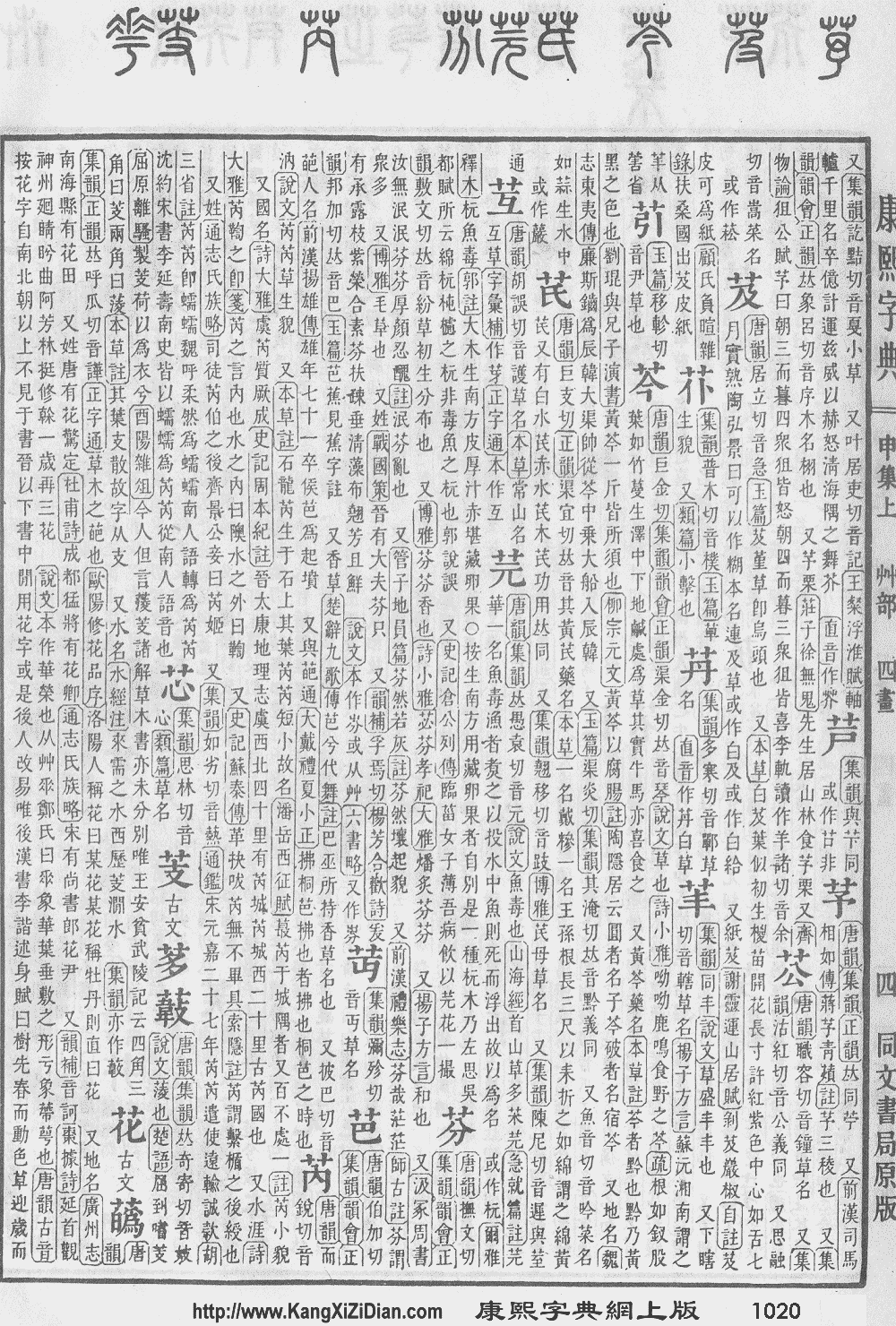
- KangXi: page 1020, character 21
- Dai Kanwa Jiten: character 30734
- Dae Jaweon: page 1478, character 5
- Hanyu Da Zidian (first edition): volume 5, page 3181, character 7
- Unihan data for U+82B1
- Unihan data for U+2F993
Chinese
| trad. | 花 | |
|---|---|---|
| simp. # | 花 | |
| alternative forms | 華/华 蘤/花 芲 𠌶 | |
Glyph origin
| Historical forms of the character 花 | ||
|---|---|---|
| Western Zhou | Shuowen Jiezi (compiled in Han) | Liushutong (compiled in Ming) |
| Bronze inscriptions | Small seal script | Transcribed ancient scripts |
 |
 |
 |
Characters in the same phonetic series (化) (Zhengzhang, 2003)
Phono-semantic compound (形聲, OC *hʷraː) : semantic 艹 (“grass; plant”) + phonetic 化 (OC *hŋʷraːls). Originally 𠌶 or 華 before the Han dynasty.
Etymology
Unclear. According to Schuessler (2007), either from:
- Proto-Sino-Tibetan *baːr (“bloom, flower”) and thus an example of possible *b ~ *w variation, with final -r moved to medial position. If so, cognate with 葩 (OC *pʰraː); outside Sinitic, compare Burmese ပန်း (pan:), Lepcha [script needed] (búr), Mizo páar. Sagart (2021) also connects it to 葩 (OC *pʰˤra), modifying Baxter and Sagart's (2014) reconstruction to *Cə-pʰˤra and proposing the sound changes *Cə-pʰ- > *Cə-ɸ- > *ɸ- > xw-.
- Or from Austroasiatic; compare Proto-Mon-Khmer *pkaaw ~ *pkaʔ (“flower, blossom”).
華 (OC *ɡʷraː, “to flower”) is a derivative.
Pronunciation

Definitions
花
- flower; blossom (Classifier: 朵 m c; 支 m c; 蕊 h mn; 束 m c; 把 m; 盆 m c; 簇 m; 紮/扎 c)
- 花朵 ― huāduǒ ― flower
- florid; flowery
- 花花綠綠/花花绿绿 ― huāhualǜlǜ ― (please add an English translation of this example)
- pattern; design
- blurred
- 眼花 ― yǎnhuā ― to have blurred vision
- fireworks
- essence; cream
- wound
- Short for 天花 (tiānhuā, “smallpox”).
- courtesan; prostitute
- to spend (money, time, etc.); to cost
- profligate
- (slang) randy; lecherous
- (slang) to be horny; to womanize
- false
- (Cantonese) scratched
- (Cantonese, of images, drawings, patterns, etc.) over-colorful; chaotic; messy
- (Cantonese, card games) flush
- (Hong Kong) pip (insignia) (Classifier: 粒 c)
- 1991, Fight Back to School, spoken by Police Commisioner (Scissor Legs) (Barry Wong):
-
- (Xiamen and Zhangzhou Hokkien) to extinguish; to put out (of fire)
- (Quanzhou Hokkien) to disappear (of a scar)
- (Shanghainese Wu) cotton
- (Shanghainese Wu) to tease
- a surname. Hua
Synonyms
Dialectal synonyms of 花朵 (“flower”) [map]
Compounds
Derived terms from 花
|
|
|
Descendants
Others:
References
- “花”, in 漢語多功能字庫 (Multi-function Chinese Character Database), 香港中文大學 (the Chinese University of Hong Kong), 2014–
- “Entry #4442”, in 臺灣閩南語常用詞辭典 [Dictionary of Frequently-Used Taiwan Minnan] (in Chinese and Min Nan), Ministry of Education, R.O.C., 2011.
Japanese
Readings
Etymology 1
| Kanji in this term |
|---|
| 花 |
| はな Grade: 1 |
| kun’yomi |
| Alternative spelling |
|---|
| 華 |
/pana/ → /fana/ → /hana/
From Old Japanese.
Pronunciation
Noun
花 • (hana)
- a flower
- 1999 February 4, “火炎草 [Fire Grass]”, in Vol.1, Konami:
- 火山の近くに生息する草。花から火炎を吹き攻撃する。
- Kazan no chikaku ni seisoku suru kusa. Hana kara kaen o fuki kōgeki suru.
- A grass that grows near volcanoes. It breathes fire from its flowers.
- 火山の近くに生息する草。花から火炎を吹き攻撃する。
- 1999 March 1, “ダーク・プラント [Dark Plant]”, in BOOSTER 1, Konami:
- 汚染された土と闇の力で育てられた花。とても凶暴。
- Osen sareta tsuchi to yami no chikara de sodaterareta hana. Totemo kyōbō.
- A flower that grows from polluted soil and dark powers. It is very nasty.
- 汚染された土と闇の力で育てられた花。とても凶暴。
- 1999 May 25, “深淵に咲く花 [The Flower That Blooms in the Abyss]”, in BOOSTER 2, Konami:
- 光の届かない深淵にひっそりと咲く、あまり見かけない花。
- Hikari no todokanai shin'en ni hissori to saku, amari mikakenai hana.
- A rarely seen flower that silently blooms in the depths of the abyss where the sun never shines.
- 光の届かない深淵にひっそりと咲く、あまり見かけない花。
- 1999 July 5, “命ある花瓶 [Living Vase]”, in BOOSTER 3, Konami:
- 生けてある花から、花粉を飛ばし噛みついてくる生きている花瓶。
- Iketearu hana kara, kafun o tobashi kamitsuitekuru ikiteiru kabin.
- A living vase that bites and releases pollen from its living flowers.
- 生けてある花から、花粉を飛ばし噛みついてくる生きている花瓶。
- 花が咲く頃
- hana ga saku goro
- when the flowers bloom
-
- Short for 生け花 (ikebana): flower arrangement
- Short for 花札 (hanafuda): Japanese playing cards
- the best days of one's life
- the best thing
- essence
Compounds
はな
- 生け花 (ikebana), 生花 (ikebana, “Japanese flower arranging”)
- 花暦 (hanagoyomi, “flower calendar”)
- 花園 (hanazono, “flower garden”)
- 花束 (hanataba, “bouquet”)
- 花茶 (hanacha, “flower tea”)
- 花火 (hanabi, “fireworks”)
- 花びら (hanabira), 花弁 (hanabira, “flower petal”)
- 花見 (hanami, “flower viewing”)
- 花婿 (hanamuko, “bridegroom”)
- 花屋 (hanaya, “florist; flower shop”)
- 花嫁 (hanayome, “bride”)
- 花輪 (hanawa, “garland; wreath”)
- 火花 (hibana, “spark”, literally “fire flower”)
Etymology 2
| Kanji in this term |
|---|
| 花 |
| か Grade: 1 |
| on’yomi |
Compounds
か
- 花被 (kahi, “perianth”)
- 紫陽花 (ajisai)
- 無花果 (ichijiku, “fig (tree)”)
- 桜花 (ōka, “cherry blossom”)
- 女郎花 (ominaeshi)
- 開花 (kaika, “flowering; blooming”)
- 花期 (kaki, “flowering season”)
- 燕子花 (kakitsubata)
- 花壇 (kadan, “flowerbed”)
- 花瓶 (kabin, “vase”)
- 花粉 (kafun, “pollen”)
- 花弁 (kaben, “petal”)
- 花蜜 (kamitsu, “nectar”)
- 花梨 (karin, “Pseudocydonia sinensis, Chinese quince”)
- 花櫚 (karin, “Pterocarpus indicus, Burmese rosewood”)
- 花車 (kyasha, “dainty, delicate, fragile”, literally “flower car”)
- 鏡花水月 (kyōka suigetsu, “metaphor for something that can be seen but not touched”, literally “flower in a mirror, moon in the water”)
- 山茶花 (sazanka)
- 石楠花 (shakunage, “one of several species of rhododendron native to east Asia”)
- 桃花 (tōka, “peach blossom”)
- 浪花 (Naniwa, “old name for Osaka”)
- 凌霄花 (nōzenkazura, “Campsis grandiflora, Chinese trumpet vine”)
Kikai
Kanji
花
Readings
- Kun: ふぁな (fana, 花)
References
- “ふぁな【花】” in JLect - Japonic Languages and Dialects Database Dictionary, 2019.
Korean
Etymology
From Middle Chinese 花 (MC hˠua).
| Historical Readings | ||
|---|---|---|
| Dongguk Jeongun Reading | ||
| Dongguk Jeongun, 1448 | 황 (Yale: hwà) | |
| Middle Korean | ||
| Text | Eumhun | |
| Gloss (hun) | Reading | |
| Hunmong Jahoe, 1527 | 곳 (Yale: kwòs) | 화 (Yale: hwà) |
Pronunciation
- (SK Standard/Seoul) IPA(key): [ɸwa̠]
- Phonetic hangul: [화]
Compounds
Okinawan
Etymology 1
| Kanji in this term |
|---|
| 花 |
| はな Grade: 1 |
| kun’yomi |
Pronunciation
- IPA(key): /hana/
Etymology 2
| Kanji in this term |
|---|
| 花 |
| ふぁな Grade: 1 |
| kun’yomi |
References
- “ふぁな【花】” in JLect - Japonic Languages and Dialects Database Dictionary, 2019.
Vietnamese
Han character
花: Hán Việt readings: hoa (
花: Nôm readings: hoa[1][2][3][4], huê[1][3][4], oa[1], ba[2]
Compounds
- 炮花 (pháo hoa)
References
- Nguyễn (2014).
- Nguyễn et al. (2009).
- Trần (2004).
- Taberd & Pigneau de Béhaine (1838).
This article is issued from Wiktionary. The text is licensed under Creative Commons - Attribution - Sharealike. Additional terms may apply for the media files.