進
See also: 进
| ||||||||
Translingual
| Stroke order (Sans-serif) | |||
|---|---|---|---|
.gif) | |||
| Stroke order | |||
|---|---|---|---|
 | |||
Han character
進 (Kangxi radical 162, 辵+8, 12 strokes in Chinese, 11 strokes in Japanese, cangjie input 卜人土 (YOG), four-corner 30301, composition ⿺辶隹)
References
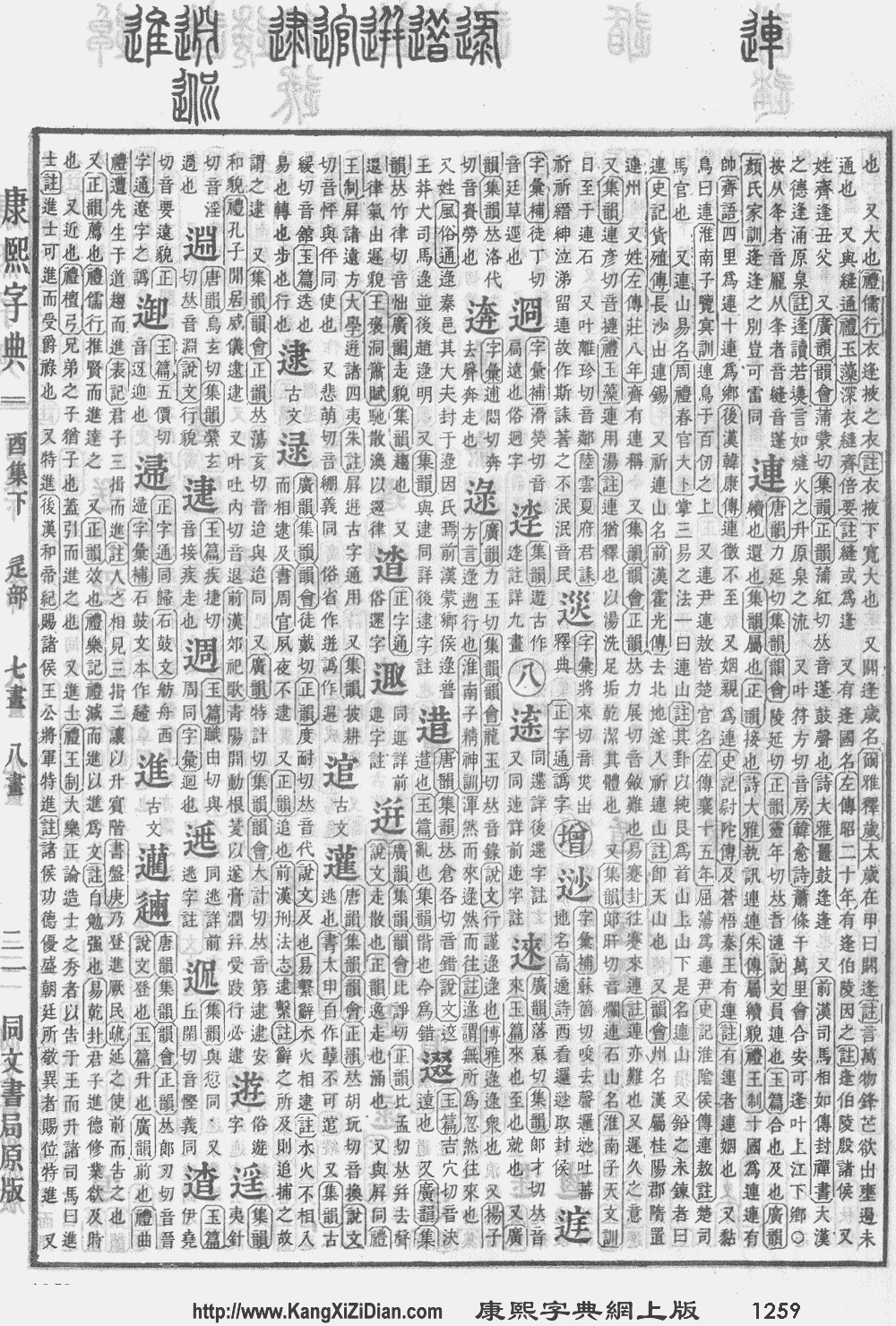
- KangXi: page 1259, character 30
- Dai Kanwa Jiten: character 38943
- Dae Jaweon: page 1749, character 11
- Hanyu Da Zidian (first edition): volume 6, page 3851, character 5
- Unihan data for U+9032
Chinese
| trad. | 進 | |
|---|---|---|
| simp. | 进 | |
Glyph origin
| Historical forms of the character 進 |
|---|
| Western Zhou |
| Bronze inscriptions |
 |
Characters in the same phonetic series (進) (Zhengzhang, 2003)
Ideogrammic compound (會意) : 辵 (“walk”) + 隹 (“short-tail bird”). A bird can only walk forward not backward, hence implying "forward". Shuowen Jiezi interprets it as Phono-semantic compound (形聲, OC *ʔslins) : semantic 辵 + abbreviated phonetic 閵 (OC *rins).
Etymology
Unknown (Schuessler, 2007).
Pronunciation
Definitions
進
- to advance; to move forward
- to enter; to go into; to come into
- (used after a verb) into; in
- to receive; to admit; to recruit
- to give; to offer (advice)
- to score (a goal)
- to eat; to drink
- Classifier for rows of houses within an old-style residential compound.
- 20th tetragram of the Taixuanjing; "advance" (𝌙)
Synonyms
- (to enter):
Dialectal synonyms of 進 (“to enter”) [map]
| Variety | Location | Words |
|---|---|---|
| Classical Chinese | 入 | |
| Formal (Written Standard Chinese) | 進 | |
| Mandarin | Beijing | 進 |
| Taiwan | 進 | |
| Jinan | 進 | |
| Luoyang | 進 | |
| Wanrong | 進 | |
| Xi'an | 進 | |
| Yinchuan | 進 | |
| Ürümqi | 進 | |
| Chengdu | 進 | |
| Guiyang | 進 | |
| Guilin | 進 | |
| Yangzhou | 進 | |
| Malaysia | 進 | |
| Singapore | 進 | |
| Cantonese | Guangzhou | 入 |
| Hong Kong | 入 | |
| Taishan | 入 | |
| Dongguan | 入 | |
| Kuala Lumpur (Guangfu) | 入 | |
| Singapore (Guangfu) | 入 | |
| Gan | Lichuan | 進 |
| Hakka | Meixian | 入 |
| Miaoli (N. Sixian) | 落, 入 | |
| Pingtung (Neipu; S. Sixian) | 入, 落 | |
| Hsinchu County (Zhudong; Hailu) | 落, 入 | |
| Taichung (Dongshi; Dabu) | 入, 落 | |
| Hsinchu County (Qionglin; Raoping) | 落, 入 | |
| Yunlin (Lunbei; Zhao'an) | 入 | |
| Huizhou | Jixi | 進 |
| Jin | Xinzhou | 進 |
| Min Bei | Jian'ou | 裡 |
| Min Dong | Fuzhou | 裡 |
| Matsu | 裡 | |
| Singapore (Fuqing) | 裡 | |
| Min Nan | Xiamen | 入 |
| Quanzhou | 入 | |
| Zhangzhou | 入 | |
| Zhao'an | 入 | |
| Tainan | 入 | |
| Penang (Hokkien) | 入 | |
| Singapore (Hokkien) | 入 | |
| Manila (Hokkien) | 入 | |
| Shantou | 入 | |
| Jieyang | 入 | |
| Singapore (Teochew) | 入 | |
| Leizhou | 入 | |
| Wenchang | 入 | |
| Haikou | 入 | |
| Singapore (Hainanese) | 入 | |
| Wu | Shanghai | 進 |
| Danyang | 進 | |
| Jinhua | 進 | |
Antonyms
- (to advance): 退 (tuì)
Compounds
Derived terms from 進
|
|
|
Japanese
| Shinjitai | 進 | |
| Kyūjitai [1] |
進󠄁 進+ 󠄁?(Adobe-Japan1) |
 |
| 進󠄃 進+ 󠄃?(Hanyo-Denshi) (Moji_Joho) | ||
| The displayed kanji may be different from the image due to your environment. See here for details. | ||
Readings
References
- “進”, in 漢字ぺディア (Kanjipedia) (in Japanese), 日本漢字能力検定協会, 2015—2023
Korean
Hanja
- This term needs a translation to English. Please help out and add a translation, then remove the text
{{rfdef}}.
Vietnamese
This article is issued from Wiktionary. The text is licensed under Creative Commons - Attribution - Sharealike. Additional terms may apply for the media files.