雉
| ||||||||
Translingual
Han character
雉 (Kangxi radical 172, 隹+5, 13 strokes, cangjie input 人大人土 (OKOG), four-corner 80414, composition ⿰矢隹)
References
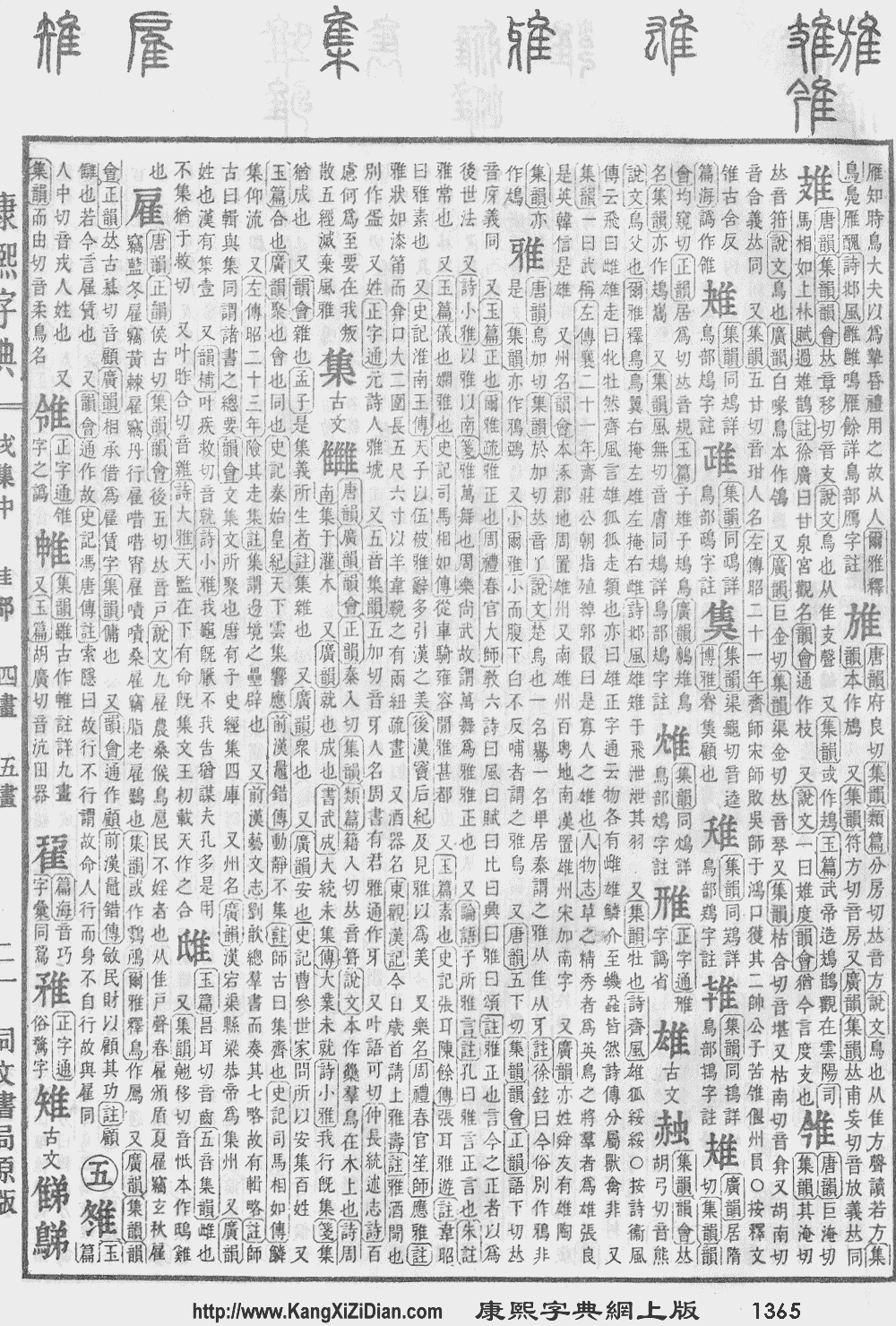
- KangXi: page 1365, character 24
- Dai Kanwa Jiten: character 41987
- Dae Jaweon: page 1870, character 8
- Hanyu Da Zidian (first edition): volume 6, page 4097, character 1
- Unihan data for U+96C9
Chinese
| simp. and trad. |
雉 | |
|---|---|---|
Glyph origin
Etymology
From Proto-Sino-Tibetan *s-rik ~ *s-ryak (“pheasant, partridge”) (STEDT; Schuessler, 2007).
Pronunciation
Definitions
雉
- pheasant
- 今有雉、兔同籠,上有三十五頭,下有九十四足。問雉、兔各幾何。 [Classical Chinese, trad.]
- From: 3rd–5th century, Sunzi Suanjing
- Jīn yǒu zhì, tù tóng lóng, shàng yǒu sānshíwǔ tóu, xià yǒu jiǔshísì zú. Wèn zhì, tù gè jǐhé. [Pinyin]
- There are pheasants and hares in a cage, with thirty-five heads on top and ninety-four feet below. We ask that how many pheasants and hares are there each.
今有雉、兔同笼,上有三十五头,下有九十四足。问雉、兔各几何。 [Classical Chinese, simp.]
- crenellated wall
- an ancient Chinese measuring unit of the area of walls equivalent to three chi in length by one chi in height
Synonyms
Dialectal synonyms of 雉 (“pheasant”) [map]
| Variety | Location | Words |
|---|---|---|
| Classical Chinese | 雉 | |
| Formal (Written Standard Chinese) | 雉, 雉雞, 野雞 | |
| Mandarin | Harbin | 野雞, 山雞 |
| Yantai (Muping) | 野雞 | |
| Jinan | 野雞 | |
| Luoyang | 野雞 | |
| Wanrong | 野雞 | |
| Xi'an | 野雞 | |
| Yinchuan | 野雞 | |
| Xining | 野雞, 馬班子 | |
| Ürümqi | 野雞 | |
| Wuhan | 野雞, 野雞子 | |
| Chengdu | 野雞 | |
| Guiyang | 野雞, 慶雞, 錦雞 | |
| Liuzhou | 野雞, 山雞 | |
| Xuzhou | 野雞 | |
| Yangzhou | 野雞 | |
| Nanjing | 野雞, 山雞 | |
| Cantonese | Guangzhou | 野雞, 山雞, 雉雞 |
| Hong Kong | 山雞 | |
| Dongguan | 山雞 | |
| Gan | Nanchang | 野雞 |
| Lichuan | 野雞 | |
| Pingxiang | 野雞 | |
| Hakka | Meixian | 野雞, 山雞, 雉雞 |
| Yudu | 野雞 | |
| Huizhou | Jixi | 山雞 |
| Jin | Taiyuan | 野雞 |
| Xinzhou | 野雞 | |
| Min Bei | Jian'ou | 山雞 |
| Min Dong | Fuzhou | 野雞 |
| Min Nan | Xiamen | 野雞, 山雞 |
| Quanzhou | 野雞, 山雞 | |
| Zhangzhou | 野雞, 山雞 | |
| Shantou | 山雞 | |
| Leizhou | 山雞 | |
| Haikou | 山雞 | |
| Southern Pinghua | Nanning (Tingzi) | 山雞 |
| Wu | Shanghai | 野雞 |
| Shanghai (Chongming) | 野雞 | |
| Suzhou | 野雞 | |
| Danyang | 野雞 | |
| Hangzhou | 野雞 | |
| Ningbo | 野雞 | |
| Wenzhou | 野雞, 山雞 | |
| Xiang | Changsha | 野雞 |
| Loudi | 野雞 | |
Japanese
Alternative forms
Etymology
| Kanji in this term |
|---|
| 雉 |
| きじ Hyōgaiji |
| kun’yomi |
(This etymology is missing or incomplete. Please add to it, or discuss it at the Etymology scriptorium.)
Usage notes
As with many terms that name organisms, this term is often spelled in katakana, especially in biological contexts (where katakana is customary), as キジ.
Korean
Hanja
雉 (eum 치 (chi))
- This term needs a translation to English. Please help out and add a translation, then remove the text
{{rfdef}}.
Vietnamese
This article is issued from Wiktionary. The text is licensed under Creative Commons - Attribution - Sharealike. Additional terms may apply for the media files.