往
| ||||||||
Translingual
| Stroke order | |||
|---|---|---|---|
 | |||
Han character
往 (Kangxi radical 60, 彳+5, 8 strokes, cangjie input 竹人卜土 (HOYG), four-corner 20214, composition ⿰彳主)
Derived characters
- 𠉫, 𠗤, 𢛛, 𣶂, 暀, 𥆜, 𫃮, 𬻯, 𭈕, 𥯂, 𮤵, 𤷮
References
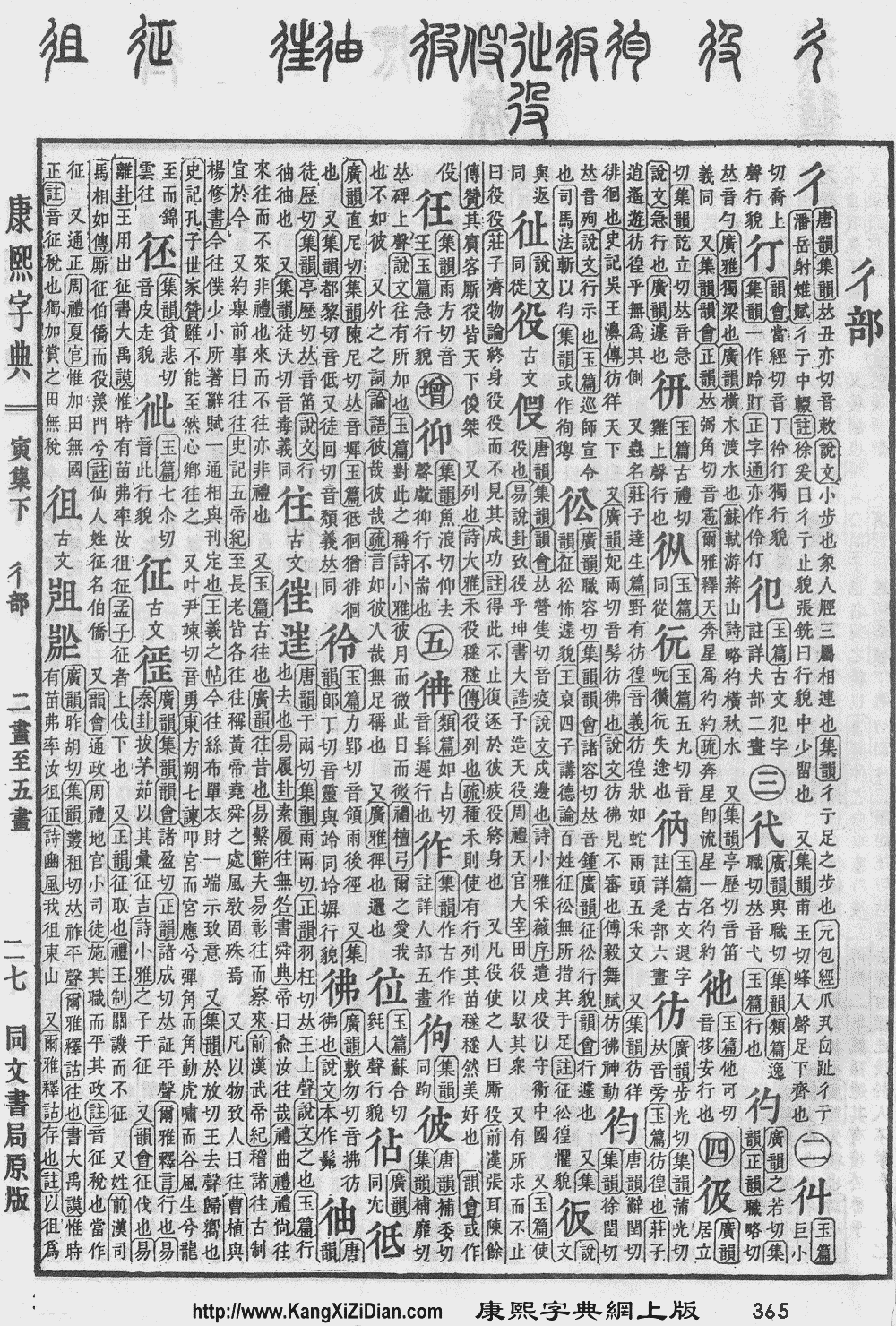
- KangXi: page 365, character 32
- Dai Kanwa Jiten: character 10073
- Dae Jaweon: page 685, character 23
- Hanyu Da Zidian (first edition): volume 2, page 817, character 6
- Unihan data for U+5F80
Chinese
| simp. and trad. |
往 | |
|---|---|---|
| alternative forms | ||
Glyph origin
| Historical forms of the character 往 | ||||||
|---|---|---|---|---|---|---|
| Shang | Western Zhou | Spring and Autumn | Warring States | Shuowen Jiezi (compiled in Han) | ||
| Oracle bone script | Bronze inscriptions | Bronze inscriptions | Chu slip and silk script | Qin slip script | Ancient script | Small seal script |
 |
 |
 |
 |
 |
 |
 |
Characters in the same phonetic series (往) (Zhengzhang, 2003)
Originally phono-semantic compound (形聲, OC *ɢʷaŋ) : semantic 止 (“foot”) + phonetic 王 (OC *ɢʷaŋ, *ɢʷaŋs). Later 彳 was added to form phono-semantic compound (形聲, OC *ɢʷaŋ) : semantic 彳 (“walk”) + semantic 止 (“foot”) + phonetic 王 (OC *ɢʷaŋ, *ɢʷaŋs).
Etymology
From Proto-Sino-Tibetan *s-wa-ŋ (“to go; to come”). Cognate with Burmese ဝင် (wang, “to come in; to enter”), Tibetan འོང ('ong, “to come”), ཡོང (yong, “to come”). Related to 于 (OC *ɢʷa, “to go”).
Pronunciation
Definitions
往
Synonyms
- 向 (xiàng)
Compounds
Derived terms from 往
|
|
|
References
- “往”, in 漢語多功能字庫 (Multi-function Chinese Character Database), 香港中文大學 (the Chinese University of Hong Kong), 2014–
Japanese
| Shinjitai | 往 |  |
| Kyūjitai [1][2][3] |
往󠄁 往+ 󠄁?(Adobe-Japan1) |
 |
| 往󠄃 往+ 󠄃?(Hanyo-Denshi) (Moji_Joho) | ||
| The displayed kanji may be different from the image due to your environment. See here for details. | ||
Readings
Etymology
| Kanji in this term |
|---|
| 往 |
| おう Grade: 5 |
| on’yomi |
*/waŋ/ → /wau/ → /ɔː/ → /oː/
From Middle Chinese 往 (MC ɦʉɐŋX).
Pronunciation
- IPA(key): [o̞ː]
References
- 白川静 (Shirakawa Shizuka) (2014), “往”, in 字通 普及版 (Jitsū fukyūban, “Jitsū trade edition”) (in Japanese), Tōkyō: Heibonsha, →ISBN
- 1914, 漢和大辭書 (Kanwa Dai Jisho, “The Great Kanji-Japanese Dictionary”) (in Japanese), page 822 (paper), page 461 (digital), Tōkyō: 興文社 (Kōbunsha)
- 1927, 新漢和辭典 (Shin Kanwa Jiten, “The New Kanji-Japanese Dictionary”) (in Japanese), page 520 (paper), page 273 (digital), Ōsaka: 松雲堂 (Shōundō)
Korean
Compounds
- 왕래 (往來, wangnae, “traffic, coming and going”)
- 왕년 (往年, wangnyeon, “former, once”)
- 왕복 (往復, wangbok, “a round trip, going back and forth”)
Vietnamese
Han character
往: Hán Nôm readings: vãng, vạng, vảng, vởn, váng, vãn
- This term needs a translation to English. Please help out and add a translation, then remove the text
{{rfdef}}.
References
This article is issued from Wiktionary. The text is licensed under Creative Commons - Attribution - Sharealike. Additional terms may apply for the media files.