徙
| ||||||||
Translingual
Han character
徙 (Kangxi radical 60, 彳+8, 11 strokes, cangjie input 竹人卜中人 (HOYLO), four-corner 21281, composition ⿰彳歨)
References
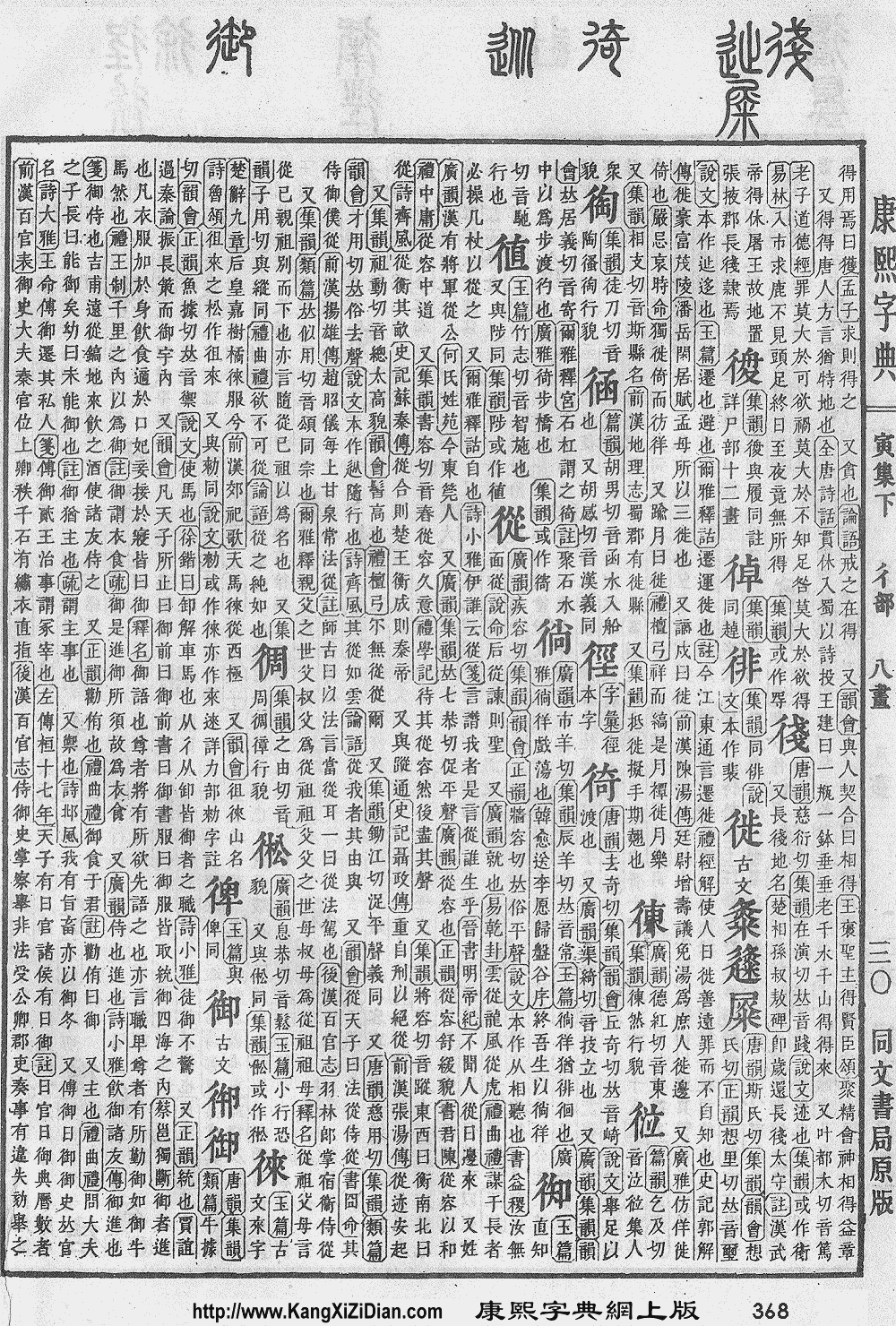
- KangXi: page 368, character 5
- Dai Kanwa Jiten: character 10142
- Dae Jaweon: page 692, character 4
- Hanyu Da Zidian (first edition): volume 2, page 827, character 12
- Unihan data for U+5F99
Chinese
| simp. and trad. |
徙 | |
|---|---|---|
| alternative forms | ||
Glyph origin
| Historical forms of the character 徙 |
|---|
| Shuowen Jiezi (compiled in Han) |
| Small seal script |
 |


During the Zhou dynasty, 徙 was represented with the phonetic borrowing 屎 (OC *hliʔ, *hri, “excrement”), with the components 辵 and 止 later being added to differentiate the character used to represent "migration". During the Warring States period, the earlier forms of 屎 consisting of 小 or 少 components (as seen in  and
and  ) had these portions transform into 米, however 徙 continued to retain the 少 form. The Chu script form of 屎 corrupted into a form with the 尸 ("body") component becoming 尾 ("tail"),[1] while the Qin script form of 徙 omitted the 尸 component of 屎 and left only 少 remaining.[1] Li Shoukui (2015) however argues that the Chu script ⿸尾少 may not actually be cognate to ⿸尸少 (and ergo 屎).[1] The clerical script form inherited the Qin script form, however had the 少 component mutate into another 止,[1] which coincidentally resulted in the clerical form matching the same character structure as 歨 (the Shang dynasty form of 步) with an additional 彳 component.
Shuowen Jiezi erroneously takes this mutated clerical script form of 徙 with two 止 components, and claims that it is a Phono-semantic compound (形聲, OC *selʔ) : semantic 辵 (“walk”) + phonetic 止 (OC *kjɯʔ). It also omits one of the 止 components to create an alternate form 𢓊, however no such character exists in ancient writing (although coincidentally it has a similar shape to the Shang and Zhou 延). Hu Houxuan (1981) states that the "ancient script" form of 徙 in Shuowen, 𡲴, comes from a corruption of the variant form featuring 尾 in place of 尸, but with the tail portion misrepresented as 火.[1] For this reason, the "ancient script" forms of 徙 provided in Shuowen are extremely corrupted.
Li Jiahao (2010) notes that the ancient form of 屎, namely ⿸尸少, may potentially suggest that 徙 is a Phono-semantic compound (形聲, OC *selʔ) : semantic 辵 (“walk”) + abbreviated phonetic 沙 (OC *sraːl, *sraːls).[1]
Pronunciation
Definitions
徙
Synonyms
| Variety | Location | Words |
|---|---|---|
| Formal (Written Standard Chinese) | 移, 挪, 移動, 挪動 | |
| Mandarin | Taiwan | 移, 挪 |
| Singapore | 移 | |
| Cantonese | Guangzhou | 移, 喐, 褪 |
| Hong Kong | 移, 喐, 褪 | |
| Taishan | 移 | |
| Hakka | Meixian | 徙, 移 |
| Miaoli (N. Sixian) | 徙 | |
| Pingtung (Neipu; S. Sixian) | 徙 | |
| Hsinchu County (Zhudong; Hailu) | 徙 | |
| Taichung (Dongshi; Dabu) | 徙 | |
| Hsinchu County (Qionglin; Raoping) | 徙 | |
| Yunlin (Lunbei; Zhao'an) | 徙 | |
| Min Nan | Xiamen | 徙 |
| Quanzhou | 徙 | |
| Zhangzhou | 徙 | |
| Tainan | 徙 | |
| Penang (Hokkien) | 徙 | |
| Singapore (Hokkien) | 徙 | |
| Jieyang | 徙 | |
| Singapore (Teochew) | 徙 | |
Compounds
References
- “徙”, in 漢語多功能字庫 (Multi-function Chinese Character Database), 香港中文大學 (the Chinese University of Hong Kong), 2014–
- Dictionary of Chinese Character Variants (教育部異體字字典), A01292
- Li Shoukui (李守奎) (April 2015), ““屎”與“徙之古文”考 [On the ancient glyphs of “屎” and “徙”]”, in 出土文獻, volume 6, Tsinghua University, archived from the original on 2021-01-11, pages 154-162
Japanese
Kanji
- This term needs a translation to English. Please help out and add a translation, then remove the text
{{rfdef}}.
Korean
Hanja
徙 • (sa) (hangeul 사)
- This term needs a translation to English. Please help out and add a translation, then remove the text
{{rfdef}}.
Vietnamese
Han character
- This term needs a translation to English. Please help out and add a translation, then remove the text
{{rfdef}}.