氏
See also: 氐
| ||||||||
| ||||||||
Translingual
| Stroke order | |||
|---|---|---|---|
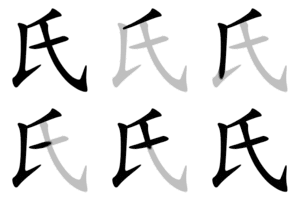 | |||
Han character
氏 (Kangxi radical 83, 氏+0, 4 strokes, cangjie input 竹女心 (HVP), four-corner 72740, composition ⿸⿱丿𠄌𫠠)
- Kangxi radical #83, ⽒.
- Shuowen Jiezi radical №449
Derived characters
References
- KangXi: page 597, character 18
- Dai Kanwa Jiten: character 17026
- Dae Jaweon: page 988, character 30
- Hanyu Da Zidian (first edition): volume 3, page 2130, character 1
- Unihan data for U+6C0F

Chinese
| simp. and trad. |
氏 | |
|---|---|---|
Glyph origin
| Historical forms of the character 氏 | ||||
|---|---|---|---|---|
| Shang | Western Zhou | Warring States | Shuowen Jiezi (compiled in Han) | Liushutong (compiled in Ming) |
| Oracle bone script | Bronze inscriptions | Chu slip and silk script | Small seal script | Transcribed ancient scripts |
 |
 |
 |
 |
 |
Characters in the same phonetic series (氏) (Zhengzhang, 2003)
Pictogram (象形) . Various interpretations exist: a man bending over to sow the field,[1] the root of a tree,[2] a man bowing over to the right, a spoon or mallet, a man holding an object, etc.
Pronunciation
Definitions
氏
- clan; family; lineage; hereditary house
- surname
- person with the surname of ...; Mr.
- (historical) née; born as; maiden name
- suffix to a personal proper noun for attribution (of a work, invention, discovery, etc.)
- 時時冠之,及貴常冠,所謂「劉氏冠」乃是也。 [Classical Chinese, trad.]
- From: The Records of the Grand Historian, by Sima Qian, c. 91 BCE
- Shíshí guàn zhī, jí guì cháng guàn, suǒwèi “Liúshì guān” nǎi shì yě. [Pinyin]
- From time to time [he] would wear (the headdress), and had always kept it on after he arose to prominence. People now refer to the style as "the headdress of Liu".
时时冠之,及贵常冠,所谓“刘氏冠”乃是也。 [Classical Chinese, simp.]
- (Classical Chinese) suffix to a noun that refers to family membership (actual or honorary)
- 母氏聖善,我無令人。 [Pre-Classical Chinese, trad.]
- From: The Classic of Poetry, c. 11th – 7th centuries BCE, translated based on James Legge's version
- Mǔshì shèng shàn, wǒ wú lìng rén. [Pinyin]
- Our mother is wise and good;
But among us there is none good.
母氏圣善,我无令人。 [Pre-Classical Chinese, simp.]- 伯氏不出而圖吾君,伯氏苟出而圖吾君,申生受賜而死。 [Classical Chinese, trad.]
- From: The Book of Rites, c. 4th – 2nd century BCE, translated based on James Legge's version
- Bóshì bù chū ér tú wú jūn, bóshì gǒu chū ér tú wú jūn, Shēnshēng shòu cì ér sǐ. [Pinyin]
- [Y]ou, venerable Sir, do not come forth and consult for the good of our ruler. If you will come forth and do this, I will die having received a great favour from you.
伯氏不出而图吾君,伯氏苟出而图吾君,申生受赐而死。 [Classical Chinese, simp.]
Usage notes
- The meaning of "née" has become largely obsolete, as current Chinese practice is for married women to continue to use their former surnames. The practice of sometimes adopting the husband's surname is being revived, however. 氏 follows the maiden name, which follows the married name — 張氏 (“née Zhang”), 李張氏 (“Li née Zhang”), or 配張氏 (“married to a lady of the Zhang clan”).
See also
- (Mr.): 先生 (xiānshēng)
Compounds
Derived terms from 氏
Pronunciation
Pronunciation
Japanese
Pronunciation
- Pitch accent only applies when used as a standalone noun.
Suffix
氏 • (-shi)
- (honorific) Mr.; Ms.
- 1997 September 1 [Oct 10 1996], Fujiko F. Fujio, “くたばれ評論家 の巻 [The Drop-Dead Critic]”, in エスパー魔美 [Esper Mami], volume 1 (fiction), 4th edition, Tokyo: Shogakukan, →ISBN, page 157:
- 部分テレポートさせた剣氏のガン細胞。
- Bubun terepōto saseta Tsurugi-shi no gan saibō.
- These are the cancer cells I teleported out of Mr. Tsurugi.
- 部分テレポートさせた剣氏のガン細胞。
-
Korean
Etymology 1
From Middle Chinese 氏 (MC d͡ʑiᴇX). Has unusual tensing, the only other such readings being 雙 (ssang) and 喫 (kkik).
| Historical Readings | ||
|---|---|---|
| Dongguk Jeongun Reading | ||
| Dongguk Jeongun, 1448 | 씽〯 (Yale: ssǐ) | |
| Middle Korean | ||
| Text | Eumhun | |
| Gloss (hun) | Reading | |
| Hunmong Jahoe, 1527 | 각시〮 (Yale: kàksí) | 시〮 (Yale: sí) |
Pronunciation
- (SK Standard/Seoul) IPA(key): [ɕ͈i]
- Phonetic hangul: [씨]
Compounds
Etymology 2
From Middle Chinese 氏 (MC t͡ɕiᴇ).
| Historical Readings | ||
|---|---|---|
| Dongguk Jeongun Reading | ||
| Dongguk Jeongun, 1448 | 징 (Yale: cì) | |
Pronunciation
- (SK Standard/Seoul) IPA(key): [t͡ɕi]
- Phonetic hangul: [지]
Hanja
Compounds
Compounds
- 월지 (月氏, wolji)
- 대월지 (大月氏, daewolji)
Vietnamese
This article is issued from Wiktionary. The text is licensed under Creative Commons - Attribution - Sharealike. Additional terms may apply for the media files.