憑

See also: 凭 and 凴
憑 U+6191, 憑
CJK UNIFIED IDEOGRAPH-6191
← 憐
[U+6190]
CJK Unified Ideographs 憒 →
[U+6192]

Translingual

Han character

憑 (Kangxi radical 61, 心+12, 16 strokes, cangjie input 戈火心 (IFP), four-corner 31332, composition ⿱馮心)

Derived characters

  • 𧂋

References

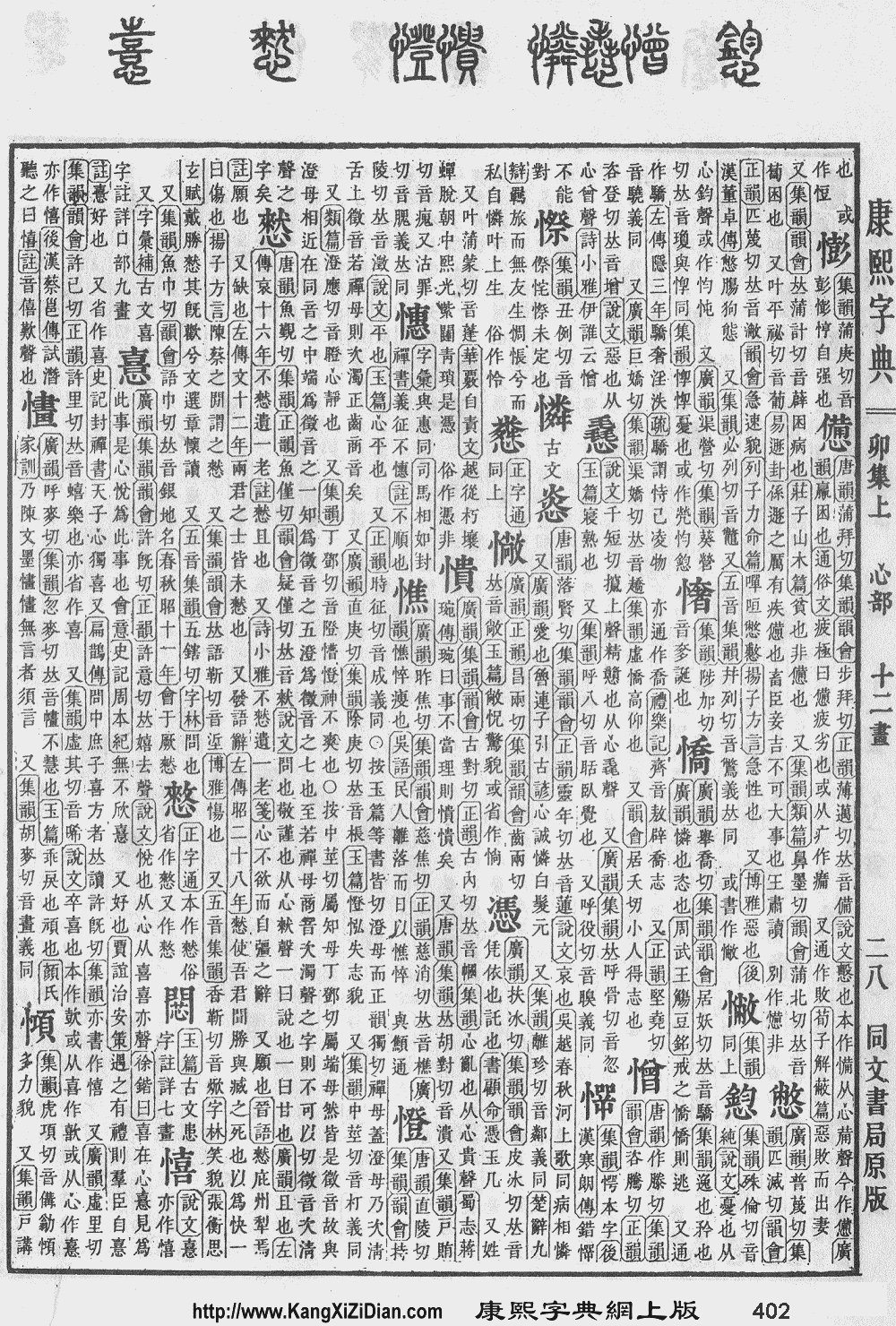
  • KangXi: page 402, character 16
  • Dai Kanwa Jiten: character 11210
  • Dae Jaweon: page 742, character 18
  • Hanyu Da Zidian (first edition): volume 4, page 2351, character 2
  • Unihan data for U+6191

Chinese

Glyph origin

Etymology 1

trad. 憑
simp. 凭
alternative forms 凴
凭 “to lean on; to depend on”

Pronunciation 1


Note:
  • pîn - vernacular;
  • pêng - literary.

Rime
Character 憑
Reading # 1/1
Initial (聲) 並 (3)
Final (韻) 蒸 (133)
Tone (調) Level (Ø)
Openness (開合) Open
Division (等) III
Fanqie 扶冰切
Baxter bing
Reconstructions
Zhengzhang
Shangfang
/bɨŋ/
Pan
Wuyun
/bɨŋ/
Shao
Rongfen
/bieŋ/
Edwin
Pulleyblank
/biŋ/
Li
Rong
/biəŋ/
Wang
Li
/bĭəŋ/
Bernard
Karlgren
/bʱi̯əŋ/
Expected
Mandarin
Reflex
píng
Expected
Cantonese
Reflex
ping4
Baxter–Sagart system 1.1 (2014)
Character 憑
Reading # 1/1
Modern
Beijing
(Pinyin)
píng
Middle
Chinese
‹ bing ›
Old
Chinese
/*[b]rəŋ/
English lean on

Notes for Old Chinese notations in the Baxter–Sagart system:

* Parentheses "()" indicate uncertain presence;
* Square brackets "[]" indicate uncertain identity, e.g. *[t] as coda may in fact be *-t or *-p;
* Angle brackets "<>" indicate infix;
* Hyphen "-" indicates morpheme boundary;

* Period "." indicates syllable boundary.
Zhengzhang system (2003)
Character 憑
Reading # 1/1
No. 859
Phonetic
component
仌
Rime
group
蒸
Rime
subdivision
0
Corresponding
MC rime
凭
Old
Chinese
/*bɯŋ/
Definitions

憑

  1. to lean on; to lean against
  2. to depend on; to rely on
  3. (colloquial) no matter
  4. on the basis of; according to; by
  5. proof; evidence
  6. (literary) to request
  7. Alternative form of 馮/冯 (féng, “to wade across a river”).
Synonyms
  • (to depend on):
  • (no matter):
  • (on the basis of):
  • (proof):
  • (to request):
Compounds
  • 憑弔/凭吊 (píngdiào)
  • 憑心/凭心
  • 憑恃/凭恃 (píngshì)
  • 憑摺/凭折
  • 憑據/凭据 (píngjù)
  • 憑桌/凭桌
  • 憑欄/凭栏 (pínglán)
  • 憑河暴虎/凭河暴虎
  • 憑準/凭准 (píngzhǔn)
  • 憑照/凭照
  • 憑眺/凭眺
  • 憑票/凭票
  • 憑空/凭空 (píngkōng)
  • 憑空捏造/凭空捏造
  • 憑空杜撰/凭空杜撰
  • 憑肩/凭肩
  • 憑脈/凭脉
  • 憑良心說/凭良心说
  • 憑著/凭著
  • 憑藉/凭借
  • 憑虛/凭虚
  • 憑虛公子/凭虚公子
  • 憑虛構象/凭虚构象
  • 憑證/凭证 (píngzhèng)
  • 憑軾/凭轼
  • 憑闌/凭阑
  • 憑陵/凭陵
  • 憑險/凭险
  • 憑驗/凭验
  • 憑高/凭高
  • 憑高望遠/凭高望远
  • 戴憑奪席/戴凭夺席
  • 戴憑重席/戴凭重席
  • 文憑/文凭 (wénpíng)
  • 有憑有據/有凭有据
  • 有證為憑/有证为凭
  • 無憑/无凭
  • 狐憑鼠伏/狐凭鼠伏
  • 白憑無故/白凭无故
  • 真憑實據/真凭实据 (zhēnpíngshíjù)
  • 空口無憑/空口无凭 (kōngkǒuwúpíng)
  • 聽憑/听凭 (tīngpíng)
  • 聽憑尊便/听凭尊便 (tīngpíngzūnbiàn)
  • 鼠憑社貴/鼠凭社贵

Pronunciation 2


Definitions

憑

  1. (Cantonese, Hakka) to lean against

Pronunciation

trad. 憑
simp. 凭
alternative forms 屏
拼


Definitions

憑 (Cantonese)

  1. back (of a chair); backrest

Compounds

  • 挨憑椅/挨凭椅

Japanese

Kanji

憑

(uncommon “Hyōgai” kanji)

  1. to lean on
  2. to depend on
  3. (of a spirit) to possess

Readings

Compounds

Korean

Etymology

From Middle Chinese 憑 (MC bɨŋ).

Hanja

憑 (eumhun 기댈 빙 (gidael bing))

  1. Hanja form? of 빙 (“lean”).

Compounds

References

  • 국제퇴계학회 대구경북지부 (國際退溪學會 大邱慶北支部) (2007). Digital Hanja Dictionary, 전자사전/電子字典.

Vietnamese

Han character

憑: Hán Nôm readings: bằng

  1. equal, even
This article is issued from Wiktionary. The text is licensed under Creative Commons - Attribution - Sharealike. Additional terms may apply for the media files.