信
| ||||||||
Translingual
| Stroke order | |||
|---|---|---|---|
 | |||
Han character
信 (Kangxi radical 9, 人+7, 9 strokes, cangjie input 人卜一口 (OYMR), four-corner 20261, composition ⿰亻言)
References
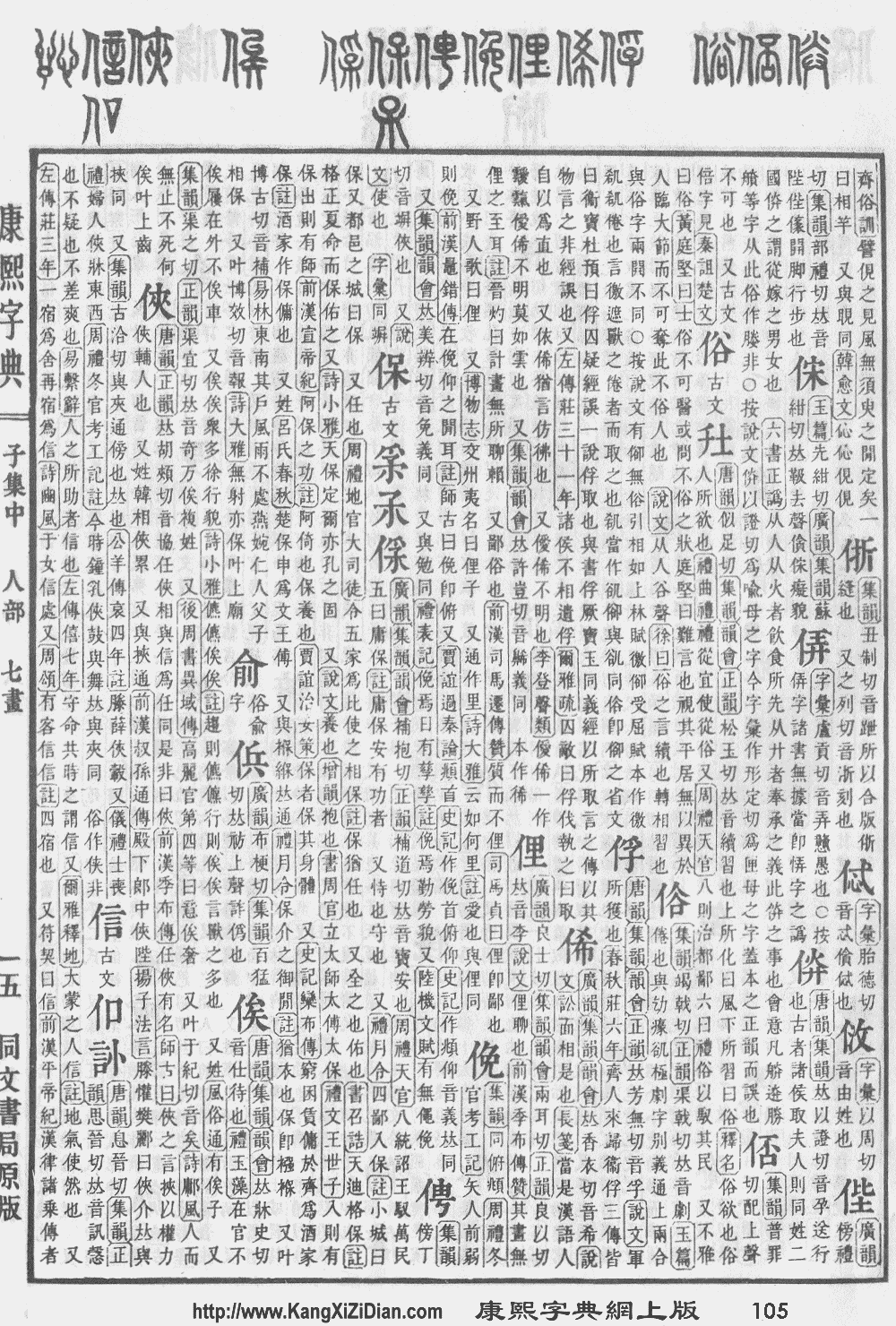
- KangXi: page 105, character 25
- Dai Kanwa Jiten: character 707
- Dae Jaweon: page 224, character 2
- Hanyu Da Zidian (first edition): volume 1, page 165, character 1
- Unihan data for U+4FE1
Chinese
Glyph origin
| Historical forms of the character 信 | |||||||||||||||||||||||||||||||||
|---|---|---|---|---|---|---|---|---|---|---|---|---|---|---|---|---|---|---|---|---|---|---|---|---|---|---|---|---|---|---|---|---|---|
| |||||||||||||||||||||||||||||||||
|
References: Mostly from Richard Sears' Chinese Etymology site (authorisation),
|


Ideogrammic compound (會意) and phono-semantic compound (形聲, OC *hljins) : phonetic 人 (OC *njin, “person”) + semantic 言 (“word”).
Etymology 1
| simp. and trad. |
信 | |
|---|---|---|
| 2nd round simp. | 伩 | |
| alternative forms | 㐰 孞 | |
Schuessler (2007) reconstructs the Old Chinese minimally as *sin and suggests possible derivation from 允 (OC *winʔ, “to trust; to be true”).
Alternatively, Sagart and Baxter (2012) reconstruct *s-niŋ-s (*s-ni[ŋ]-s in Baxter and Sagart, 2014) and suggest a derivation from 仁 (OC *niŋ, “kind”) with the prefix *s-, probably used to increase its valency.
Pronunciation
Definitions
信
- true; accurate; verifiable
- truly; indeed
- 信可樂也。 [Literary Chinese, trad.]
- From: 353 CE, Wang Xizhi, Preface to the Poems Composed at the Orchid Pavilion
- Xìn kě lè yě. [Pinyin]
- Truly, what an enjoyable occasion it was!
信可乐也。 [Literary Chinese, simp.]
- trustworthy
- to believe; to trust in something
- to believe in (a faith); to be religious in
- 我父親信佛教。/我父亲信佛教。 ― Wǒ fùqīn xìn fójiào. ― My father is a Buddhist. (lit. My father believes in Buddhism.)
- 這人來,為要作見證,就是為光作見證,叫眾人因他可以信。 [MSC, trad.]
- From: 新標點和合本 (Chinese Union Version with New Punctuation), 約翰福音 (John) 1:7
- Zhè rén lái, wèi yào zuò jiànzhèng, jiù shì wèi guāng zuò jiànzhèng, jiào zhòngrén yīn tā kěyǐ xìn. [Pinyin]
- The same came for a witness, to bear witness of the Light, that all men through him might believe.
这人来,为要作见证,就是为光作见证,叫众人因他可以信。 [MSC, simp.]
- trust; confidence; faith
- 祢用重價救贖我,使我脫離罪惡河,叫我這不配的人憑信得救。 [MSC, trad.]
- From: 2009, 磐石現代樂團 [Music Stone], lyrics by 謝鴻文 [Steve Hsieh], 讓我 [Let Me]
- Mí yòng zhòngjià jiùshú wǒ, shǐ wǒ tuōlí zuì'è hé, jiào wǒ zhè bùpèi de rén píng xìn déjiù. [Pinyin]
- Allowing me, this unworthy person, to be saved by faith.
祢用重价救赎我,使我脱离罪恶河,叫我这不配的人凭信得救。 [MSC, simp.]
- at will
- letter (written communication) (Classifier: 封 m c mn)
- message; news; information
- 信息 ― xìnxī ― news, message
- evidence
- 信物 ― xìnwù ― token, keepsake
- courier; messenger
- (mineralogy) arsenolite
- a surname: Xin
Synonyms
- (true):
- (to believe):
- (to believe in a faith): 信仰 (xìnyǎng)
- (letter):
- (information):
- (evidence):
Compounds
|
|
|
Pronunciation
Definitions
信
- Alternative form of 申 (shēn, “to express; to state”).
- 《春秋》貴義而不貴惠,信道而不信邪。 [Classical Chinese, trad.]
- From: Commentary of Guliang, circa 206 BCE– 9 CE
- “Chūnqiū” guì yì ér bù guì huì, shēn dào ér bù shēn xié. [Pinyin]
- The Spring and Autumn Annals treasure deeds of righteousness rather than the dispensation of favour, and advocate the just principles instead of corrupt ways.
《春秋》贵义而不贵惠,信道而不信邪。 [Classical Chinese, simp.]
- Alternative form of 伸 (shēn, “to extend”).
References
- “信”, in 漢語多功能字庫 (Multi-function Chinese Character Database), 香港中文大學 (the Chinese University of Hong Kong), 2014–
Japanese
Readings
Compounds
- 信愛
- 信越
- 信管
- 信疑
- 信義 (shingi): faith
- 信教
- 信仰 (shinkō): belief, faith; to have faith in a religion, profess faith in
- 信金
- 信経
- 信玄袋
- 信号 (shingō): a signal; traffic lights
- 信士
- 信実 (shinjitsu): sincerity, honesty, truth, faithfulness
- 信者 (shinja): a believer
- 信受
- 信書
- 信女
- 信証
- 信賞必罰
- 信条
- 信心 (shinjin)
- 信託 (shintaku): a trust, an entrustment; leaving things up to a trusted party; to set up a financial trust; to leave in trust
- 信天翁 (shinten'ō)
- 信徒 (shinto): one who believes in a religion; a believer
- 信任 (shinnin): trust, confidence, credence; to trust, confide
- 信認
- 信念
- 信販
- 信伏, 信服, 信腹
- 信奉 (shinpō): belief, faith
- 信望
- 信約
- 信用 (shin'yō): confidence, trust
- 信頼 (shinrai): reliance, trust, confidence
- 信憑 (shinpyō)
Noun
信 • (shin)
Vietnamese
Han character
- This term needs a translation to English. Please help out and add a translation, then remove the text
{{rfdef}}.