出
| ||||||||
Translingual
| Stroke order | |||
|---|---|---|---|
 | |||
| Stroke order | |||
|---|---|---|---|
 | |||
Han character
出 (Kangxi radical 17, 凵+3, 5 strokes, cangjie input 山山 (UU), four-corner 22772, composition ⿱屮凵 or ⿻凵山)
Derived characters
Related characters
- 岀 (
U+5C80, Unorthodox variant)
References
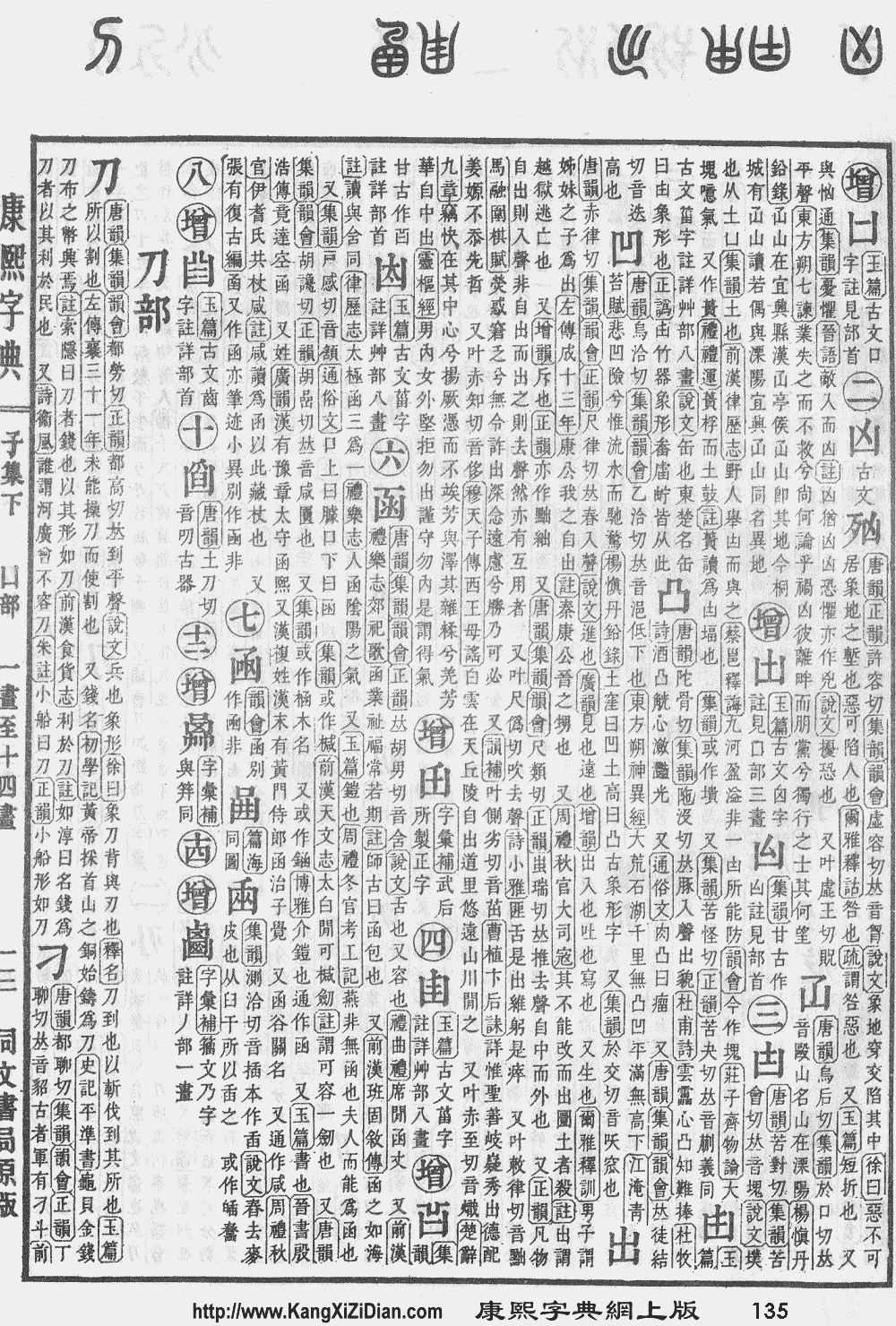
- KangXi: page 135, character 11
- Dai Kanwa Jiten: character 1811
- Dae Jaweon: page 301, character 7
- Hanyu Da Zidian (first edition): volume 1, page 307, character 8
- Unihan data for U+51FA
Chinese
| simp. and trad. |
出 | |
|---|---|---|
Glyph origin
| Historical forms of the character 出 | ||||
|---|---|---|---|---|
| Shang | Western Zhou | Warring States | Shuowen Jiezi (compiled in Han) | Liushutong (compiled in Ming) |
| Oracle bone script | Bronze inscriptions | Chu slip and silk script | Small seal script | Transcribed ancient scripts |
 |
 |
 |
 |
 |
| Old Chinese | |
|---|---|
| 聉 | *r̥ʰuːlʔ, *ŋrɯd, *ʔr'uːd, *ŋruːd |
| 贅 | *kljods |
| 祟 | *sqʰluds |
| 出 | *kʰljuds, *kʰljud |
| 茁 | *ʔl'ɯd, *skruːd, *skrod, *skrud |
| 欪 | *qʰlɯd, *l̥ʰud |
| 貀 | *ŋr'uːd |
| 袦 | *ŋr'oːd |
| 咄 | *ʔl'oːd, *ʔl'uːd |
| 柮 | *sɡloːd, *ʔl'uːd |
| 拙 | *kljod |
| 炪 | *kljod, *l̥ʰud |
| 掘 | *ɡlod, *ɡlud |
| 鈯 | *l'uːd |
| 啒 | *kluːd, *qʰluːd |
| 淈 | *kluːd, *ɡluːd |
| 窟 | *kʰluːd |
| 泏 | *kʰluːd, *ʔl'ud |
| 堀 | *kʰluːd, *ɡlud |
| 胐 | *kʰluːd |
| 窋 | *ʔl'ud |
| 絀 | *ʔl'ud |
| 黜 | *l̥ʰud |
| 屈 | *klud, *kʰlud |
| 趉 | *klud |
| 鶌 | *klud |
| 詘 | *kʰlud |
| 倔 | *ɡlud |
| 崛 | *ɡlud, *ŋɡlud |
Ideogrammic compound (會意) : 止 (“foot”) + 凵 (“cave”) – to step out of a cave; to exit. Compare 各.
By the Qin dynasty, the character has lost its original shape. Based on the distorted form, Shuowen mistakenly interprets the character as a pictogram (象形) of a plant growing outwards.
Etymology 1
The Chinese term may be tentatively comparable to Burmese ထွက် (htwak, “to go or come out; to produce or yield; to leave”), from Proto-Sino-Tibetan *s-twak (“to come or go out; to emerge”); the -t final may be particular to Chinese. This term may have been conflated with a descendant from Proto-Sino-Tibetan *m-(t/d)u (“nephew; descendant”) – whence the Burmese တူ (tu, “nephew”) – a sense no longer productive but was mentioned in the glossary book Erya, c. 2nd century BCE. (STEDT)
Pronunciation
Definitions
出
- to go out; to leave; to exit
- to appear
- to come; to arrive
- 出席 ― chūxí ― to attend
- to send out; to put forth
- to exceed
- to produce; to turn out
- to happen; to arise
- to vent
- (ergative) to publish; to be released (e.g. a product, film, or announcement)
- to expend
- Particle placed after verbs to indicate an outward movement.
- Particle placed after verbs to indicate a completed action. to determine
Compounds
|
|
|
Etymology 2
| For pronunciation and definitions of 出 – see 齣 (“act; stanza; time, occasion; etc.”). (This character, 出, is the simplified and variant traditional form of 齣.) |
Notes:
|
Japanese
Readings
Compounds
- 出湯 (ideyu)
Etymology 1
| Kanji in this term |
|---|
| 出 |
| で Grade: 1 |
| kun’yomi |
The 連用形 (ren'yōkei, “stem or continuative form”) of the verb 出る (deru, “to come out”).
Pronunciation
Derived terms
- 出花 (debana)
- 出会 (deai)
- 出格子 (degōshi)
- 出額 (debitai)
- 出掛 (dekake)
- 出稽古 (degeiko, “home tutoring”)
- 出口 (deguchi, “exit; outlet”)
- 出際 (degiwa)
- 出歯 (deba), 出っ歯 (deppa)
- 出汁 (dejiru), 出汁 (dashi, “dashi, broth”)
- 出城 (dejiro)
- 出刃 (deba)
- 出水 (demizu)
- 出先 (desaki)
- 出窓 (demado)
- 出足 (deashi)
- 出鱈目 (detarame, “nonsensical; haphazard”)
- 出潮 (deshio)
- 出入 (deiri, “income and expenses; free associations”)
- 出番 (deban, “one's turn”)
- 出鼻 (debana, “projecting part of a mountain or cape; the start”)
- 出物 (demono)
- 出放題 (dehōdai)
- 出方 (dekata)
- 出木年 (dekidoshi)
- 出目 (deme)
- 出様 (desama)
- 出来 (deki)
- 出来る (dekiru, “can; be finished or ready; be made”)
- 出臍 (debeso)
Etymology 2
| Kanji in this term |
|---|
| 出 |
| しゅつ Grade: 1 |
| on’yomi |
From Middle Chinese 出 (MC t͡ɕʰiuɪt̚, “to go or come out”).
Derived terms
- 出所 (shussho, “(Buddhist) priest, bonze”)
- 出演 (shutsuen, “appearance (as on a stage or on TV), performance”)
- 出家 (shukke)
- 出火 (shukka, “outbreak of fire”)
- 出荷 (shukka, “shipping”)
- 出芽 (shutsuga)
- 出駕 (shutsuga)
- 出殻 (shukkoku)
- 出棺 (shukkan)
- 出監 (shukkan)
- 出願 (shutsugan, “application (a verbal or written request)”)
- 出渠 (shukkyo)
- 出漁 (shutsuryō)
- 出漁 (shutsugyo)
- 出京 (shukkyō)
- 出郷 (shutsugō)
- 出勤 (shukkin, “going to work”)
- 出金 (shukkin)
- 出群 (shutsugun)
- 出軍 (shutsugun)
- 出撃 (shutsugeki, “sortie”)
- 出欠 (shukketsu, “attendance, roll call”)
- 出血 (shukketsu, “hemorrhage, bleeding; loss in business”)
- 出現 (shutsugen, “appearance, entrance, revealing”)
- 出庫 (shukko)
- 出御 (shutsugyo)
- 出向 (shukkō)
- 出校 (shukkō)
- 出港 (shukkō, “ship's departure from a port”)
- 出航 (shukkō, “sailing, casting off”)
- 出講 (shukkō)
- 出国 (shutsugoku, “to go abroad”)
- 出獄 (shutsugoku, “to be released from prison”)
- 出札 (shussatsu)
- 出産 (shussan, “childbirth, child-bearing, giving birth”)
- 出仕 (shutsuji, “to take up an official post”)
- 出師 (shusshi, “dispatching troops”)
- 出資 (shusshi, “investment (contribution of money)”)
- 出時 (shutsuji)
- 出自 (shutsuji)
- 出社 (shussha, “to go to work”)
- 出場 (shutsuba, “appearance on a stage; participation in a competition”)
- 出色 (shusshoku)
- 出身 (shusshin, “hometown, school from which one graduated”)
- 出陣 (shutsujin, “going to battle, leaving for the front”)
- 出世 (shusse, “success in life”)
- 出征 (shussei, “joining a military and going to war”)
- 出生 (shussei, “be born”)
- 出精 (shussei)
- 出席 (shusseki, “attendance, presence”)
- 出船 (shussen)
- 出前 (shutsuzen, “catering; food supplied to order”)
- 出訴 (shusso)
- 出走 (shussō, “entry in a race; starting a race”)
- 出題 (shutsudai)
- 出炭 (shuttan)
- 出端 (shuttan)
- 出超 (shutchō, “excess of exports; favorable trade balance”)
- 出陳 (shutchin)
- 出廷 (shuttei, “appearance in court”)
- 出典 (shutten, “authority, source (of a quotation etc.)”)
- 出展 (shutten)
- 出店 (shutten, “opening up a store; setting up a food stall”)
- 出度 (shutsudo)
- 出土 (shutsudo, “archeological excavation”)
- 出頭 (shuttō, “presence, appearance; turn in to the police”)
- 出動 (shukkin, “going into action, military deployment”)
- 出納 (shutsunō)
- 出馬 (shutsuba, “riding out on a horse; often to a battlefield”)
- 出発 (shuppatsu, “departure”)
- 出帆 (shuppan)
- 出版 (shuppan, “publication, publishing”)
- 出費 (shuppi, “spending, expenditure”)
- 出品 (shuppin, “putting (a product) on display”)
- 出府 (shuppu)
- 出兵 (shuppei, “dispatching of troops”)
- 出穂 (shussui)
- 出没 (shutsubotsu, “to infest, to haunt”)
- 出奔 (shuppon, “flight; elopement”)
- 出門 (shutsumon)
- 出藍 (shutsuran)
- 出立 (shuttatsu, “depart on a journey”)
- 出猟 (shutsuryō)
- 出力 (shutsuryoku, “generating power, output”)
- 出塁 (shutsurui, “(baseball) times on base”)
- 出廬 (shutsuro)
- 出捐 (shutsuen)
Etymology 3
| Kanji in this term |
|---|
| 出 |
| ず Grade: 1 |
| kun’yomi |
Contraction of verb 出ず (izu, “to go or come out”, obsolete)
Usage notes
The 出る (deru) form is now the standard term for this in modern Japanese.
Korean
Etymology 1
From Middle Chinese 出 (MC t͡ɕʰiuɪt̚).
| Historical Readings | ||
|---|---|---|
| Dongguk Jeongun Reading | ||
| Dongguk Jeongun, 1448 | 튫〮 (Yale: {{{2}}}), 츓〮 (Yale: chyúlq), ᄎᆏᆼ〮 (Yale: {{{2}}}) | |
| Middle Korean | ||
| Text | Eumhun | |
| Gloss (hun) | Reading | |
| Gwangju Cheonjamun, 1575 | 날 (Yale: {{{2}}}) | 츌 (Yale: chyul) |
| Sinjeung Yuhap, 1576 | 날 (Yale: {{{2}}}) | 츌 (Yale: chyul) |
| Seokbong Cheonjamun, 1583 | 날 (Yale: {{{2}}}) | 츌 (Yale: chyul) |
Pronunciation
- (SK Standard/Seoul) IPA(key): [t͡ɕʰuɭ]
- Phonetic hangul: [출]
Compounds
- 출가 (出家, chulga)
- 출간 (出刊, chulgan)
- 출격 (出擊, chulgyeok)
- 출경 (出京, chulgyeong)
- 출고 (出庫, chulgo)
- 출국 (出國, chulguk)
- 출근 (出勤, chulgeun)
- 출납 (出納, chullap)
- 출동 (出動, chuldong)
- 출두 (出頭, chuldu)
- 출마 (出馬, chulma)
- 출몰 (出沒, chulmol)
- 출발 (出發, chulbal)
- 출범 (出帆, chulbeom)
- 출산 (出産, chulsan)
- 출생 (出生, chulsaeng)
- 출석 (出席, chulseok)
- 출세 (出世, chulse)
- 출소 (出所, chulso)
- 출시 (出市, chulsi)
- 출신 (出身, chulsin)
- 출입 (出入, churip)
- 출자 (出資, chulja)
- 출제 (出題, chulje)
- 출중 (出衆, chuljung)
- 출판 (出版 / 出板, chulpan)
- 출항 (出港, chulhang)
- 출항 (出航, chulhang)
- 출혈 (出血, chulhyeol)
- 가출 (家出, gachul)
- 각출 (各出, gakchul)
- 갹출 (醵出, gyakchul)
- 검출 (檢出, geomchul)
- 공출 (供出, gongchul)
- 구출 (救出, guchul)
- 노출 (露出, nochul)
- 누출 (漏出, nuchul)
- 대출 (貸出, daechul)
- 도출 (導出, dochul)
- 돌출 (突出, dolchul)
- 매출 (賣出, maechul)
- 반출 (搬出, banchul)
- 방출 (放出, bangchul)
- 배출 (排出, baechul)
- 배출 (輩出, baechul)
- 분출 (噴出, bunchul)
- 산출 (算出, sanchul)
- 색출 (索出, saekchul)
- 선출 (選出, seonchul)
- 성출 (誠出, seongchul)
- 속출 (續出, sokchul)
- 송출 (送出, songchul)
- 수출 (輸出, suchul)
- 신출 (新出, sinchul)
- 연출 (演出, yeonchul)
- 외출 (外出, oechul)
- 유출 (流出, yuchul)
- 인출 (引出, inchul)
- 일출 (日出, ilchul)
- 제출 (提出, jechul)
- 지출 (支出, jichul)
- 진출 (進出, jinchul)
- 차출 (差出, chachul)
- 창출 (創出, changchul)
- 추출 (抽出, chuchul)
- 축출 (逐出, chukchul)
- 탈출 (脫出, talchul)
- 퇴출 (退出, toechul)
- 표출 (表出, pyochul)
- 호출 (呼出, hochul)
- 출판사 (出版社, chulpansa)
- 청출어람 (靑出於藍, cheongchureoram)
- 입신출세 (出立身世, ipsinchulse)
- 영탈이출 (潁脫而出, yeongtarichul)
- 출호이반호이 (出乎爾反乎爾, chulhoibanhoi)
Etymology 2
From Middle Chinese 出 / 齣.
Pronunciation
- (SK Standard/Seoul) IPA(key): [t͡ɕʰʌ̹k̚]
- Phonetic hangul: [척]