伏
| ||||||||
Translingual
| Stroke order | |||
|---|---|---|---|
 | |||
Han character
伏 (Kangxi radical 9, 人+4, 6 strokes, cangjie input 人戈大 (OIK), four-corner 23234, composition ⿰亻犬)
References
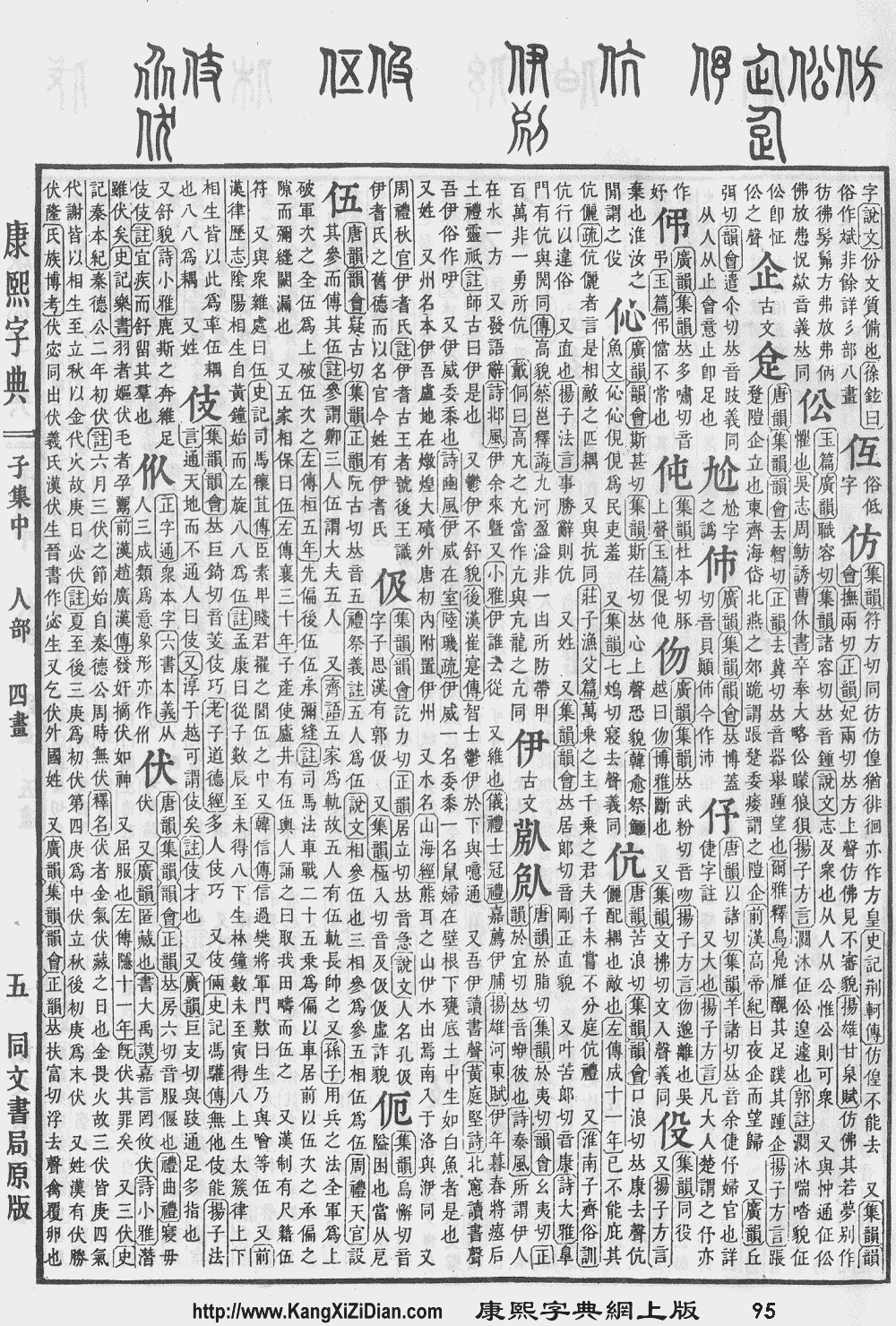
- KangXi: page 95, character 23
- Dai Kanwa Jiten: character 438
- Dae Jaweon: page 202, character 7
- Hanyu Da Zidian (first edition): volume 1, page 119, character 4
- Unihan data for U+4F0F
Chinese
| simp. and trad. |
伏 | |
|---|---|---|
Glyph origin
| Historical forms of the character 伏 | |||||||||||||||||||||
|---|---|---|---|---|---|---|---|---|---|---|---|---|---|---|---|---|---|---|---|---|---|
| Western Zhou | Warring States | Shuowen Jiezi (compiled in Han) | Liushutong (compiled in Ming) | ||||||||||||||||||
| Bronze inscriptions | Chu slip and silk script | Qin slip script | Small seal script | Transcribed ancient scripts | |||||||||||||||||
 |
 |
 |
 |
 | |||||||||||||||||
||||
|
References: Mostly from Richard Sears' Chinese Etymology site (authorisation),
| |||||||||||||||||||||


Characters in the same phonetic series (伏) (Zhengzhang, 2003)
Ideogrammic compound (會意) : 人 (“person”) + 犬 (“dog”) – meaning “prostrate”.
- A dog at the side of a person.
- A person adopting the position of a dog.
Pronunciation 1
Definitions
伏
- to lie prostrate
- to crouch; to crawl
- to ambush; to lie hidden
- to hide; to conceal
- to surrender; to yield
- to accept; to submit; to bear; to endure
- to subdue
- to go down; to fall down
- to remain; to wait for
- to remove
- 屠羊說曰:「大王失國,非臣之罪,故不敢伏其誅;大王反國,非臣之功,故不敢當其賞。」 [Classical Chinese, trad.]
- From: Zhuangzi, circa 3rd – 2nd centuries BCE
- Tú yáng Yuè yuē: “Dàiwang shī guó, fēi chén zhī zuì, gù bùgǎn fú qí zhū; dàiwang fǎn guó, fēi chén zhī gōng, gù bùgǎn dāng qí shǎng.” [Pinyin]
- (please add an English translation of this example)
屠羊说曰:“大王失国,非臣之罪,故不敢伏其诛;大王反国,非臣之功,故不敢当其赏。” [Classical Chinese, simp.]
- residence
- hottest days of summer
- (obsolete) horizontal wooden bar in front of a carriage chair
- Short for 伏特 (fútè, “volt”).
- Alternative form of 服 (fú).
- a surname
Compounds
Derived terms from 伏
|
|
|
Pronunciation 2
Definitions
伏
- (archaic or dialectal) to hatch
- 伏小雞/伏小鸡 [Shanghainese] ― [b̥v̩ʷ³³ ɕiɔ³³ t͡ɕi⁴⁴] [IPA] ― to hatch chicks
Compounds
|
|
|
Pronunciation
Synonyms
- (Mandarin) 雷 (léi)
Etymology 3
| For pronunciation and definitions of 伏 – see 復 (“to return; to recover; to resume; etc.”). (This character, 伏, is a variant form of 復.) |
Etymology 4
| For pronunciation and definitions of 伏 – see 負 (“to carry; to bear; to rely on; to load; to burden; etc.”). (This character, 伏, is a variant form of 負.) |
Etymology 5
| For pronunciation and definitions of 伏 – see 袱 (“a piece of cloth used to wrap bundles”). (This character, 伏, is the second-round simplified form of 袱.) |
Notes:
|
Etymology 6
| For pronunciation and definitions of 伏 – see 匐. (This character, 伏, is the second-round simplified form of 匐.) |
Notes:
|
Japanese
Korean
Vietnamese
This article is issued from Wiktionary. The text is licensed under Creative Commons - Attribution - Sharealike. Additional terms may apply for the media files.