劍
| ||||||||
Translingual
| Traditional | 劍 |
|---|---|
| Shinjitai | 剣 |
| Simplified | 剑 |
Han character
劍 (Kangxi radical 18, 刀+13, 15 strokes, cangjie input 人人中弓 (OOLN), four-corner 82800, composition ⿰僉刂)
Derived characters
- 𠐘, 𡃍, 𤑯, 𤢾, 𧁴, 𣋽
Descendants
- 剣 (In Japanese shinjitai)
- 剑 (In simplified Chinese)
References
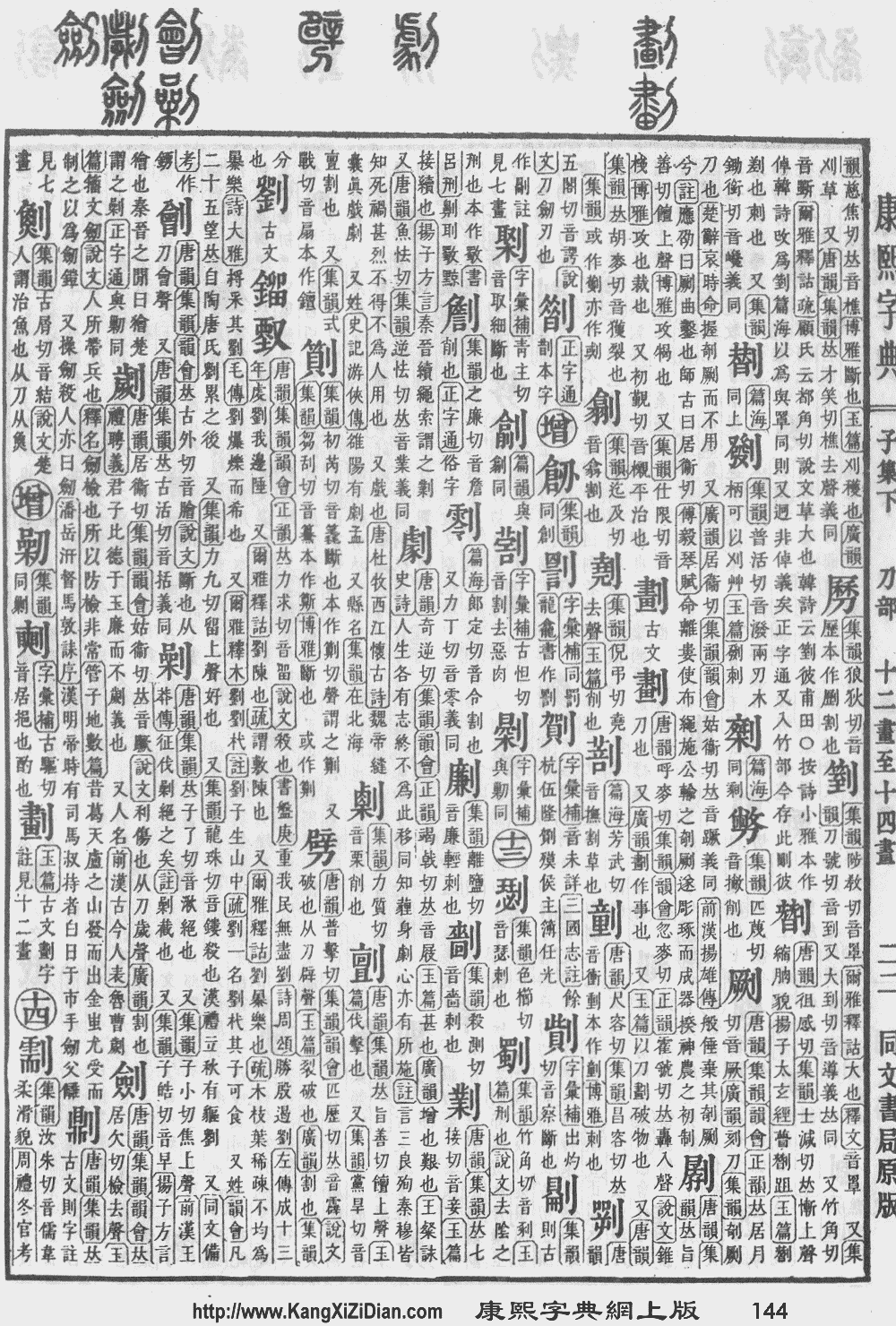
- KangXi: page 144, character 45
- Dai Kanwa Jiten: character 2228
- Dae Jaweon: page 326, character 4
- Hanyu Da Zidian (first edition): volume 1, page 358, character 10
- Unihan data for U+528D
Chinese
| trad. | 劍 | |
|---|---|---|
| simp. | 剑 | |
| alternative forms | ||

Glyph origin
| Historical forms of the character 劍 |
|---|
| Shuowen Jiezi (compiled in Han) |
| Small seal script |
 |
| Old Chinese | |
|---|---|
| 厱 | *raːm, *kʰreːm, *kʰlam |
| 歛 | *qʰlaːm |
| 臉 | *ɡ·reːmʔ, *skʰlam, *kramʔ |
| 醶 | *ɡr·reːmʔ, *skʰraːmʔ |
| 鹼 | *kreːmʔ, *skʰlam |
| 薟 | *ɡ·ram, *ɡ·ramʔ, *qʰram |
| 匳 | *ɡ·ram |
| 獫 | *ɡ·ram, *ɡ·ramʔ, *ɡ·rams, *qʰramʔ |
| 蘞 | *ɡ·ram, *ɡ·ramʔ, *qʰlam |
| 籢 | *ɡ·ram |
| 斂 | *ɡ·ramʔ, *ɡ·rams |
| 瀲 | *ɡ·ramʔ, *ɡ·rams |
| 撿 | *ɡ·ramʔ, *kramʔ |
| 羷 | *ɡ·ramʔ |
| 殮 | *ɡ·rams |
| 簽 | *skʰlam |
| 僉 | *skʰlam |
| 憸 | *skʰlam, *skʰlamʔ, *sqʰlam, *qʰramʔ |
| 譣 | *skʰlam, *qʰramʔ |
| 檢 | *kramʔ |
| 瞼 | *kramʔ |
| 儉 | *ɡramʔ |
| 顩 | *ŋramʔ, *rlɯmʔ, *kʰrɯmʔ |
| 嬐 | *ŋramʔ |
| 嶮 | *ŋramʔ, *hŋramʔ |
| 噞 | *ŋramʔ, *ŋrams |
| 驗 | *ŋrams |
| 險 | *qʰramʔ |
| 劒 | *kams |
| 劍 | *kams |
| 𩏩 | *qʰam |
Phono-semantic compound (形聲, OC *kams) : phonetic 僉 (OC *skʰlam) + semantic 刂.
Etymology
Schuessler (2007) proposes a possible native origin, from *k-nominalized adjective 剡 (OC *ɦljamʔ, *lamʔ), which is from Proto-Sino-Tibetan *s-rjam (“sharp”) and lost its *r- initial due to folk etymology; doublets 磏 (OC *r(i)am, “whetstone”) and 鐮 (OC *ɡ·rem, “sickle”) retain *r-.
Alternatively, the double-edged sword seemingly originated from the southern state of Wu (吳); so a native Wu term, of unknown linguistic affiliation, might have yielded both Old Chinese 劍 (OC *kams) and Proto-Vietic *t-kɨəm.
Pronunciation
Definitions
劍
- sword (bladed on both sides); sabre
- 鄭之刀,宋之斤,魯之削,吳粵之劍,遷乎其地而弗能為良,地氣然也。 [Classical Chinese, trad.]
- From: Rites of Zhou, circa 3rd century BCE
- Zhèng zhī dāo, Sòng zhī jīn, Lǔ zhī xuē, Wúyuè zhī jiàn, qiān hū qí dì ér fú néng wéi liáng, dì qì rán yě. [Pinyin]
- The knives of Zheng, the axes of Song, the pen-knives of Lu, and the double-edged swords of Wu and Yue are famous for their origin. In no other places, can one make these things so well. This is natural because of the qi of the earth.
郑之刀,宋之斤,鲁之削,吴粤之剑,迁乎其地而弗能为良,地气然也。 [Classical Chinese, simp.]
- Classifier for swings of a sword.
- a surname
Compounds
|
|
|
Descendants
Japanese
| 剣 | |
| 劍 |
Kanji
(“Jinmeiyō” kanji used for names, kyūjitai kanji, shinjitai form 剣)
- Kyūjitai form of 剣: double-edged sword; swordsmanship
Korean
Alternative forms
Etymology
From Middle Chinese 劍 (MC kɨɐmH).
| Historical Readings | ||
|---|---|---|
| Dongguk Jeongun Reading | ||
| Dongguk Jeongun, 1448 | 검〮 (Yale: kém) | |
| Middle Korean | ||
| Text | Eumhun | |
| Gloss (hun) | Reading | |
| Hunmong Jahoe, 1527 | 환도 (Yale: hwantwo) | 검〯 (Yale: kěm) |
Pronunciation
- (SK Standard/Seoul) IPA(key): [kɘ(ː)m]
- Phonetic hangul: [검(ː)]
- Though still prescribed in Standard Korean, most speakers in both Koreas no longer distinguish vowel length.
Compounds
- 검객 (劍客, geomgaek)
- 검공 (劍工, geomgong, “sword smith”)
- 검극 (劍劇, geomgeuk, “sword play”)
- 검극 (劍戟, geomgeuk, “swords and spears”)
- 검난 (劍難, geomnan, “tragedy caused by the sword”)
- 검도 (劍道, geomdo)
- 검무 (劍舞, geommu, “sword dance”)
- 검법 (劍法, geombeop, “swordsmanship”)
- 검사 (劍士, geomsa)
- 검술 (劍術, geomsul)
- 검장 (劍匠, geomjang, “sword smith”)
- 검호 (劍豪, geomho, “swordsman par excellence”)
Vietnamese
Compounds
- 劍術 (kiếm thuật)
Usage notes
- Chữ Nôm. The modern Vietnamese word for sword is kiếm.