尼
| ||||||||
Translingual
| Stroke order | |||
|---|---|---|---|
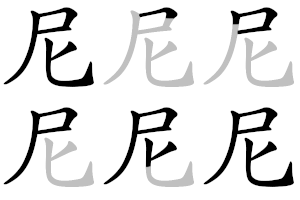 | |||
Han character
尼 (Kangxi radical 44, 尸+2, 5 strokes, cangjie input 尸心 (SP), four-corner 77211, composition ⿸尸匕)
References
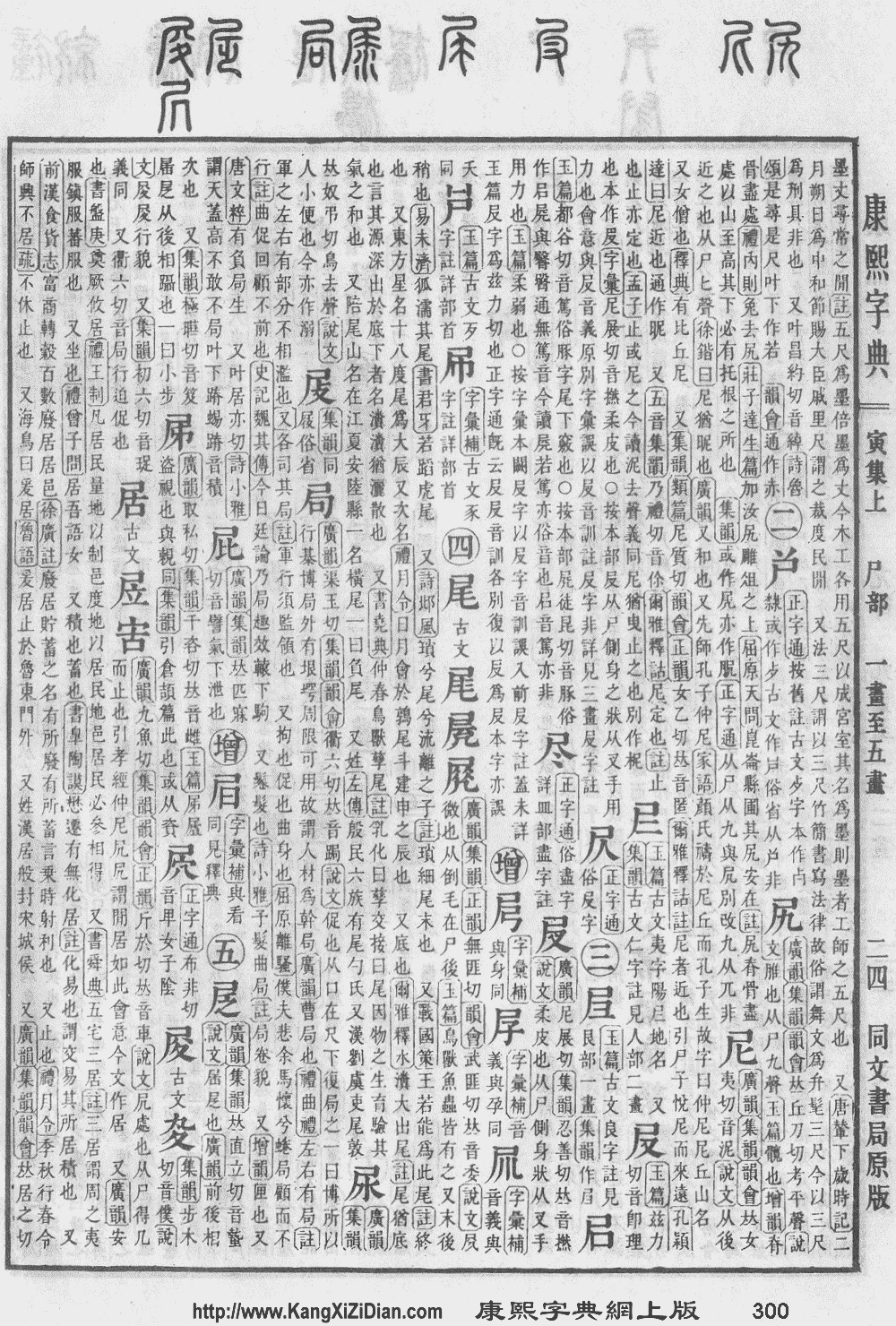
- KangXi: page 300, character 3
- Dai Kanwa Jiten: character 7635
- Dae Jaweon: page 596, character 1
- Hanyu Da Zidian (first edition): volume 2, page 965, character 4
- Unihan data for U+5C3C
Chinese
Glyph origin
| Historical forms of the character 尼 | |
|---|---|
| Shuowen Jiezi (compiled in Han) | Liushutong (compiled in Ming) |
| Small seal script | Transcribed ancient scripts |
 |
 |
Ideogrammic compound (會意) . The character does not appear as an independent character in the oracle bone script but appears as a component of 𢓚 and 秜. The character shows a man (尸) sitting on or leaning on another man (匕), giving the original meaning of “to stop” or “close; intimate”; the derivative 昵 refers to the latter meaning.
Etymology 1
| trad. | 尼 | |
|---|---|---|
| simp. # | 尼 | |
Clipping of 比丘尼 (bǐqiūní), from Sanskrit भिक्षुणी (bhikṣuṇī, “female beggar”) or Pali bhikkhunī (“female beggar”). Compare Sanskrit भिक्षु (bhikṣu, “beggar”).
Pronunciation
Etymology 2
| trad. | 尼 | |
|---|---|---|
| simp. # | 尼 | |
Unknown. Possibly a variant of 邇 (OC *njelʔ, “near”) (compare Mandarin 你 (nǐ) from 爾 (OC *njelʔ)), or a conflation of 邇 (OC *njelʔ, “near”) and 昵 (OC *niɡ) (Schuessler, 2007).
Pronunciation
Pronunciation
Definitions
尼
Etymology 4
| trad. | 尼 | |
|---|---|---|
| simp. # | 尼 | |
(This etymology is missing or incomplete. Please add to it, or discuss it at the Etymology scriptorium.)
Pronunciation
Etymology 5
| trad. | 尼 | |
|---|---|---|
| simp. # | 尼 | |
Possibly from Proto-Sino-Tibetan *m/s-njal (“to sleep; to lie down”) (Sagart, 2004) while inheriting a *-t applicative suffix (Jacques, 2016a), since Middle Chinese sources quote the fanqie 女乙切 or /*ɳit̚/ (The Jingdian Shiwen section for the quotation from Mencius; see below). The stem word can be compared with the Tibetan ཉལ་པ (nyal pa, “to lie down; to go to sleep; to dwell”), and possibly with the Tangut 𗱩 (*njwij¹, “to obstruct; to obscure; to choke up”). See also 柅 (OC *nil, *nilʔ, “stopper”) attested in the Zhou Yi.
Pronunciation
(Can we verify(+) this pronunciation?)
Definitions
尼
- (literary) to stop; to obstruct
- 行或使之,止或尼之。行止,非人所能也。 [Classical Chinese, trad. and simp.]
- From: Mencius, c. 4th century BCE, translated based on James Legge's version
- Xíng huò shǐ zhī, zhǐ huò nì zhī. Xíng zhǐ, fēi rén suǒ néng yě. [Pinyin]
- A man's advancement is effected, it may be, by others, and the stopping him is, it may be, from the efforts of others. But to advance a man or to stop his advance is really beyond the power of other men.
Compounds
|
Etymology 6
| trad. | 尼 | |
|---|---|---|
| simp. # | 尼 | |
| alternative forms | 乃 倷 | |
(This etymology is missing or incomplete. Please add to it, or discuss it at the Etymology scriptorium.)
Pronunciation
Synonyms
| Variety | Location | Words |
|---|---|---|
| Formal (Written Standard Chinese) | 些 | |
| Mandarin | Taiwan | 些 |
| Singapore | 些 | |
| Cantonese | Guangzhou | 啲 |
| Hong Kong | 啲 | |
| Taishan | 尼 | |
| Singapore (Guangfu) | 啲 | |
| Hakka | Meixian | 兜 |
| Miaoli (N. Sixian) | 兜 | |
| Pingtung (Neipu; S. Sixian) | 兜 | |
| Hsinchu County (Zhudong; Hailu) | 兜 | |
| Taichung (Dongshi; Dabu) | 兜 | |
| Hsinchu County (Qionglin; Raoping) | 兜 | |
| Yunlin (Lunbei; Zhao'an) | 兜 | |
| Min Nan | Xiamen | 寡 |
| Zhangzhou | 寡 | |
| Tainan | 寡 | |
| Singapore (Hokkien) | 寡 | |
| Manila (Hokkien) | 寡 | |
| Shantou | 撮 | |
| Jieyang | 撮 | |
| Singapore (Teochew) | 撮 | |
| Wu | Wenzhou | 厘兒 |
Pronunciation
Compounds
|
|
Japanese
Etymology 1
| Kanji in this term |
|---|
| 尼 |
| あま Grade: S |
| kun’yomi |
Pronunciation
Derived terms
Pronunciation
- IPA(key): [a̠ma̠]
Proper noun
尼 • (Ama)
Synonyms
- 密林 (mitsurin)
References
- 1988, 国語大辞典(新装版) (Kokugo Dai Jiten, Revised Edition) (in Japanese), Tōkyō: Shogakukan
- 2006, 大辞林 (Daijirin), Third Edition (in Japanese), Tōkyō: Sanseidō, →ISBN
Korean
Etymology
From Middle Chinese 尼 (MC ɳˠiɪ). Recorded as Middle Korean 니 (ni) (Yale: ni) in Hunmong Jahoe (訓蒙字會 / 훈몽자회), 1527.