難
| ||||||||
 | ||||||||
| ||||||||
Translingual
| Traditional | 難 |
|---|---|
| Simplified | 难 |
| Japanese | 難 |
| Korean | 難 |
Alternative forms
- In traditional Chinese, Japanese kyūjitai, Korean hanja and Vietnamese Nôm, the component
 for this character is written with 廿 on top. Note that the bottom portion is written 口 overlapped by 夫 and not 中 on top of 天.
- In Japanese shinjitai, the component
 is written with 艹 on top and has one stroke less. Due to Han unification, both traditional Chinese and Japanese forms are encoded under the same code point. The appearance of this character will differ according to the font used.
- In simplified Chinese, the component is simplified to 又 instead, giving the character 难 (
U+96BE). - Two compatibility ideographs exist for this character.
U+FA68corresponds to the kyūjitai form of this character whileU+FAC7corresponds to the alternative Korean form which is similar to Japanese shinjitai.
Han character
難 (Kangxi radical 172, 隹+11 in Chinese and Korean, 隹+10 in Japanese, 19 strokes in Chinese and Korean, 18 strokes in Japanese, cangjie input 廿人人土 (TOOG) or 廿戈人土 (TIOG), four-corner 40514, composition ⿰⿱廿⿻口夫隹(GHTKV or U+FA68) or ⿰𦰩隹(J or U+FAC7))
Derived characters
Related characters
References
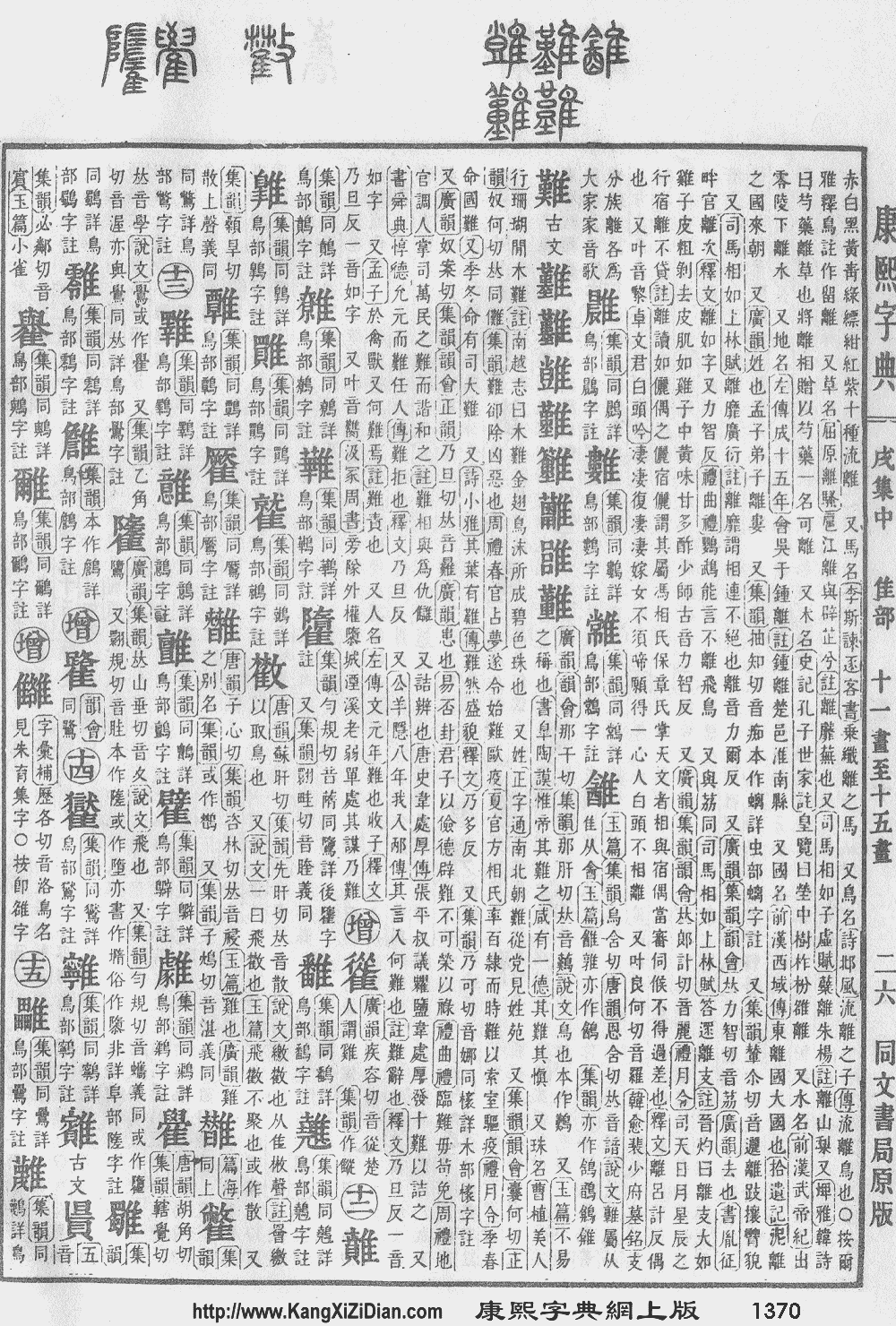
- KangXi: page 1370, character 5
- Dai Kanwa Jiten: character 42128
- Dae Jaweon: page 1876, character 2
- Hanyu Da Zidian (first edition): volume 6, page 4108, character 5
- Unihan data for U+96E3
- Unihan data for U+FA68
- Unihan data for U+FAC7
Chinese
| trad. | 難 | |
|---|---|---|
| simp. | 难 | |
| alternative forms | 𨿻 𩀏 𩀙 𩀡 𩀤 𨿻 𩀏 𩀙 𩀡 𩀤 𩁘 𩁚 𩁢 𩁣 𩁤 𩁩 𩁪 𩁬 𩁮 𩁲 𩁳 𪄿 𪅀 𪇠 𪇼 | |
Glyph origin
Phono-semantic compound (形聲, OC *n̥ʰaːn, *naːns) : phonetic 𦰩 + semantic 隹 (“bird”) – a type of bird. Phonetically borrowed for other senses.
Etymology
From Proto-Sino-Tibetan *na-n/t (“ill, pain, difficult, evil spirit”).
Cognate with Tibetan མནར (mnar, “to suffer; suffering”), ན (na, “to be sick, ill”), ནན་ཏེ (nan te, “sick, ill”), ནད (nad, “disease, suffering”), Burmese နာ (na, “to suffer pain, to be ill”), နတ် (nat, “nat (spirit), evil spirit”).
Pronunciation 1
Definitions
難
- difficult; hard; troublesome
- bad; unpleasant
- to feel difficult; to find difficult
- 皋陶曰:「都!在知人,在安民。」禹曰:「吁!咸若時,惟帝其難之。」 [Classical Chinese, trad.]
- From: The Book of Documents, circa 4th – 3rd century BCE
- Gāoyáo yuē: “Dōu! Zài zhīrén, zài ānmín.” Yǔ yuē: “Xū! Xián ruò shí, wéi Dì qí nán zhī.” [Pinyin]
- Gaoyao continued, "Oh! it lies in knowing men, and giving repose to the people." Yu said, "Alas! to attain to both these things might well be a difficulty even to the [deity] Di."
皋陶曰:“都!在知人,在安民。”禹曰:“吁!咸若时,惟帝其难之。” [Classical Chinese, simp.]
- to make things difficult for; to put someone in a difficult position
- difficulty; something which is difficult; issue
- 責難於君謂之恭,陳善閉邪謂之敬。 [Classical Chinese, trad.]
- From: Mencius, c. 4th century BCE
- Zé nán yú jūn wèi zhī gōng, chén shàn bì xié wèi zhī jìng. [Pinyin]
- To urge one's sovereign to difficult achievements may be called showing respect for him. To set before him what is good and repress his perversities may be called showing reverence for him.
责难于君谓之恭,陈善闭邪谓之敬。 [Classical Chinese, simp.]
- 79th tetragram of the Taixuanjing; "difficulties" (𝍔)
- Alternative form of 戁/𫺷 (nǎn, “to dread; to fear”).
- Alternative form of 攤/摊 (tān, “sacrificial rites for getting rid of bogeys”).
Synonyms
Antonyms
- (easy): 容易 (róngyì)
Compounds
|
|
|
Pronunciation 2
Definitions
難
Compounds
|
|
|
Descendants
References
- “難”, in 漢語多功能字庫 (Multi-function Chinese Character Database), 香港中文大學 (the Chinese University of Hong Kong), 2014–
- Dictionary of Chinese Character Variants (教育部異體字字典), A04467
Japanese
| Shinjitai | 難 | |
| Kyūjitai [1][2] |
難 難or 難+ ︀? |
|
| 難󠄀 難+ 󠄀?(Adobe-Japan1) | ||
| 難󠄄 難+ 󠄄?(Hanyo-Denshi) (Moji_Joho) | ||
| The displayed kanji may be different from the image due to your environment. See here for details. | ||
Readings
From Middle Chinese 難 (MC nɑn, nɑnH):
From Middle Chinese; compare Mandarin 難/难 (nuó):
From native Japanese roots:
- Kun: かたい (katai, 難い, Jōyō)←かたし (katasi, 難し, historical); むずかしい (muzukashii, 難しい, Jōyō)←むづかしい (mudukasii, 難しい, historical); うれい (urei, 難い)←うれひ (urefi, 難ひ, historical); かたき (kataki, 難き); がたし (gatashi, 難し); かたんず (katanzu, 難んず); なじる (najiru, 難る); むつかしい (mutsukashii, 難しい)←むつかし (mutukasi, 難し, historical); わざわい (wazawai, 難い)←わざはひ (wazafafi, 難ひ, historical); にくい (nikui, 難い)
Compounds
Etymology
| Kanji in this term |
|---|
| 難 |
| なん Grade: 6 |
| on’yomi |
| Alternative spelling |
|---|
| 難 (kyūjitai) |
From Middle Chinese 難 (MC nɑn).