擔

See also: 担
擔 U+64D4, 擔
CJK UNIFIED IDEOGRAPH-64D4
← 擓
[U+64D3]
CJK Unified Ideographs 擕 →
[U+64D5]

Translingual

Japanese 担
Simplified 担
Traditional 擔

Han character

擔 (Kangxi radical 64, 手+13, 16 strokes, cangjie input 手弓金口 (QNCR), four-corner 57061, composition ⿰扌詹)

Descendants

References

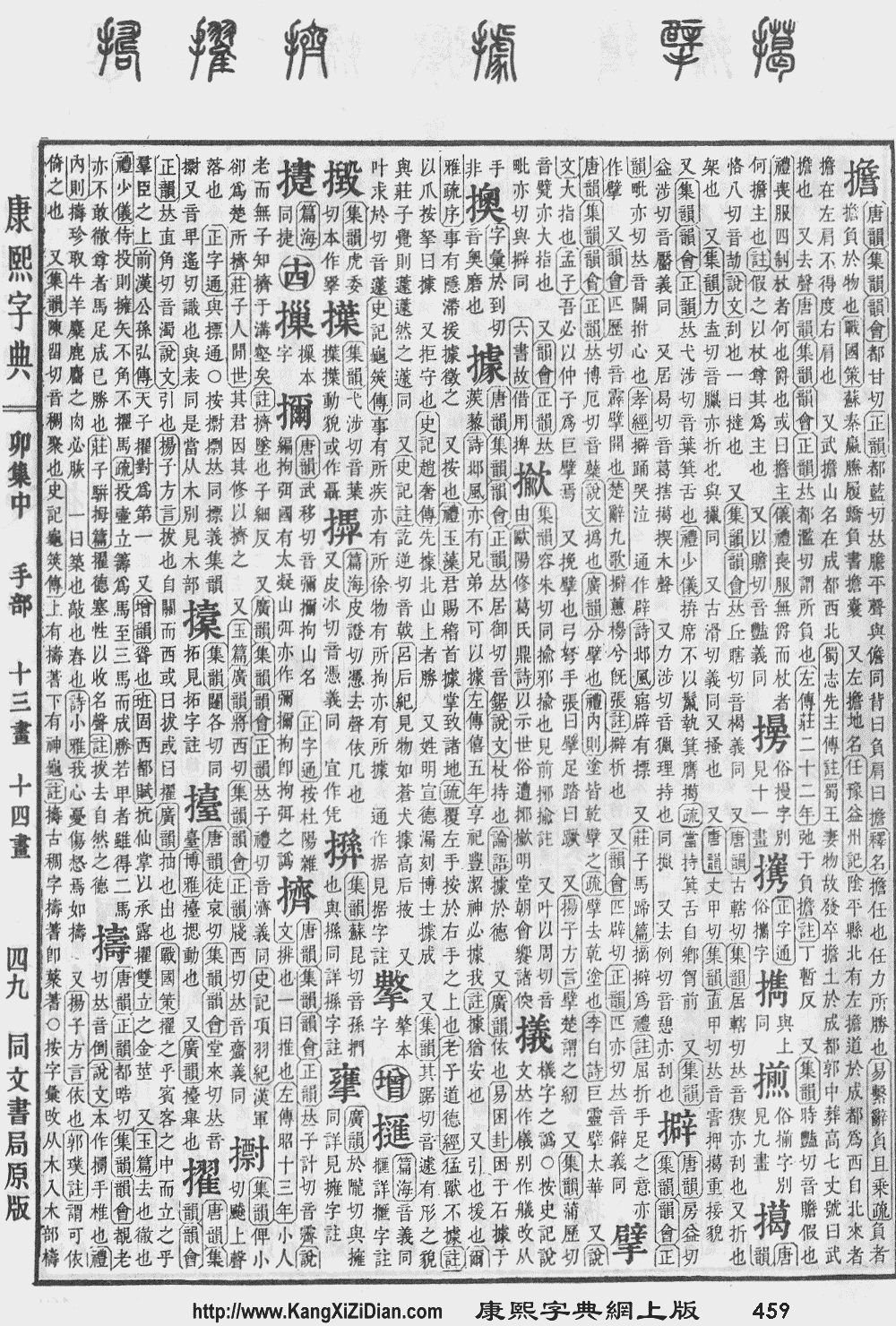
  • KangXi: page 459, character 1
  • Dai Kanwa Jiten: character 12828
  • Dae Jaweon: page 807, character 23
  • Hanyu Da Zidian (first edition): volume 3, page 1971, character 3
  • Unihan data for U+64D4

Chinese

trad. 擔
simp. 担*
alternative forms 儋
担
𧭃
𥣲

Glyph origin

Phono-semantic compound (形聲, OC *taːm, *taːms) : semantic 扌 (“hand”) + phonetic 詹 (OC *tjam) – to carry by hand.

Etymology

According to STEDT, from Proto-Sino-Tibetan *tam (“to carry on shoulder”), whence Burmese ထမ်း (htam:, “to carry on the shoulder”). Schuessler (2007), on the other hand, notes 擔 (OC *taːm) is an area word whose source is probably Austroasiatic; compare Proto-Mon-Khmer *klam ~ *kləm (“to carry on shoulder”), whence Khmu klam (“to carry on shoulder”). An alternative form with initial *t which agrees with later Old Chinese is widespread; compare also Khmer ទាំ (tŏəm, “to tire of; to bear”), Khmer ទ្រាំ (trŏəm, “to bear; to endure”), Proto-Hmong-Mien *ntam (“to carry on shoulder”), whence Iu Mien daːm¹, and Proto-Tai *trwaːmᴬ (“to carry on the back”), whence Thai หาม (hǎam, “to carry”).

The softened initial in Min Bei points to OC pre-nasalization which is supported by Iu Mien daːm¹ (Schuessler, 2007), an early Chinese loan into Hmong-Mien (Baxter and Sagart, 2014).

擔 (OC *taːms) is 擔 (OC *taːm) with the passive s/h-suffix, literally "what is carried".

Pronunciation 1


Note:
  • taⁿ - vernacular;
  • tam - literary.
Note:
  • dam1/dang1 - literary (dang1 - Chenghai);
  • dan1 - vernacular.
  • Wu
    • (Shanghainese)
      • Wiktionary: 1te; 1'ne
      • Sinological IPA (key): /te̞⁵³/, /ʔne̞⁵³/
Note: 1'ne - variant, possibly influenced by 拿, used in e.g. 擔伊做脫.

Rime
Character 擔
Reading # 1/2
Initial (聲) 端 (5)
Final (韻) 談 (143)
Tone (調) Level (Ø)
Openness (開合) Open
Division (等) I
Fanqie 都甘切
Reconstructions
Zhengzhang
Shangfang
/tɑm/
Pan
Wuyun
/tɑm/
Shao
Rongfen
/tɑm/
Edwin
Pulleyblank
/tam/
Li
Rong
/tɑm/
Wang
Li
/tɑm/
Bernard
Karlgren
/tɑm/
Expected
Mandarin
Reflex
dān
Expected
Cantonese
Reflex
daam1
Baxter–Sagart system 1.1 (2014)
Character 擔
Reading # 1/3
Modern
Beijing
(Pinyin)
dān
Middle
Chinese
‹ tam ›
Old
Chinese
/*mə-tˁam/
English carry on the shoulder

Notes for Old Chinese notations in the Baxter–Sagart system:

* Parentheses "()" indicate uncertain presence;
* Square brackets "[]" indicate uncertain identity, e.g. *[t] as coda may in fact be *-t or *-p;
* Angle brackets "<>" indicate infix;
* Hyphen "-" indicates morpheme boundary;

* Period "." indicates syllable boundary.
Zhengzhang system (2003)
Character 擔
Reading # 1/2
No. 16747
Phonetic
component
詹
Rime
group
談
Rime
subdivision
1
Corresponding
MC rime
擔
Old
Chinese
/*taːm/
Notes 見國語說文作儋

Definitions

擔

  1. to carry on a shoulder pole
  2. to bear; to shoulder; to undertake
  3. (Cantonese) to hold in one's mouth

Compounds

Pronunciation 2


Note:
  • tàⁿ - vernacular;
  • tàm - literary.

Rime
Character 擔
Reading # 2/2
Initial (聲) 端 (5)
Final (韻) 談 (143)
Tone (調) Departing (H)
Openness (開合) Open
Division (等) I
Fanqie 都濫切
Reconstructions
Zhengzhang
Shangfang
/tɑmH/
Pan
Wuyun
/tɑmH/
Shao
Rongfen
/tɑmH/
Edwin
Pulleyblank
/tamH/
Li
Rong
/tɑmH/
Wang
Li
/tɑmH/
Bernard
Karlgren
/tɑmH/
Expected
Mandarin
Reflex
dàn
Expected
Cantonese
Reflex
daam3
Baxter–Sagart system 1.1 (2014)
Character 擔 擔
Reading # 2/3 3/3
Modern
Beijing
(Pinyin)
dàn dàn
Middle
Chinese
‹ tam › ‹ tamH ›
Old
Chinese
/*tˁam/ /*mə-tˁam-s/
English burden burden

Notes for Old Chinese notations in the Baxter–Sagart system:

* Parentheses "()" indicate uncertain presence;
* Square brackets "[]" indicate uncertain identity, e.g. *[t] as coda may in fact be *-t or *-p;
* Angle brackets "<>" indicate infix;
* Hyphen "-" indicates morpheme boundary;

* Period "." indicates syllable boundary.
Zhengzhang system (2003)
Character 擔
Reading # 2/2
No. 16753
Phonetic
component
詹
Rime
group
談
Rime
subdivision
1
Corresponding
MC rime
擔
Old
Chinese
/*taːms/

Definitions

擔

  1. carrying pole with loads on both ends
  2. burden; load; responsibilities
  3. picul, a traditional Chinese unit of weight previously around 60 kg and now standardized to 50 kg
  4. Classifier for things carried on a shoulder pole: load

Compounds

Japanese

Shinjitai

担

Kyūjitai

擔

Kanji

擔

(uncommon “Hyōgai” kanji, kyūjitai kanji, shinjitai form 担)

  1. A traditional unit of measurement equivalent to 60kg or approximately 132.3lb
  2. shouldering
  3. carry
  4. raise
  5. bear

Readings

Korean

Hanja

擔 (eumhun 멜 담 (mel dam))

  1. Hanja form? of 담 (“shouldering”).
  2. Hanja form? of 담 (“carry”).
  3. Hanja form? of 담 (“raise”).
  4. Hanja form? of 담 (“bear”).

Compounds

Vietnamese

Han character

擔: Hán Nôm readings: đâm, đảm, tạ

  1. This term needs a translation to English. Please help out and add a translation, then remove the text {{rfdef}}.
This article is issued from Wiktionary. The text is licensed under Creative Commons - Attribution - Sharealike. Additional terms may apply for the media files.