拿
See also: 拏
| ||||||||
Translingual
| Stroke order | |||
|---|---|---|---|
 | |||
Han character
拿 (Kangxi radical 64, 手+6, 10 strokes, cangjie input 人口手 (ORQ), four-corner 80502, composition ⿱合手)
References
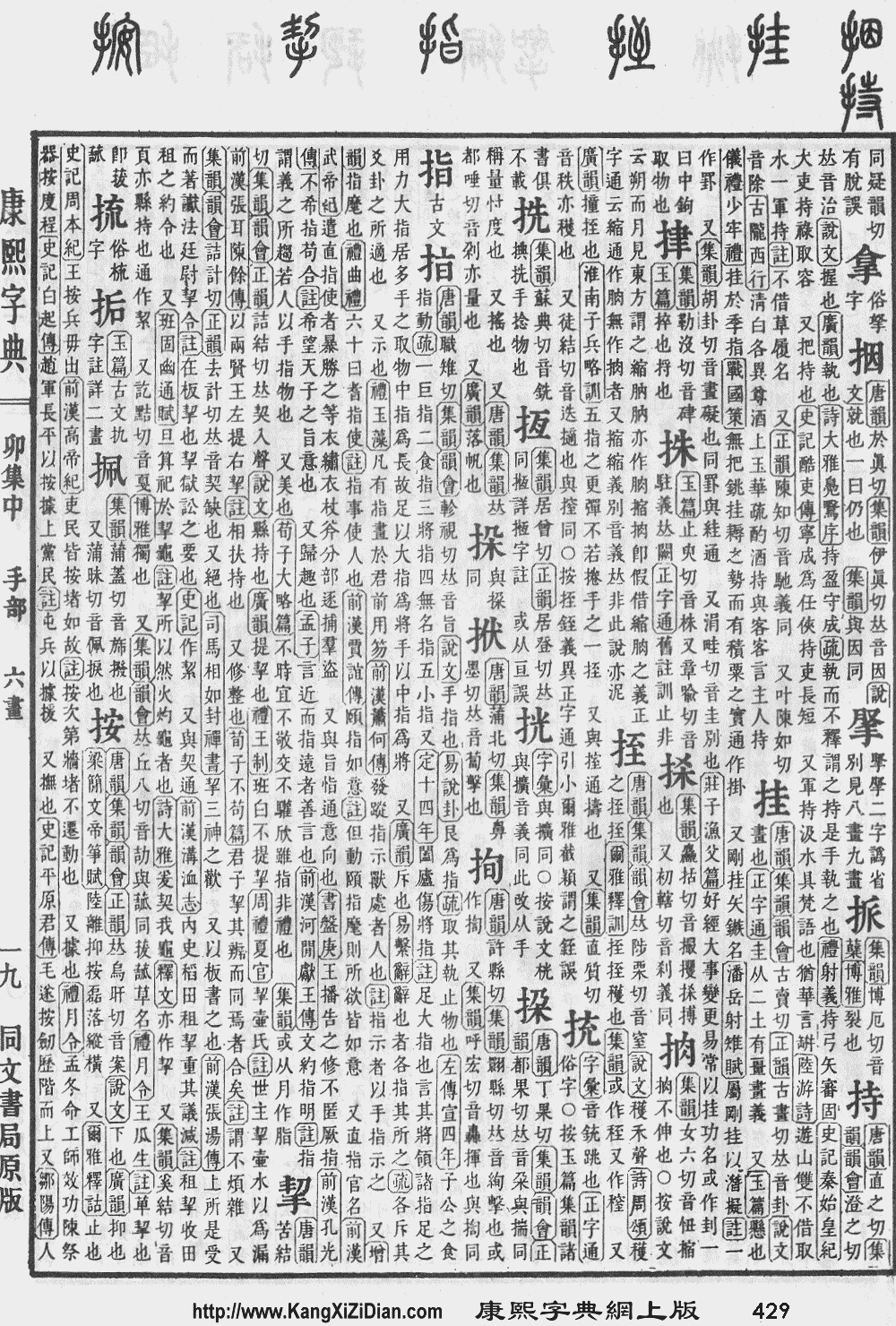
- KangXi: page 429, character 1
- Dai Kanwa Jiten: character 12015
- Dae Jaweon: page 777, character 19
- Hanyu Da Zidian (first edition): volume 3, page 1864, character 3
- Unihan data for U+62FF
Chinese
| simp. and trad. |
拿 | |
|---|---|---|
| alternative forms | 拏 挐 㧱 | |
Glyph origin
Characters in the same phonetic series (女) (Zhengzhang, 2003)
| Old Chinese | |
|---|---|
| 拿 | *rnaː |
| 拏 | *rnaː |
| 詉 | *rnaː |
| 蒘 | *rnaː, *na |
| 笯 | *rnaː, *naː, *naːs |
| 挐 | *rnaː, *na |
| 絮 | *rnaːs, *nas, *snas, *nas |
| 呶 | *rnaːw |
| 怓 | *rnaːw |
| 帑 | *n̥ʰaːŋʔ, *naː |
| 奴 | *naː |
| 砮 | *naː, *naːʔ |
| 駑 | *naː |
| 孥 | *naː |
| 努 | *naːʔ |
| 弩 | *naːʔ |
| 怒 | *naːʔ, *naːs |
| 袽 | *na |
| 帤 | *na |
| 女 | *naʔ, *nas |
| 籹 | *naʔ |
| 恕 | *hnjas |
| 如 | *nja, *njas |
| 茹 | *nja, *njaʔ, *njas |
| 洳 | *nja, *njas |
| 鴽 | *nja |
| 蕠 | *nja |
| 汝 | *njaʔ |
| 肗 | *njaʔ |
A later alternative glyph of 拏/拿 (ná) and 挐 for senses related to “to take with hand”. Originally regarded as unorthodox by Zhengzitong and Zihui.
Pronunciation
Definitions
拿
- to take; to hold; to grasp
- to seize; to capture
- to have a firm grasp of
- 拿權/拿权 ― náquán ― to hold the reins
- 拿不准 ― nábùzhǔn ― to be unsure
- to deliberately make things difficult for; to coerce
- to get; to receive
- to act; to pretend
- 拿架子 ― ná jiàzi ― to put on airs
- by means of; with; by
- used to introduce the target of a following verb phrase
- (Cantonese) Alternative form of 嗱.
-
- 拿,我同你講,我就肯定一樣野,就係嗰間房,我入去住嘅時候整嘅。 [Cantonese, trad.]
- naa4, ngo5 tung4 nei5 gong2, ngo5 zau6 hang2 ding6 jat1 joeng6 je5, zau6 hai6 go2 gaan1 fong4, ngo5 jap6 heoi3 zyu6 ge3 si4 hau6 zing2 ge3. [Jyutping]
- (please add an English translation of this example)
拿,我同你讲,我就肯定一样野,就系嗰间房,我入去住嘅时候整嘅。 [Cantonese, simp.]
-
- (Northern Wu, Min Bei) particle introducing the object of the verb
Synonyms
- (to take):
Dialectal synonyms of 拿 (“to take; to hold”) [map]
- (with):
Dialectal synonyms of 用 (“with; by; using”) [map]
| Variety | Location | Words |
|---|---|---|
| Formal (Written Standard Chinese) | 用, 拿 | |
| Mandarin | Beijing | 拿, 用 |
| Jinan | 用, 拿 | |
| Xi'an | 用, 拿 | |
| Wuhan | 用, 架, 拿 | |
| Chengdu | 拿, 使 | |
| Yangzhou | 拿, 用 | |
| Hefei | 用, 拿 | |
| Cantonese | Guangzhou | 用, 攞 |
| Hong Kong | 用, 攞 | |
| Yangjiang | 用, 捰 | |
| Gan | Nanchang | 用, 拿 |
| Hakka | Meixian | 用 |
| Jin | Taiyuan | 拿, 用 |
| Min Bei | Jian'ou | 使 |
| Min Dong | Fuzhou | 使, 獲 |
| Min Nan | Xiamen | 用 |
| Jinjiang | 用 | |
| Manila (Hokkien) | 用 | |
| Chaozhou | 用 | |
| Wu | Suzhou | 拿, 用 |
| Wenzhou | 用, 𧵊 | |
| Xiang | Changsha | 用, 拿 |
| Shuangfeng | 用 | |
- (object marker):
Dialectal synonyms of 把 (“particle introducing the object of the verb”) [map]
Compounds
Derived terms from 拿
|
|
Japanese
Kanji
拿
- This term needs a translation to English. Please help out and add a translation, then remove the text
{{rfdef}}.
Vietnamese
This article is issued from Wiktionary. The text is licensed under Creative Commons - Attribution - Sharealike. Additional terms may apply for the media files.