朋

朋 U+670B, 朋
CJK UNIFIED IDEOGRAPH-670B
← 朊
[U+670A]
CJK Unified Ideographs 朌 →
[U+670C]

Translingual

Stroke order
8 strokes

Han character

朋 (Kangxi radical 74, 月+4, 8 strokes, cangjie input 月月 (BB), four-corner 77220, composition ⿰月月)

Derived characters

References

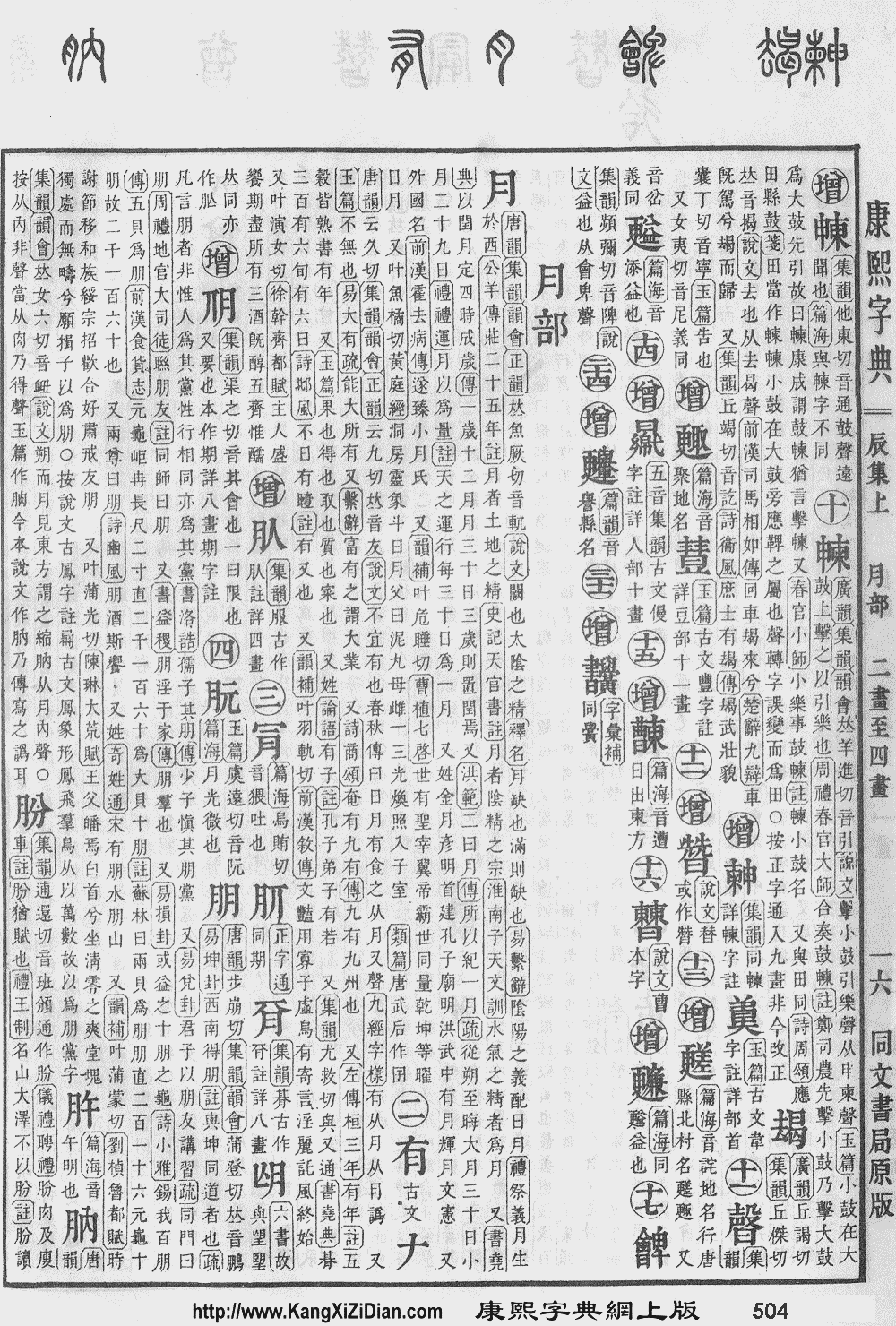
  • KangXi: page 504, character 29
  • Dai Kanwa Jiten: character 14340
  • Dae Jaweon: page 883, character 4
  • Hanyu Da Zidian (first edition): volume 3, page 2050, character 6
  • Unihan data for U+670B

Chinese

simp. and trad.
朋

Glyph origin

Historical forms of the character 朋
Shang Western Zhou Warring States Shuowen Jiezi (compiled in Han) Liushutong (compiled in Ming)
Oracle bone script Bronze inscriptions Qin slip script Small seal script Transcribed ancient scripts

Pictogram (象形) .

The oracle bone script form consisted of two strings of five cowries. Some forms of the oracle bone script contained an additional 人 which later evolved into 勹 (OC *pruː), which served as a phonetic component.

Shuowen erroneously suggests 朋 (OC *bɯːŋ) was the ancient form of 鳳 (OC *bums).

Duplication of 月 (“moon”) in current form.

Pronunciation


  • Dialectal data
Variety Location 朋
Mandarin Beijing /pʰəŋ³⁵/
Harbin /pʰəŋ²⁴/
Tianjin /pʰəŋ⁴⁵/
Jinan /pʰəŋ⁴²/
Qingdao /pʰəŋ⁴²/
Zhengzhou /pʰəŋ⁴²/
Xi'an /pʰəŋ²⁴/
Xining /pʰə̃²⁴/
Yinchuan /pʰəŋ⁵³/
Lanzhou /pʰə̃n⁵³/
Ürümqi /pʰɤŋ⁵¹/
Wuhan /pʰoŋ²¹³/
Chengdu /pʰoŋ³¹/
Guiyang /pʰoŋ²¹/
Kunming /pʰoŋ¹/
Nanjing /pʰən²⁴/
Hefei /pʰəŋ⁵⁵/
Jin Taiyuan /pʰəŋ¹¹/
Pingyao /pʰəŋ¹³/
Hohhot /pʰə̃ŋ³¹/
Wu Shanghai /bã²³/
Suzhou /bən¹³/
Hangzhou /boŋ²¹³/
Wenzhou /boŋ³¹/
Hui Shexian /pʰʌ̃⁴⁴/
Tunxi /pʰan⁴⁴/
Xiang Changsha /poŋ³³/
Xiangtan /bən¹²/
Gan Nanchang /pʰuŋ²⁴/
Hakka Meixian /pʰen¹¹/
Taoyuan /pʰen¹¹/
Cantonese Guangzhou /pʰɐŋ²¹/
Nanning /pʰɐŋ²¹/
Hong Kong /pʰɐŋ²¹/
Min Xiamen (Min Nan) /piŋ³⁵/
Fuzhou (Min Dong) /pɛiŋ⁵³/
Jian'ou (Min Bei) /paiŋ²¹/
Shantou (Min Nan) /pʰeŋ⁵⁵/
Haikou (Min Nan) /foŋ³¹/

Rime
Character 朋
Reading # 1/1
Initial (聲) 並 (3)
Final (韻) 登 (129)
Tone (調) Level (Ø)
Openness (開合) Open
Division (等) I
Fanqie 步崩切
Reconstructions
Zhengzhang
Shangfang
/bəŋ/
Pan
Wuyun
/bəŋ/
Shao
Rongfen
/bəŋ/
Edwin
Pulleyblank
/bəŋ/
Li
Rong
/bəŋ/
Wang
Li
/bəŋ/
Bernard
Karlgren
/bʱəŋ/
Expected
Mandarin
Reflex
péng
Expected
Cantonese
Reflex
pang4
Baxter–Sagart system 1.1 (2014)
Character 朋
Reading # 1/1
Modern
Beijing
(Pinyin)
péng
Middle
Chinese
‹ bong ›
Old
Chinese
/*[b]ˁəŋ/
English set of cowries; friend

Notes for Old Chinese notations in the Baxter–Sagart system:

* Parentheses "()" indicate uncertain presence;
* Square brackets "[]" indicate uncertain identity, e.g. *[t] as coda may in fact be *-t or *-p;
* Angle brackets "<>" indicate infix;
* Hyphen "-" indicates morpheme boundary;

* Period "." indicates syllable boundary.
Zhengzhang system (2003)
Character 朋
Reading # 1/1
No. 9663
Phonetic
component
朋
Rime
group
蒸
Rime
subdivision
0
Corresponding
MC rime
朋
Old
Chinese
/*bɯːŋ/

Definitions

朋

  1. † unit of shell money; various theories exist about the exact amount
  2. friend
    朋友  ―  péngyǒu  ―  friend
    良朋  ―  liángpéng  ―  good friend
  3. (literary) to gang up; to band together
  4. (literary) to be similar; to equal
    碩大無朋/硕大无朋  ―  shuòdàwúpéng  ―  exceptionally large; enormous
  5. a surname

Compounds

  • 良朋益友
  • 酒肉朋友 (jiǔròu péngyou)
  • 面朋
  • 高朋 (gāopéng)
  • 高朋故戚
  • 朋奸
  • 朋比作奸
  • 交朋結義/交朋结义
  • 呼朋引類/呼朋引类
  • 夠朋友/够朋友 (gòu péngyou)
  • 引類呼朋/引类呼朋
  • 挾朋樹黨/挟朋树党
  • 朋儔/朋俦
  • 朋儕/朋侪
  • 朋友有舊/朋友有旧
  • 朋從/朋从
  • 朋比為奸/朋比为奸 (péngbǐwéijiān)
  • 朋謀/朋谋
  • 朋頭/朋头
  • 朋馳/朋驰

Japanese

Shinjitai 朋
Kyūjitai
[1][2]

朋󠄁
朋+&#xE0101;?
(Adobe-Japan1)
朋󠄃
朋+&#xE0103;?
(Hanyo-Denshi)
(Moji_Joho)
The displayed kanji may be different from the image due to your environment.
See here for details.

Kanji

朋

(“Jinmeiyō” kanji used for names)

  1. friend
  2. faction

Readings

Compounds

Etymology 1

Kanji in this term
朋
とも
Jinmeiyō
kun’yomi
For pronunciation and definitions of 朋 – see the following entry.
【とも】
[noun] friend, companion, comrade, pal
[noun] member of the same category
Alternative spellings
友, 朋
(This term, 朋, is an alternative spelling of the above term.)

Proper noun

朋(とも) • (Tomo) 

  1. a female given name

References

  1. 1914, 漢和大辭書 (Kanwa Dai Jisho, “The Great Kanji-Japanese Dictionary”) (in Japanese), page 1089 (paper), page 595 (digital), Tōkyō: 興文社 (Kōbunsha)
  2. 1927, 新漢和辭典 (Shin Kanwa Jiten, “The New Kanji-Japanese Dictionary”) (in Japanese), page 657 (paper), page 341 (digital), Ōsaka: 松雲堂 (Shōundō)

Korean

Etymology

From Middle Chinese 朋 (MC bəŋ). Recorded as Middle Korean 브ᇰ (pung) (Yale: pung) in Hunmong Jahoe (訓蒙字會 / 훈몽자회), 1527.

Hanja

Wikisource 朋 (eumhun 벗 붕 (beot bung))

  1. Hanja form? of 붕 (“friend”).

Compounds

References

  • 국제퇴계학회 대구경북지부 (國際退溪學會 大邱慶北支部) (2007). Digital Hanja Dictionary, 전자사전/電子字典.

Vietnamese

Han character

朋: Hán Nôm readings: bằng, bẵng

  1. This term needs a translation to English. Please help out and add a translation, then remove the text {{rfdef}}.
This article is issued from Wiktionary. The text is licensed under Creative Commons - Attribution - Sharealike. Additional terms may apply for the media files.