既
| ||||||||
 | ||||||||
Translingual
Han character
既 (Kangxi radical 71, 无+5, 9 strokes in Chinese, 10 strokes in Japanese and Korean, cangjie input 日戈一女山 (AIMVU), four-corner 71714, composition ⿰⿲𠄌𫜹丶旡)
References
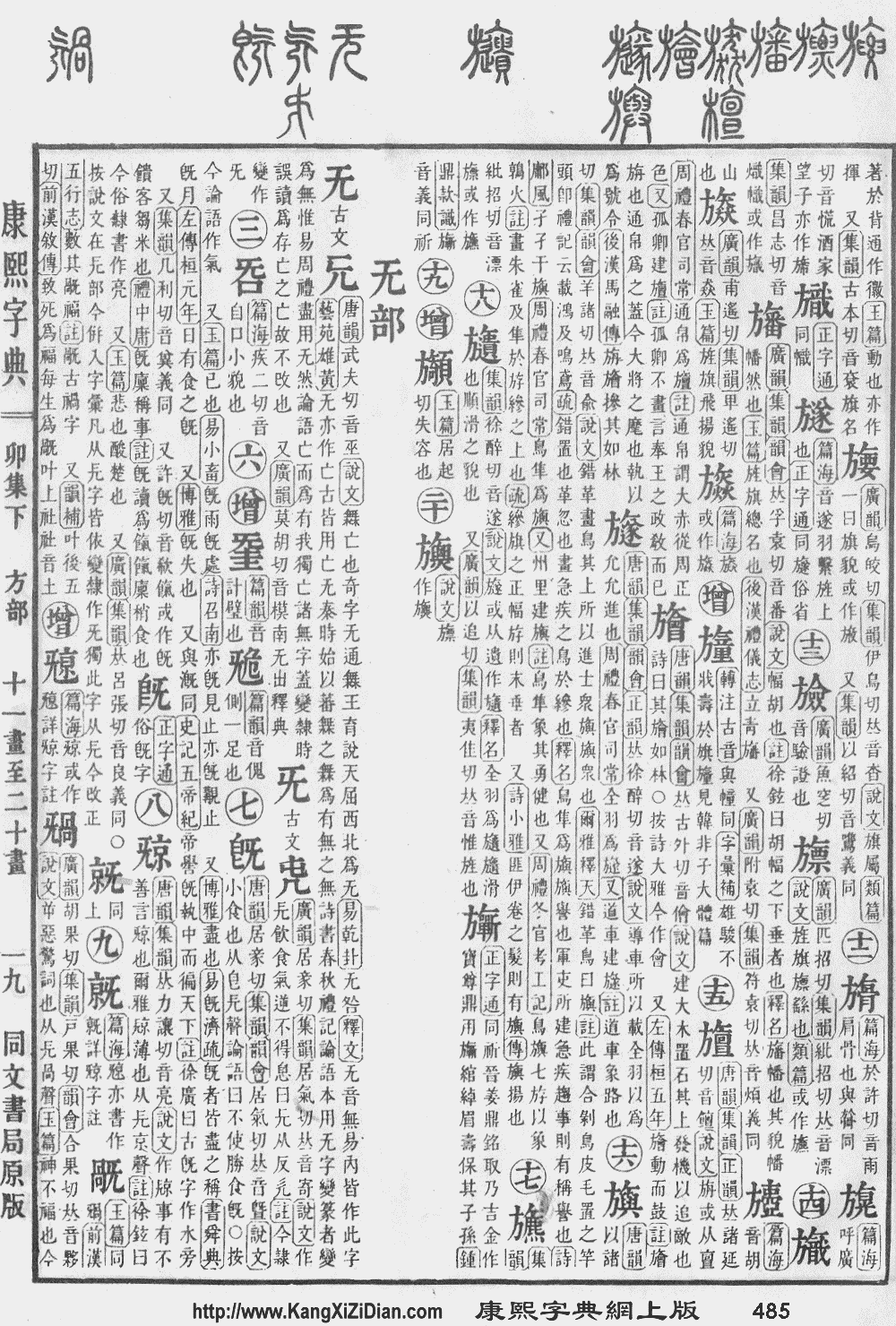
- KangXi: page 485, character 31
- Dai Kanwa Jiten: character 13721
- Dae Jaweon: page 848, character 3
- Hanyu Da Zidian (first edition): volume 2, page 1148, character 1
- Unihan data for U+65E2
- Unihan data for U+FA42
Chinese
| trad. | 既/旣 | |
|---|---|---|
| simp. | 既 | |
| 2nd round simp. | 旡 | |
Glyph origin
| Historical forms of the character 既 | ||
|---|---|---|
| Shang | Western Zhou | Warring States |
| Oracle bone script | Bronze inscriptions | Chu slip and silk script |
 |
 |
 |
Ideogrammic compound (會意) : 皀 (“bowl of rice”) + 旡 (“kneeling figure”) – person kneeling at bowl of rice – sitting down to eat (rice already finished cooking), or turning away (already finished eating).
Note the stroke order in the right component 旡, which may not be clear in the compressed form of this character: the left vertical and second horizontal are one stroke with a corner, while the upper right vertical continues in a diagonal stroke to lower left.
Etymology
Maybe Sino-Tibetan (Schuessler, 2007). Exopassive (perfective) of 訖/讫 (qì, “to finish”); possibly cognate to 暨 (jì, “to reach”), yet see there.
Pronunciation
Definitions
既
- already
- 既往不咎 ― jìwǎngbùjiù ― to let bygones be bygones
- 克明俊德,以親九族,九族既睦,平章百姓。 [Classical Chinese, trad.]
- From: The Book of Documents, circa 4th – 3rd century BCE
- Kèmíng jùndé, yǐ qīn jiǔzú, jiǔzú jì mù, píngzhāng bǎixìng. [Pinyin]
- [A]nd thence proceeded to the love of (all in) the nine classes of his kindred, who (thus) became harmonious. He (also) regulated and polished the people (of his domain).
克明俊德,以亲九族,九族既睦,平章百姓。 [Classical Chinese, simp.]- 相如既歸,趙王以為賢大夫,使不辱於諸侯,拜相如為上大夫。 [Classical Chinese, trad.]
- From: The Records of the Grand Historian, by Sima Qian, c. 91 BCE
- Xiàngrú jì guī, Zhào wáng yǐwéi xián dàfū, shǐ bù rǔ yú zhūhóu, bài Xiàngrú wéi shàngdàfū. [Pinyin]
- (please add an English translation of this example)
相如既归,赵王以为贤大夫,使不辱于诸侯,拜相如为上大夫。 [Classical Chinese, simp.]
- (obsolete) to have a total solar eclipse or lunar eclipse
- 秋七月壬辰朔,日有食之,既。 [Classical Chinese, trad. and simp.]
- From: Commentary of Zuo, c. 4th century BCE, translated based on James Legge's version
- Qiū qīyuè rénchén shuò, rì yǒu shí zhī, jì. [Pinyin]
- In autumn, in the seventh month, on [the day] Renchen, the first day of the moon, the sun was totally eclipsed.
- (literary) to be finished; to end
- (obsolete) all
- 彼眾我寡,及其未既濟也,請擊之。 [Classical Chinese, trad.]
- From: Commentary of Zuo, c. 4th century BCE, translated based on James Legge's version
- Bǐ zhòng wǒ guǎ, jí qí wèi jì jì yě, qǐng jī zhī. [Pinyin]
- They are many, and we are few. Pray let us attack them, before they have all crossed over.
彼众我寡,及其未既济也,请击之。 [Classical Chinese, simp.]
- since; as; now that
- 使同乎我與若者正之,既同乎我與若矣,惡能正之! [Classical Chinese, trad.]
- From: Zhuangzi, circa 3rd – 2nd centuries BCE
- Shǐ tóng hū wǒ yǔ ruò zhě zhèng zhī, jì tóng hū wǒ yǔ ruò yǐ, wū néng zhèng zhī! [Pinyin]
- If I employ one who agrees with me, how can he, agreeing with me, do so correctly?
使同乎我与若者正之,既同乎我与若矣,恶能正之! [Classical Chinese, simp.]- 耶和華神對蛇說:「你既做了這事,就必受咒詛,比一切的牲畜野獸更甚!你必用肚子行走,終身吃土。」 [MSC, trad.]
- From: 新標點和合本 (Chinese Union Version with New Punctuation), 創世記 (Genesis) 3:14
- Yēhéhuá Shén duì shé shuō: “Nǐ jì zuò le zhè shì, jiù bì shòu zhòuzǔ, bǐ yīqiè de shēngchù yěshòu gèngshèn! Nǐ bì yòng dùzi xíngzǒu, zhōngshēn chī tǔ.” [Pinyin]
- And the LORD God said unto the serpent, Because thou hast done this, thou art cursed above all cattle, and above every beast of the field; upon thy belly shalt thou go, and dust shalt thou eat all the days of thy life
耶和华神对蛇说:“你既做了这事,就必受咒诅,比一切的牲畜野兽更甚!你必用肚子行走,终身吃土。” [MSC, simp.]
- both . . . (and...); as well as
Synonyms
| Variety | Location | Words |
|---|---|---|
| Classical Chinese | 已, 業, 業已, 既 | |
| Formal (Written Standard Chinese) | 已經, 已, 業經, 業已, 已然 | |
| Mandarin | Beijing | 已經 |
| Taiwan | 已經 | |
| Jinan | 已經 | |
| Xi'an | 已經 | |
| Wuhan | 已經 | |
| Chengdu | 已經 | |
| Guilin | 已經 | |
| Yangzhou | 已經 | |
| Hefei | 已經 | |
| Singapore | 已經 | |
| Sokuluk (Gansu Dungan) | 可價 | |
| Cantonese | Guangzhou | 已經, 經已 |
| Hong Kong | 已經, 經已 | |
| Taishan | 經已 | |
| Yangjiang | 應 | |
| Singapore (Guangfu) | 已經 | |
| Gan | Nanchang | 已經 |
| Hakka | Meixian | 既經 |
| Miaoli (N. Sixian) | 既經 | |
| Pingtung (Neipu; S. Sixian) | 既經, 已經 | |
| Hsinchu County (Zhudong; Hailu) | 既經 | |
| Taichung (Dongshi; Dabu) | 既經 | |
| Hsinchu County (Qionglin; Raoping) | 既經 | |
| Yunlin (Lunbei; Zhao'an) | 已經 | |
| Huizhou | Jixi | 已經 |
| Jin | Taiyuan | 已經 |
| Min Bei | Jian'ou | 已經 |
| Min Dong | Fuzhou | 已經 |
| Matsu | 已經 | |
| Min Nan | Xiamen | 已經 |
| Quanzhou | 已經 | |
| Zhangzhou | 已經 | |
| Taipei | 已經 | |
| Kaohsiung | 已經 | |
| Singapore (Hokkien) | 已經 | |
| Manila (Hokkien) | 已經 | |
| Chaozhou | 已經 | |
| Shantou | 已經 | |
| Jieyang | 已經 | |
| Pontianak (Teochew) | 已經 | |
| Wu | Suzhou | 已經 |
| Wenzhou | 已經 | |
| Xiang | Changsha | 現是, 已經 |
| Shuangfeng | 已經, 既已經 | |
Japanese
| Shinjitai | 既 | |
| Kyūjitai [1] |
既 既or 既+ ︀? |
|
| 既󠄀 既+ 󠄀?(Adobe-Japan1) | ||
| 既󠄄 既+ 󠄄?(Hanyo-Denshi) (Moji_Joho) | ||
| The displayed kanji may be different from the image due to your environment. See here for details. | ||
Readings
References
- “既”, in 漢字ぺディア (Kanjipedia) (in Japanese), 日本漢字能力検定協会, 2015—2023