染

染 U+67D3, 染
CJK UNIFIED IDEOGRAPH-67D3
← 柒
[U+67D2]
CJK Unified Ideographs 柔 →
[U+67D4]

Translingual

Han character

染 (Kangxi radical 75, 木+5, 9 strokes, cangjie input 水弓木 (END), four-corner 34904, composition ⿱氿木(GJKV) or ⿱氿𣎳(HT))

Derived characters

References

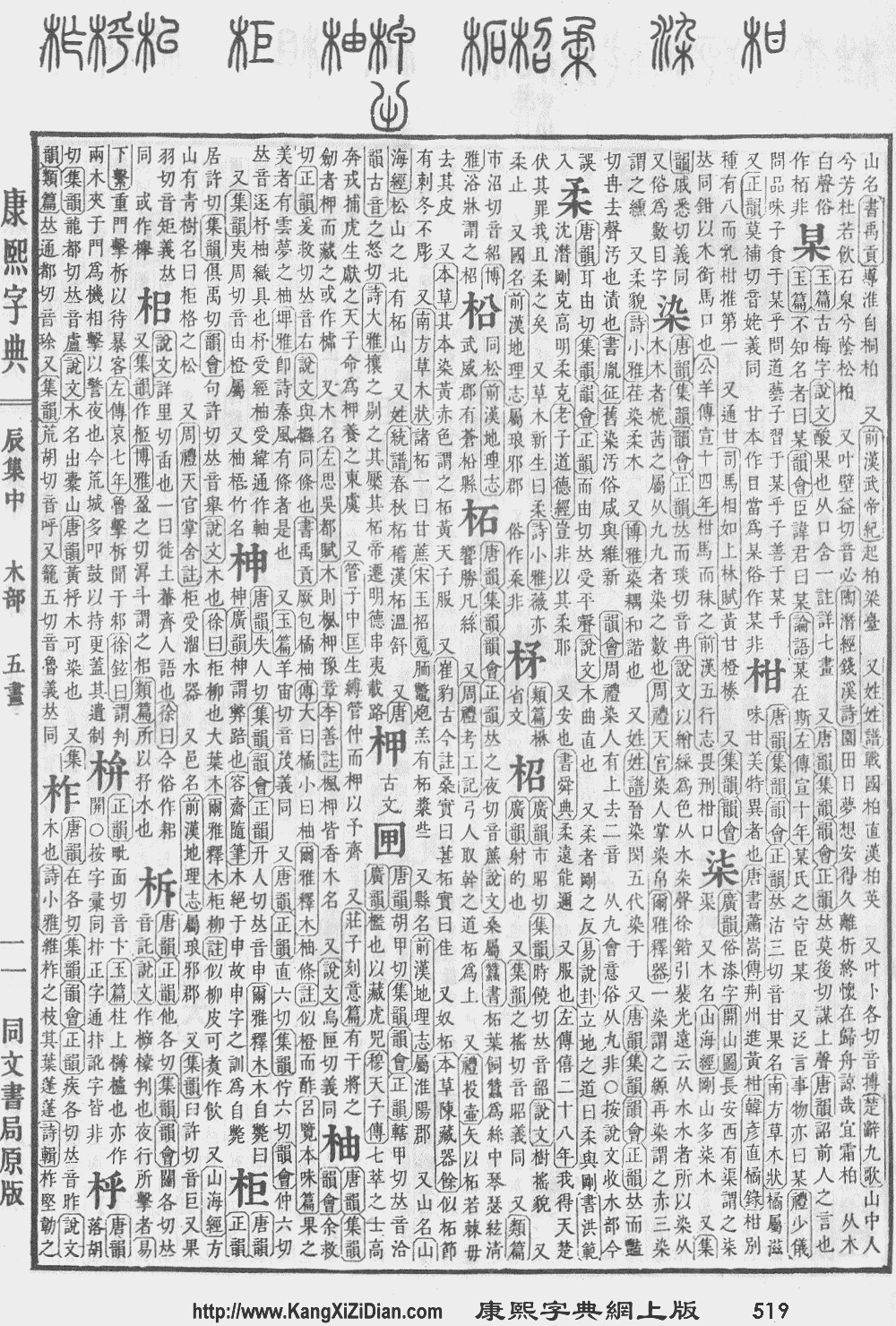
  • KangXi: page 519, character 4
  • Dai Kanwa Jiten: character 14621
  • Dae Jaweon: page 907, character 3
  • Hanyu Da Zidian (first edition): volume 2, page 1188, character 7
  • Unihan data for U+67D3

Chinese

trad. 染
simp. # 染

Glyph origin

Historical forms of the character 染
Shuowen Jiezi (compiled in Han) Liushutong (compiled in Ming)
Small seal script Transcribed ancient scripts


References:

Mostly from Richard Sears' Chinese Etymology site (authorisation),
which in turn draws data from various collections of ancient forms of Chinese characters, including:

  • Shuowen Jiezi (small seal),
  • Jinwen Bian (bronze inscriptions),
  • Liushutong (Liushutong characters) and
  • Yinxu Jiaguwen Bian (oracle bone script).

Ideogrammic compound (會意) : 氵 (“water”) + 九 (“hook”) + 木 (“tree”) – to hang (on a hook 九) from a tree (木) into water (氵), so as to dye.

Earlier forms more often graphically 氵 + 杂; in the modern form, the water radical is moved upward to the upper-left corner.

Etymology

Coblin (1986) compares this to Tibetan ཉམས་པ (nyams pa, “be stained, tarnished, spoiled”); Pan (1987) also notes Proto-Tai *ɲuɔmᴬ as well as Vietnamese nhuộm, both meaning "to dye".

Schuessler (2007) cites Downer (1986)'s opinion that form with 上 (shàng) tone is the verb, while form with 去 (qù) tone is the noun meaning "kind of cloth" (Lǐjì).

Pronunciation


Note:
  • liám/jiám - literary;
  • ní - vernacular.
Note:
  • riam2 - literary;
  • ni2 - vernacular.

  • Dialectal data
Variety Location 染
Mandarin Beijing /ʐan²¹⁴/
Harbin /ʐan²¹³/
Tianjin /ian¹³/
/ʐan¹³/
Jinan /ʐã⁵⁵/
Qingdao /iã⁵⁵/
Zhengzhou /ʐan⁵³/
Xi'an /ʐã⁵³/
Xining /ʐã⁵³/
Yinchuan /ʐan⁵³/
Lanzhou /ʐɛ̃n⁴⁴²/
Ürümqi /ʐan⁵¹/
Wuhan /nan⁴²/
Chengdu /zan⁵³/
Guiyang /zan⁴²/
Kunming /ʐã̠⁵³/
Nanjing /ʐaŋ²¹²/
Hefei /ʐæ̃²⁴/
/ʐən²⁴/
Jin Taiyuan /zæ̃⁵³/
Pingyao /ʐɑŋ⁵³/
Hohhot /ʐæ̃⁵³/
Wu Shanghai /ȵi²³/
/zø²³/
Suzhou /ȵiɪ³¹/
Hangzhou /zz̩ʷõ¹³/
Wenzhou /ȵi³⁵/
Hui Shexian /ne³⁵/
Tunxi /ȵiɛ²⁴/
Xiang Changsha /yẽ⁴¹/
Xiangtan /iẽ⁴²/
Gan Nanchang /ȵiɛn²¹³/
Hakka Meixian /ŋiam⁵³/
Taoyuan /ŋiɑm⁵⁵/
Cantonese Guangzhou /jim²³/
Nanning /jim²⁴/
Hong Kong /jim¹³/
Min Xiamen (Min Nan) /liam⁵³/
/ni⁵³/
Fuzhou (Min Dong) /nieŋ³²/
Jian'ou (Min Bei) /niŋ²¹/
Shantou (Min Nan) /ziam⁵³/
/nĩ⁵³/
Haikou (Min Nan) /zam²¹³/
/ni²¹³/

Rime
Character 染 染
Reading # 1/2 2/2
Initial (聲) 日 (38) 日 (38)
Final (韻) 鹽 (153) 鹽 (153)
Tone (調) Rising (X) Departing (H)
Openness (開合) Open Open
Division (等) III III
Fanqie 而琰切 而豔切
Reconstructions
Zhengzhang
Shangfang
/ȵiᴇmX/ /ȵiᴇmH/
Pan
Wuyun
/ȵiɛmX/ /ȵiɛmH/
Shao
Rongfen
/ȵʑjæmX/ /ȵʑjæmH/
Edwin
Pulleyblank
/ȵiamX/ /ȵiamH/
Li
Rong
/ȵiɛmX/ /ȵiɛmH/
Wang
Li
/ȵʑĭɛmX/ /ȵʑĭɛmH/
Bernard
Karlgren
/ȵʑi̯ɛmX/ /ȵʑi̯ɛmH/
Expected
Mandarin
Reflex
rǎn ràn
Expected
Cantonese
Reflex
jim5 jim6
Baxter–Sagart system 1.1 (2014)
Character 染
Reading # 1/1
Modern
Beijing
(Pinyin)
rǎn
Middle
Chinese
‹ nyemX ›
Old
Chinese
/*C.n[a]mʔ/
English to dye

Notes for Old Chinese notations in the Baxter–Sagart system:

* Parentheses "()" indicate uncertain presence;
* Square brackets "[]" indicate uncertain identity, e.g. *[t] as coda may in fact be *-t or *-p;
* Angle brackets "<>" indicate infix;
* Hyphen "-" indicates morpheme boundary;

* Period "." indicates syllable boundary.
Zhengzhang system (2003)
Character 染 染
Reading # 1/2 2/2
No. 10790 10791
Phonetic
component
染 染
Rime
group
談 談
Rime
subdivision
3 3
Corresponding
MC rime
冉 染
Old
Chinese
/*njomʔ/ /*njoms/

Definitions

染

  1. to dye
    把頭髮染成棕色/把头发染成棕色  ―  bǎ tóufà rǎn chéng zōngsè  ―  to dye one's hair brown
  2. to catch (a disease); to fall into (a bad habit)
    染上破傷風/染上破伤风  ―  rǎn shàng pòshāngfēng  ―  to get tetanus
  3. a surname: Ran

Compounds

References

Japanese

Kanji

染

(grade 6 “Kyōiku” kanji)

  1. dye, color, paint, stain, print

Readings

Korean

Etymology

From Middle Chinese 染 (MC ȵiᴇmX, ȵiᴇmH).

Historical readings

Pronunciation

  • (SK Standard/Seoul) IPA(key): [jɘ(ː)m]
  • Phonetic hangul: [염(ː)]
    • Though still prescribed in Standard Korean, most speakers in both Koreas no longer distinguish vowel length.

Hanja

Wikisource 染 (eumhun 물들일 염 (muldeuril yeom))

  1. Hanja form? of 염 (“dye”).

Compounds

References

  • 국제퇴계학회 대구경북지부 (國際退溪學會 大邱慶北支部) (2007). Digital Hanja Dictionary, 전자사전/電子字典.

Vietnamese

Han character

染: Hán Nôm readings: nhuộm, nhẹm, nhiễm, nhuốm, ruộm, vẩn

  1. This term needs a translation to English. Please help out and add a translation, then remove the text {{rfdef}}.
This article is issued from Wiktionary. The text is licensed under Creative Commons - Attribution - Sharealike. Additional terms may apply for the media files.