毋
| ||||||||
| ||||||||
Translingual
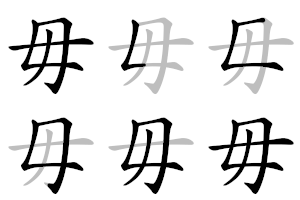
| Stroke order | |||
|---|---|---|---|
 | |||
Han character
毋 (Kangxi radical 80, 毋+0, 4 strokes, cangjie input 田十 (WJ), four-corner 77500, composition ⿻⿻𠃋𠃌𠂇(GHTV) or ⿻⿻𠃋𠃌十(JK))
- Kangxi radical #80, ⽏.
Derived characters
- Appendix:Chinese radical/毋
- 𥁉, 𣏭, 𩬍
References
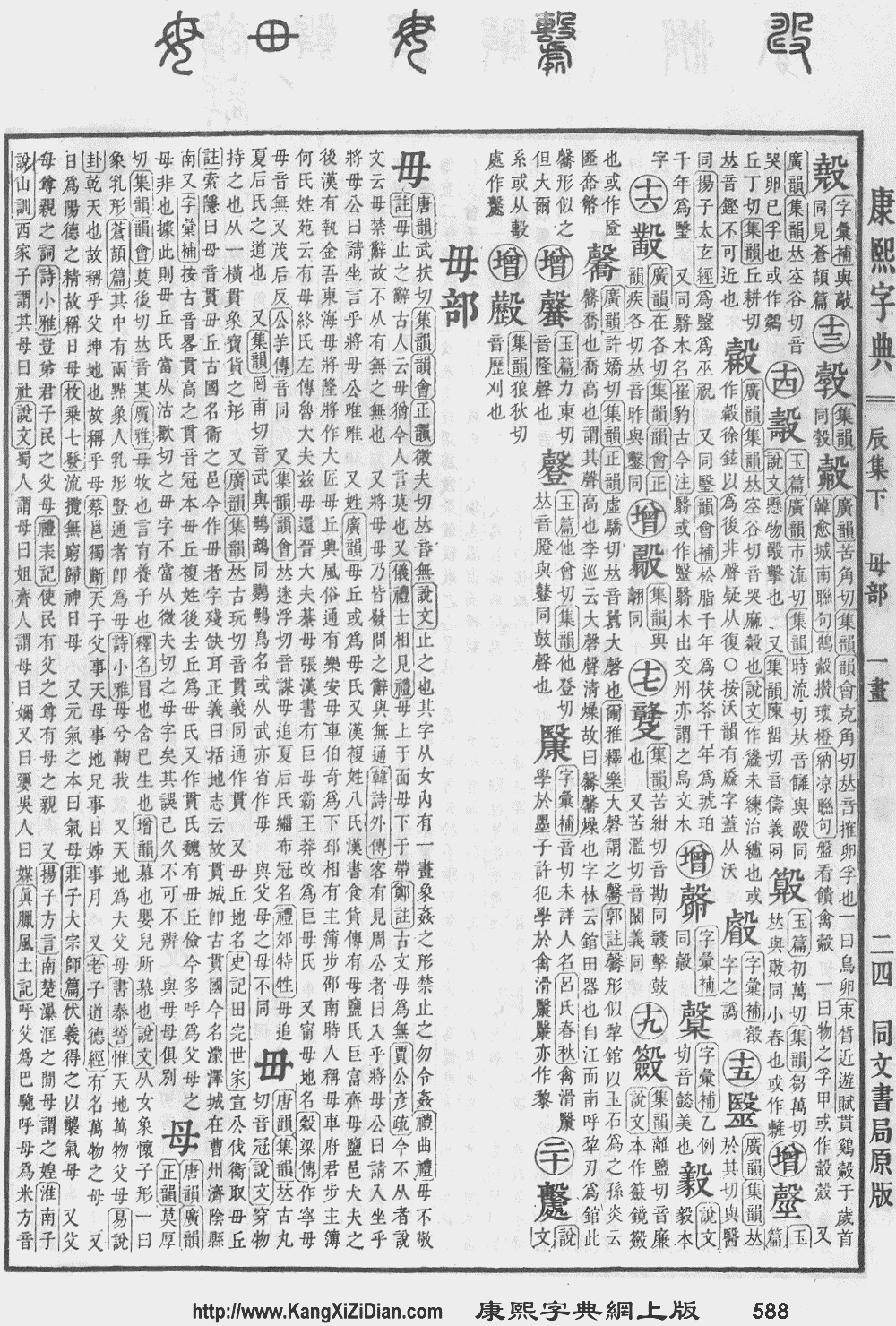
- KangXi: page 588, character 23
- Dai Kanwa Jiten: character 16721
- Dae Jaweon: page 980, character 29
- Hanyu Da Zidian (first edition): volume 4, page 2380, character 1
- Unihan data for U+6BCB
Chinese
| simp. and trad. |
毋 | |
|---|---|---|
| alternative forms | 不 vernacular Hakka and Min Nan 唔 vernacular Hakka and Min Nan 伓 vernacular Min Nan 呣 vernacular Min Nan | |
Glyph origin
| Historical forms of the character 毋 | ||
|---|---|---|
| Western Zhou | Shuowen Jiezi (compiled in Han) | Liushutong (compiled in Ming) |
| Bronze inscriptions | Small seal script | Transcribed ancient scripts |
 |
 |
 |
Characters in the same phonetic series (母) (Zhengzhang, 2003)
| Old Chinese | |
|---|---|
| 脢 | *mɯːs, *mɯː, *mɯːs |
| 挴 | *mlɯːʔ, *mɯːʔ |
| 海 | *hmlɯːʔ |
| 毐 | *ʔmɯː, *ʔmɯːʔ |
| 呣 | *mɯ |
| 拇 | *mɯʔ |
| 母 | *mɯʔ |
| 胟 | *mɯʔ |
| 姆 | *mɯʔ, *mɯs, *maːʔ |
| 畮 | *mɯʔ |
| 踇 | *mɯʔ |
| 苺 | *mɯs, *mɯːʔ, *mɯːs |
| 莓 | *mɯs, *mɯː, *mɯːs |
| 敏 | *mrɯʔ, *mrɯŋʔ |
| 鰵 | *mrɯŋʔ |
| 慜 | *mrɯŋʔ |
| 毋 | *ma |
| 梅 | *mɯː |
| 酶 | *mɯː |
| 鋂 | *mɯː |
| 每 | *mɯːʔ |
| 毎 | *mɯːs |
| 痗 | *mɯːs, *hmɯːs |
| 晦 | *hmɯːs |
| 誨 | *hmɯːs |
| 悔 | *hmɯːʔ, *hmɯːs |
| 霉 | *mrɯl |
In the oracle bone script, 母 (“mother”) was borrowed to represent this character. It was later specialized to distinguish it from “mother”, replacing the two dots with one stroke.
Etymology
Cognate with 無 (OC *ma, “to not have”). Already in Zhou time, phonetically confused with and read like 無 (OC *ma).
Pronunciation
Definitions
毋
- (literary) do not, don't
- 宜未雨而綢繆,毋臨渴而掘井。 [Classical Chinese, trad.]
- From: 朱子家訓 (The Familial Rules of Zhuzi)
- Yí wèi yǔ ér chóumóu, wú lín kě ér jué jǐng. [Pinyin]
- It is proper to bind [the window] tightly when it is not yet raining. Do not dig a well when you are about to be thirsty. (I.e., one should prepare before it is too late. See 未雨綢繆/未雨绸缪 (wèiyǔchóumóu) and 臨渴掘井/临渴掘井 (línkějuéjǐng).)
宜未雨而绸缪,毋临渴而掘井。 [Classical Chinese, simp.]
- (literary or Hakka, Hokkien) not
- 我毋捌字。 [Hokkien] ― Góa m̄ pat-jī. [Pe̍h-ōe-jī] ― I'm illiterate (literally: I don't know characters)
- (literary) Alternative form of 無/无 (wú, “to not have”).
- a surname
Synonyms
Dialectal synonyms of 不 (“not”) [map]
Compounds
References
- Dictionary of Chinese Character Variants (教育部異體字字典), A02097
- “Entry #818”, in 臺灣閩南語常用詞辭典 [Dictionary of Frequently-Used Taiwan Minnan] (in Chinese and Min Nan), Ministry of Education, R.O.C., 2011.
Japanese
Korean
Vietnamese
References
- Trần (2004).
This article is issued from Wiktionary. The text is licensed under Creative Commons - Attribution - Sharealike. Additional terms may apply for the media files.