溝

See also: 沟
溝 U+6E9D, 溝
CJK UNIFIED IDEOGRAPH-6E9D
← 溜
[U+6E9C]
CJK Unified Ideographs 溞 →
[U+6E9E]

Translingual

Han character

溝 (Kangxi radical 85, 水+10, 13 strokes, cangjie input 水廿廿月 (ETTB), four-corner 35147, composition ⿰氵冓)

References

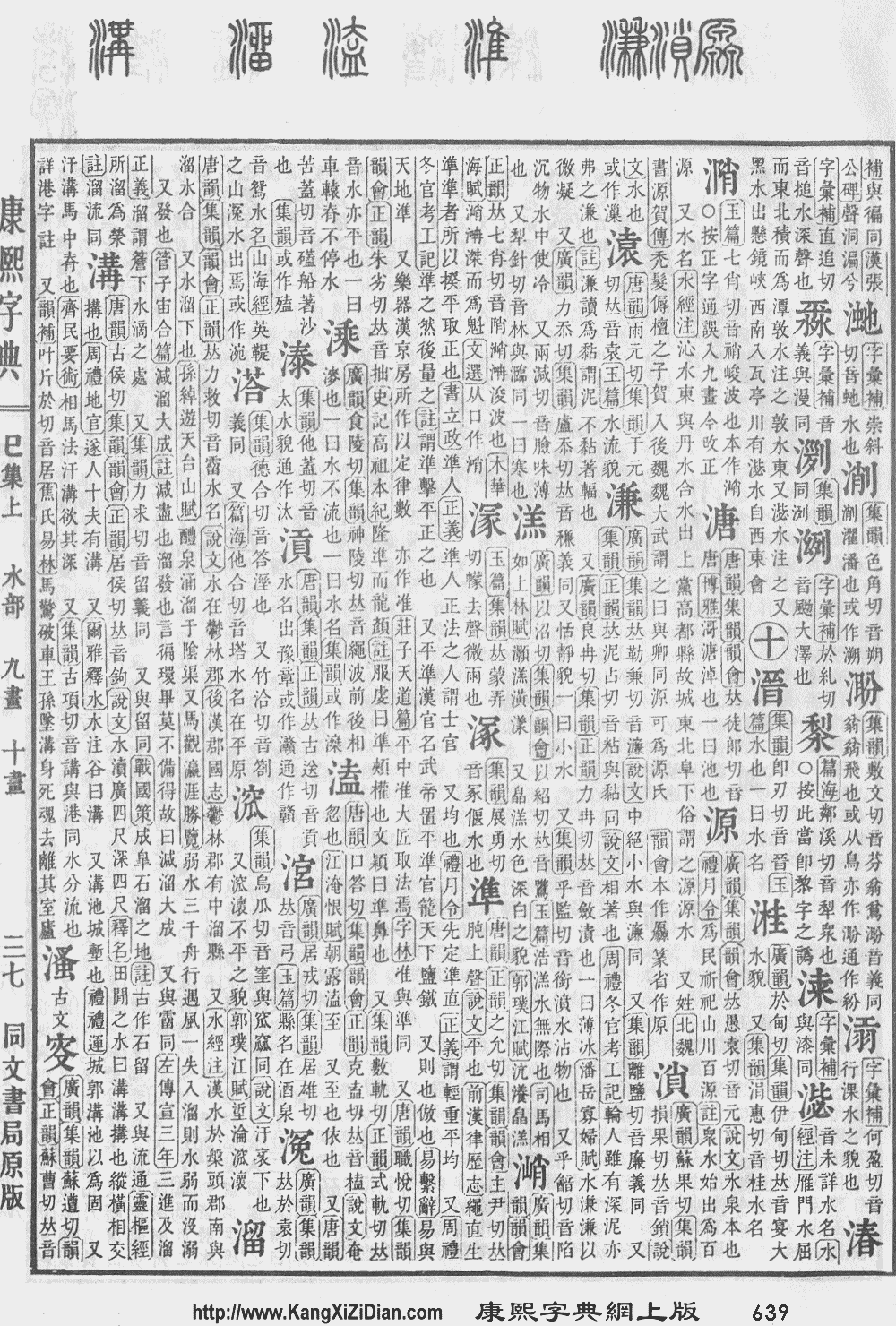
  • KangXi: page 639, character 34
  • Dai Kanwa Jiten: character 17944
  • Dae Jaweon: page 1046, character 22
  • Hanyu Da Zidian (first edition): volume 3, page 1692, character 6
  • Unihan data for U+6E9D

Chinese

Glyph origin

Phono-semantic compound (形聲, OC *koː) : semantic 氵 (“water”) + phonetic 冓 (OC *koː, *koːs).

Etymology 1

trad. 溝
simp. 沟*

Possibly the k-prefix noun of 漏 (OC *roːs, “to leak”) (Schuessler, 2007).

Pronunciation


Note: gau1 - uncommon (due to homophony with 㞗).
Note:
  • gău - vernacular;
  • gĕu - literary.
Note:
  • kau - vernacular;
  • ko͘/kio - literary.

  • Dialectal data
Variety Location 溝
Mandarin Beijing /kou⁵⁵/
Harbin /kou⁴⁴/
Tianjin /kou²¹/
Jinan /kou²¹³/
Qingdao /kou²¹³/
Zhengzhou /kou²⁴/
Xi'an /kou²¹/
Xining /kɯ⁴⁴/
Yinchuan /kəu⁴⁴/
Lanzhou /kou³¹/
Ürümqi /kɤu⁴⁴/
Wuhan /kəu⁵⁵/
Chengdu /kəu⁵⁵/
Guiyang /kəu⁵⁵/
Kunming /kəu⁴⁴/
Nanjing /kəɯ³¹/
Hefei /kɯ²¹/
Jin Taiyuan /kəu¹¹/
Pingyao /kəu¹³/
Hohhot /kəu³¹/
Wu Shanghai /kɤ⁵³/
Suzhou /kɤ⁵⁵/
Hangzhou /kø³³/
Wenzhou /kau³³/
Hui Shexian /kiu³¹/
Tunxi /t͡ɕiu¹¹/
Xiang Changsha /kəu³³/
Xiangtan /kəɯ³³/
Gan Nanchang /kiɛu⁴²/
Hakka Meixian /keu⁴⁴/
Taoyuan /keu²⁴/
Cantonese Guangzhou /kʰɐu⁵³/
Nanning /kɐu⁵⁵/
Hong Kong /kɐu⁵⁵/
/kʰɐu⁵⁵/
Min Xiamen (Min Nan) /kɔ⁵⁵/
/kau⁵⁵/
Fuzhou (Min Dong) /kau⁴⁴/
Jian'ou (Min Bei) /ke⁵⁴/
Shantou (Min Nan) /kau³³/
Haikou (Min Nan) /kɔu²³/
/kau²³/

Rime
Character 溝
Reading # 1/1
Initial (聲) 見 (28)
Final (韻) 侯 (137)
Tone (調) Level (Ø)
Openness (開合) Open
Division (等) I
Fanqie 古侯切
Reconstructions
Zhengzhang
Shangfang
/kəu/
Pan
Wuyun
/kəu/
Shao
Rongfen
/kəu/
Edwin
Pulleyblank
/kəw/
Li
Rong
/ku/
Wang
Li
/kəu/
Bernard
Karlgren
/kə̯u/
Expected
Mandarin
Reflex
gōu
Expected
Cantonese
Reflex
gau1
Baxter–Sagart system 1.1 (2014)
Character 溝
Reading # 1/1
Modern
Beijing
(Pinyin)
gōu
Middle
Chinese
‹ kuw ›
Old
Chinese
/*[k]ˁ(r)o/
English irrigation canal

Notes for Old Chinese notations in the Baxter–Sagart system:

* Parentheses "()" indicate uncertain presence;
* Square brackets "[]" indicate uncertain identity, e.g. *[t] as coda may in fact be *-t or *-p;
* Angle brackets "<>" indicate infix;
* Hyphen "-" indicates morpheme boundary;

* Period "." indicates syllable boundary.
Zhengzhang system (2003)
Character 溝
Reading # 1/1
No. 4185
Phonetic
component
冓
Rime
group
侯
Rime
subdivision
0
Corresponding
MC rime
鉤
Old
Chinese
/*koː/

Definitions

溝

  1. ditch; trench; channel (artificial or natural) (Classifier: 條/条 m; 道 m)
    排水溝/排水沟  ―  páishuǐgōu  ―  drainage ditch
  2. trench (military)
    壕溝/壕沟  ―  háogōu  ―  trench (military)
    深溝高壘/深沟高垒  ―  shēngōugāolěi  ―  to build firm fortifications (literally, “to dig deep trenches and build high defensive walls”)
  3. gully; valley
  4. groove; rut; furrow (Classifier: 道 m)
    屁股溝/屁股沟  ―  pìgǔ gōu  ―  gluteal cleft
    開溝播種/开沟播种  ―  kāi gōu bōzhǒng  ―  to make furrows for sowing seeds
  5. a numeral that refers to 1032 or others

Synonyms

Compounds

See also

Chinese numerals
1041081012101610201024102810321036104010441048
萬/万 (wàn) 億/亿 (yì) 兆 (zhào) (Taiwan) 京 (jīng) (Taiwan) 垓 (gāi) 秭 (zǐ) 穰 (ráng) 溝/沟 (gōu) 澗/涧 (jiàn) 正 (zhèng) 載/载 (zài) 極/极 (jí)
萬億/万亿 (wànyì)
(Mainland China)
億億/亿亿
(Mainland China)

Etymology 2

trad. 溝
simp. 沟*

Pronunciation


Definitions

溝

  1. Only used in 溝瞀/沟瞀 (kòumào, “ignorant”).

Etymology 3

trad. 溝
simp. 沟*

Pronunciation


Definitions

溝

  1. (Cantonese) Alternative form of 摳/抠 (“to mix”).

Etymology 4

trad. 溝
simp. 沟*
alternative forms 媾

Pronunciation


Definitions

溝

  1. (chiefly Cantonese) to pick up; to hit on
Derived terms
  • 受溝/受沟

Etymology 5

For pronunciation and definitions of 溝 – see 港 (“tributary of a larger river or lake; river; etc.”).
(This character, 溝, is a variant form of 港.)

Japanese

Shinjitai 溝
Kyūjitai
[1]

溝󠄁
溝+&#xE0101;?
(Adobe-Japan1)
溝󠄃
溝+&#xE0103;?
(Hanyo-Denshi)
(Moji_Joho)
The displayed kanji may be different from the image due to your environment.
See here for details.

Kanji

溝

(common “Jōyō” kanji)

Readings

Etymology 1

Kanji in this term
溝
こう
Grade: S
kan’on

(This etymology is missing or incomplete. Please add to it, or discuss it at the Etymology scriptorium.)

Pronunciation

  • IPA(key): [ko̞ː]

Noun

溝(こう) • (kō) 

  1. ditch, channel
    排(はい)水(すい)溝(こう) ― haisuikō ― drainage ditch
  2. groove, furrow
    海(かい)溝(こう) ― kaikō ― ocean trench

Number

溝(こう) • (kō) 

  1. [from 17th c.] a hundred nonillion, equivalent to 1032

Etymology 2

Kanji in this term
溝
うなて
Grade: S
kun’yomi
Alternative spelling
池溝

(This etymology is missing or incomplete. Please add to it, or discuss it at the Etymology scriptorium.)

Pronunciation

  • IPA(key): [ɯ̟ᵝna̠te̞]

Noun

溝(うなて) • (unate) 

  1. (agriculture) irrigation ditch
Usage notes
  • This term is usually written in kanji in formal or technical contexts (e.g., in a newspaper or in official documentation). In informal contexts, however, it is generally written in hiragana.

Etymology 3

Kanji in this term
溝
せせなぎ
Grade: S
kun’yomi

(This etymology is missing or incomplete. Please add to it, or discuss it at the Etymology scriptorium.)

Pronunciation

  • IPA(key): [se̞se̞na̠ɡʲi]

Noun

溝(せせなぎ) • (sesenagi) ←せせなき (sesenaki)?

  1. channel with rainwater, sewage or other dirty water
    Synonyms: 溝 (dobu), 下水 (gesui)
  2. Synonym of せせらぎ (seseragi)
Usage notes
  • This term is usually written in kanji in formal or technical contexts (e.g., in a newspaper or in official documentation). In informal contexts, however, it is generally written in hiragana.

Etymology 4

Kanji in this term
溝
せせなげ
Grade: S
kun’yomi

(This etymology is missing or incomplete. Please add to it, or discuss it at the Etymology scriptorium.)

Pronunciation

  • IPA(key): [se̞se̞na̠ɡe̞]

Noun

溝(せせなげ) • (sesenage) 

  1. Synonym of 溝 (sesenagi)
Usage notes
  • This term is usually written in kanji in formal or technical contexts (e.g., in a newspaper or in official documentation). In informal contexts, however, it is generally written in hiragana.

Etymology 5

Kanji in this term
溝
どぶ
Grade: S
kun’yomi
For pronunciation and definitions of 溝 – see the following entry.
【どぶドブ】
[noun] drainage ditch
Alternative spellings
溝, どぶ
(This term, 溝, is an alternative (uncommon) spelling of the above term.)

Etymology 6

Kanji in this term
溝
みぞ
Grade: S
kun’yomi

Ultimately from Proto-Japonic *minsə.

Pronunciation

  • (Tokyo) みぞ [mìzó] (Heiban – [0])
  • IPA(key): [mʲizo̞]

Noun

溝(みぞ) • (mizo) 

  1. ditch
    溝(みぞ)にはまる
    mizo ni hamaru
    get stuck in a ditch
  2. groove, furrow
    レコードの溝(みぞ) ― rekōdo no mizo ― record grooves
  3. gap between different opinions or emotions; disagreement
    大(おお)きな溝(みぞ)がある。
    Ōki na mizo ga aru.
    There is tremendous disagreement.
    夫(ふう)婦(ふ)間(かん)の溝(みぞ)が深(ふか)まる。
    Fūfukan no mizo ga fukamaru.
    The gap between the husband and the wife widens [deepens].

Proper noun

溝(みぞ) • (Mizo) 

  1. a surname

Etymology 7

Kanji in this term
溝
みぞさき
Grade: S
nanori

(This etymology is missing or incomplete. Please add to it, or discuss it at the Etymology scriptorium.)

Pronunciation

  • IPA(key): [mʲizo̞sa̠kʲi]

Proper noun

溝(みぞさき) • (Mizosaki) 

  1. a surname

References

  1. “溝”, in 漢字ぺディア (Kanjipedia)‎ (in Japanese), 日本漢字能力検定協会, 2015—2023

Korean

Hanja

溝 • (gu) (hangeul 구, revised gu, McCune–Reischauer ku, Yale kwu)

  1. This term needs a translation to English. Please help out and add a translation, then remove the text {{rfdef}}.

Vietnamese

Han character

溝: Hán Nôm readings: câu

  1. This term needs a translation to English. Please help out and add a translation, then remove the text {{rfdef}}.
This article is issued from Wiktionary. The text is licensed under Creative Commons - Attribution - Sharealike. Additional terms may apply for the media files.