折

See also: 摺
折 U+6298, 折
CJK UNIFIED IDEOGRAPH-6298
← 抗
[U+6297]
CJK Unified Ideographs 抙 →
[U+6299]

Translingual

Stroke order
7 strokes

Han character

折 (Kangxi radical 64, 手+4, 7 strokes, cangjie input 手竹一中 (QHML), four-corner 52021, composition ⿰扌斤)

Derived characters

References

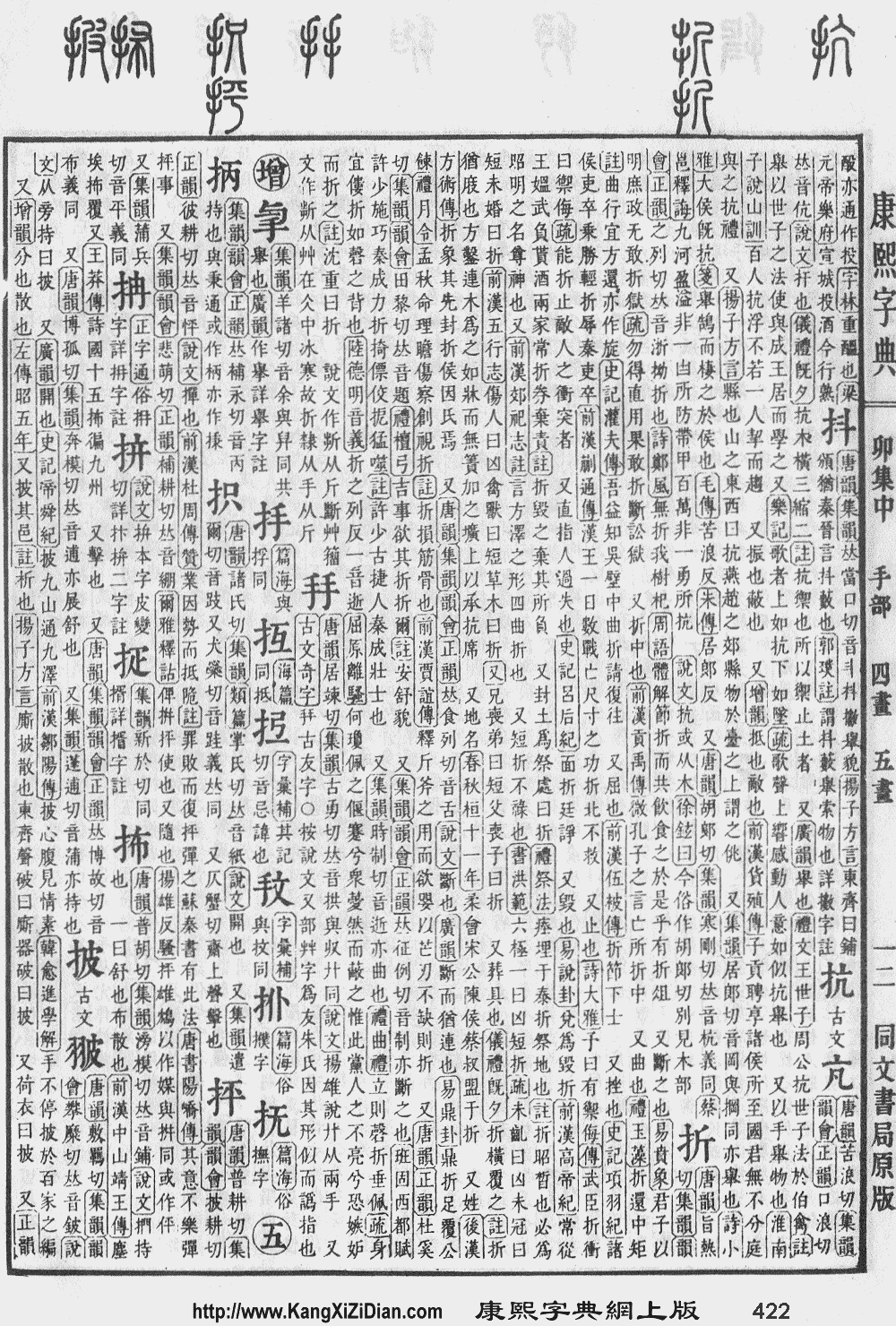
  • KangXi: page 422, character 4
  • Dai Kanwa Jiten: character 11890
  • Dae Jaweon: page 770, character 1
  • Hanyu Da Zidian (first edition): volume 3, page 1838, character 7
  • Unihan data for U+6298

Chinese

Glyph origin

Historical forms of the character 折
Shang Western Zhou Warring States Shuowen Jiezi (compiled in Han) Liushutong (compiled in Ming)
Oracle bone script Bronze inscriptions Chu slip and silk script Small seal script Transcribed ancient scripts

Originally 㪿, an ideogrammic compound (會意) : ⿱屮屮 (“a tree 木 cut in half”) + 斤 (“axe”) – an axe cutting a tree in half.

In the current form, the left side has become 扌 (“hand”).

Etymology 1

simp. and trad.
折
alternative forms
 
㪿
𣂚
𣂹
𣂟
𣂲
㪿
𣂚
𣂹
𣂟
𣂲
摺/折

From Proto-Sino-Tibetan *tsjat (“to cut off; to sever; to break”).

Pronunciation 1


Note:
  • siĕk - vernacular;
  • ciék - literary.
Note:
  • chi̍h, chek - vernacular;
  • chiat - literary.

Rime
Character 折
Reading # 2/3
Initial (聲) 章 (23)
Final (韻) 仙 (81)
Tone (調) Checked (Ø)
Openness (開合) Open
Division (等) III
Fanqie 旨熱切
Baxter tsyiet
Reconstructions
Zhengzhang
Shangfang
/t͡ɕiᴇt̚/
Pan
Wuyun
/t͡ɕiɛt̚/
Shao
Rongfen
/t͡ɕjæt̚/
Edwin
Pulleyblank
/ciat̚/
Li
Rong
/t͡ɕiɛt̚/
Wang
Li
/t͡ɕĭɛt̚/
Bernard
Karlgren
/t͡ɕi̯ɛt̚/
Expected
Mandarin
Reflex
zhe
Expected
Cantonese
Reflex
zit3
Baxter–Sagart system 1.1 (2014)
Character 折
Reading # 3/3
Modern
Beijing
(Pinyin)
zhé
Middle
Chinese
‹ tsyet ›
Old
Chinese
/*tet/
English bend; break (v.t.)

Notes for Old Chinese notations in the Baxter–Sagart system:

* Parentheses "()" indicate uncertain presence;
* Square brackets "[]" indicate uncertain identity, e.g. *[t] as coda may in fact be *-t or *-p;
* Angle brackets "<>" indicate infix;
* Hyphen "-" indicates morpheme boundary;

* Period "." indicates syllable boundary.
Zhengzhang system (2003)
Character 折
Reading # 2/3
No. 16947
Phonetic
component
折
Rime
group
月
Rime
subdivision
2
Corresponding
MC rime
晢
Old
Chinese
/*ʔljed/
Definitions

折

  1. to break off; to snap; to pluck off
  2. to bend
  3. to lose
  4. to die (young)
  5. to admire; to be convinced
  6. to trade; to exchange
  7. to censure; to blame
  8. difficulty; obstacle
  9. (Cantonese) to discount
    呢度折咗之後大概係三百蚊。 [Cantonese, trad.]
    呢度折咗之后大概系三百蚊。 [Cantonese, simp.]
    ni1 dou6 zit3 zo2 zi1 hau6 daai6 koi3 hai6 saam1 baak3 man1. [Jyutping]
    These items are around 300 dollars after discounting.
  10. (Cantonese) discount
    呢件衫冇折。 [Cantonese]  ―  ni1 gin6 saam1 mou5 zit3. [Jyutping]  ―  There is no discount on this clothing item.
  11. Classifier for discount.
    打九折  ―  dǎ jiǔ zhé  ―  ten percent off (or discount to ninety percent of the original price)
  12. Classifier for folds.
  13. Classifier for theatrical scenes.
  14. (Chinese calligraphy) a change in direction of a stroke (such as in ㇕, ㇉, or ㇜)
  15. a surname: Zhe
Synonyms
  • (discount): 扣 (kòu)
Coordinate terms
Compounds

Pronunciation 2


Definitions

折

  1. to turn over; to flip
  2. to pour out; to tip something out
Compounds
  • 折碗
  • 折莫
  • 折籮/折箩

Pronunciation 3


Rime
Character 折
Reading # 3/3
Initial (聲) 常 (25)
Final (韻) 仙 (81)
Tone (調) Checked (Ø)
Openness (開合) Open
Division (等) III
Fanqie 常列切
Baxter dzyiet
Reconstructions
Zhengzhang
Shangfang
/d͡ʑiᴇt̚/
Pan
Wuyun
/d͡ʑiɛt̚/
Shao
Rongfen
/d͡ʑjæt̚/
Edwin
Pulleyblank
/d͡ʑiat̚/
Li
Rong
/ʑiɛt̚/
Wang
Li
/ʑĭɛt̚/
Bernard
Karlgren
/ʑi̯ɛt̚/
Expected
Mandarin
Reflex
shé
Expected
Cantonese
Reflex
sit6
Baxter–Sagart system 1.1 (2014)
Character 折
Reading # 2/3
Modern
Beijing
(Pinyin)
shé
Middle
Chinese
‹ dzyet ›
Old
Chinese
/*N-tet/
English bend (v.i.)

Notes for Old Chinese notations in the Baxter–Sagart system:

* Parentheses "()" indicate uncertain presence;
* Square brackets "[]" indicate uncertain identity, e.g. *[t] as coda may in fact be *-t or *-p;
* Angle brackets "<>" indicate infix;
* Hyphen "-" indicates morpheme boundary;

* Period "." indicates syllable boundary.
Zhengzhang system (2003)
Character 折
Reading # 3/3
No. 16951
Phonetic
component
折
Rime
group
月
Rime
subdivision
2
Corresponding
MC rime
折
Old
Chinese
/*ɦljed/
Definitions

折

  1. to break
  2. to be at a (financial) loss
Compounds
  • 掂梢折本
  • 消折
  • 東量西折/东量西折

Pronunciation 4


Rime
Character 折
Reading # 1/3
Initial (聲) 定 (7)
Final (韻) 齊 (39)
Tone (調) Level (Ø)
Openness (開合) Open
Division (等) IV
Fanqie 杜奚切
Baxter dej
Reconstructions
Zhengzhang
Shangfang
/dei/
Pan
Wuyun
/dei/
Shao
Rongfen
/dɛi/
Edwin
Pulleyblank
/dɛj/
Li
Rong
/dei/
Wang
Li
/diei/
Bernard
Karlgren
/dʱiei/
Expected
Mandarin
Reflex
tí
Expected
Cantonese
Reflex
tai4
Zhengzhang system (2003)
Character 折
Reading # 1/3
No. 16937
Phonetic
component
折
Rime
group
歌
Rime
subdivision
2
Corresponding
MC rime
嗁
Old
Chinese
/*l'eːl/

Definitions

折

  1. Only used in 折折.

Etymology 2

For pronunciation and definitions of 折 – see 摺 (“to destroy; to fold; etc.”).
(This character, 折, is the simplified form of 摺.)
Notes:

Etymology 3

For pronunciation and definitions of 折 – see 翼 (“wing; wing; etc.”).
(This character, 折, is a variant form of 翼.)

References

Japanese

Kanji

折

(grade 4 “Kyōiku” kanji)

  1. fold

Readings

Compounds

Etymology

Kanji in this term
折
おり
Grade: 4
kun’yomi
For pronunciation and definitions of 折 – see the following entry.
【おり】
[noun] occasion; time
[verb] stem or continuative form of おる (oru) [godan]
Alternative spellings
折, 折り
(This term, 折, is an alternative spelling of the above term.)

Korean

Hanja

折 • (jeol, je) (hangeul 절, 제, revised jeol, je, McCune–Reischauer chŏl, che, Yale cel, cey)

  1. To fold

Vietnamese

Han character

折: Hán Việt readings: chiết (之(chi)列(liệt)切(thiết))[1][2][3], triếp[3], triệp[3]
折: Nôm readings: chết[1][2][3][4][5], giết[1][2][3][4][5], chẹt[2][3][4][5], chiết[1][2][5], chét[1][3], xít[1][4], chệch[3][4], chịt[3][4], nhét[3][4], nhít[3][4], siết[3][4], xiết[3][4], chích[1], chít[3], dít[3], gãy[3], gẩy[3], giẹp[3], quạt[3], trét[3]

  1. Nôm form of chết (“to die”).
  2. Nôm form of giết (“to kill; to murder”).

References

  1. Nguyễn (2014).
  2. Nguyễn et al. (2009).
  3. Trần (2004).
  4. Hồ (1976).
  5. Taberd & Pigneau de Béhaine (1838).
This article is issued from Wiktionary. The text is licensed under Creative Commons - Attribution - Sharealike. Additional terms may apply for the media files.