替
| ||||||||
Translingual
| Stroke order | |||
|---|---|---|---|
 | |||
Han character
替 (Kangxi radical 73, 曰+8, 12 strokes, cangjie input 手人日 (QOA), four-corner 55603, composition ⿱㚘曰)
References
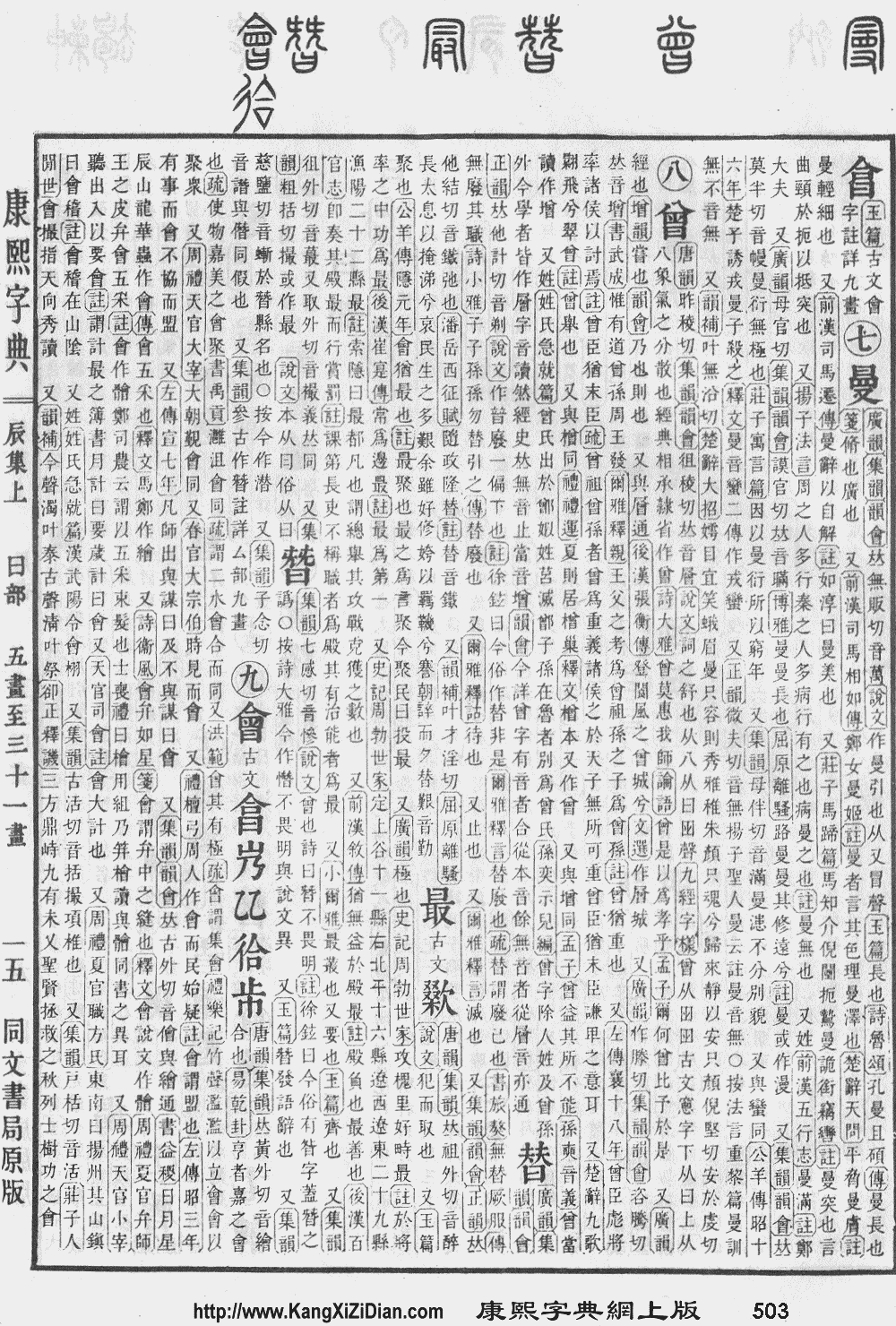
- KangXi: page 503, character 4
- Dai Kanwa Jiten: character 14300
- Dae Jaweon: page 877, character 3
- Hanyu Da Zidian (first edition): volume 2, page 1515, character 8
- Unihan data for U+66FF
Chinese
| trad. | 替 | |
|---|---|---|
| simp. # | 替 | |
| alternative forms | 暜 𤾕 𤽽 㬱 | |
Glyph origin
| Historical forms of the character 替 | ||
|---|---|---|
| Warring States | Shuowen Jiezi (compiled in Han) | Liushutong (compiled in Ming) |
| Bronze inscriptions | Small seal script | Transcribed ancient scripts |
 |
 |
 |
Characters in the same phonetic series (替) (Zhengzhang, 2003)
Ideogrammic compound (會意) : 竝 + 曰 – two figures (竝) changing places. Two top components have been simplified from 立 to 夫.
Pronunciation
Definitions
替
- to substitute for; to displace (Can we add an example for this sense?)
- for; in place of
- to decline; to go downhill; to be on the wane; to fall; to decay
- 曰:「有謂一向嚴華夷之防閑,守儒俗之界分,則勢孤力替。尊慕之義無以維持。則不問俗之華夷、人之舊新,破其畦稜,而與之成其事,亦時宜之一道也。其言如何?」 [Korean Literary Sinitic, trad.]
- From: 1946, writing by Kim Yeong'ik (金永益)
- Wal: "Yu wi ilhyang eom hwai ji banghan, su yu sok ji gyebun, jeuk se go ryeok che. Jonmo ji ui mu i yuji. Jeuk bulmun sok ji hwai, in ji gusin, pa gi hyu reung, i yeo ji seong gi sa, yeok siui ji il do ya. Gi eon yeoha?" [Sino-Korean]
- He said: "There are those who say that if we always hold firm to the limits of the hua and the yi and keep to the borders between the Confucian and profane worlds, our circumstances shall be forlorn and our strength faltering. The cause of honoring and commemorating is not upheld thereby. So if we disregard whether the customs are hua or yi or whether the people are of the old or new types, breaking these boundaries and achieving our aim along with them, this would also be a way to act appropriately for these times. What do you have to say?"
Synonyms
- (to substitute):
Synonyms of 替
- (for):
Dialectal synonyms of 替 (“for”) [map]
| Variety | Location | Words |
|---|---|---|
| Formal (Written Standard Chinese) | 替, 為 | |
| Mandarin | Beijing | 給, 替 |
| Taiwan | 給, 替 | |
| Jinan | 給, 替 | |
| Xi'an | 替, 給 | |
| Wuhan | 跟, 幫 | |
| Chengdu | 幫, 給, 跟 | |
| Yangzhou | 代, 替 | |
| Hefei | 代, 幫 | |
| Singapore | 替 | |
| Cantonese | Guangzhou | 同, 幫 |
| Hong Kong | 同, 幫 | |
| Yangjiang | 替, 幐 | |
| Gan | Nanchang | 跟, 幫 |
| Hakka | Meixian | 同, 代 |
| Jin | Taiyuan | 替, 給 |
| Min Bei | Jian'ou | 替, 幫 |
| Min Dong | Fuzhou | 替, 共 |
| Min Nan | Xiamen | 替, 共 |
| Quanzhou | 共 | |
| Zhangzhou | 共 | |
| Tainan | 替, 共 | |
| Singapore (Hokkien) | 替, 共 | |
| Chaozhou | 代, 個 | |
| Wu | Suzhou | 替, 搭 |
| Wenzhou | 代 | |
| Xiang | Changsha | 幫, 跟, 代 |
| Shuangfeng | 幫 | |
- (to decline):
Compounds
Japanese
Vietnamese
This article is issued from Wiktionary. The text is licensed under Creative Commons - Attribution - Sharealike. Additional terms may apply for the media files.