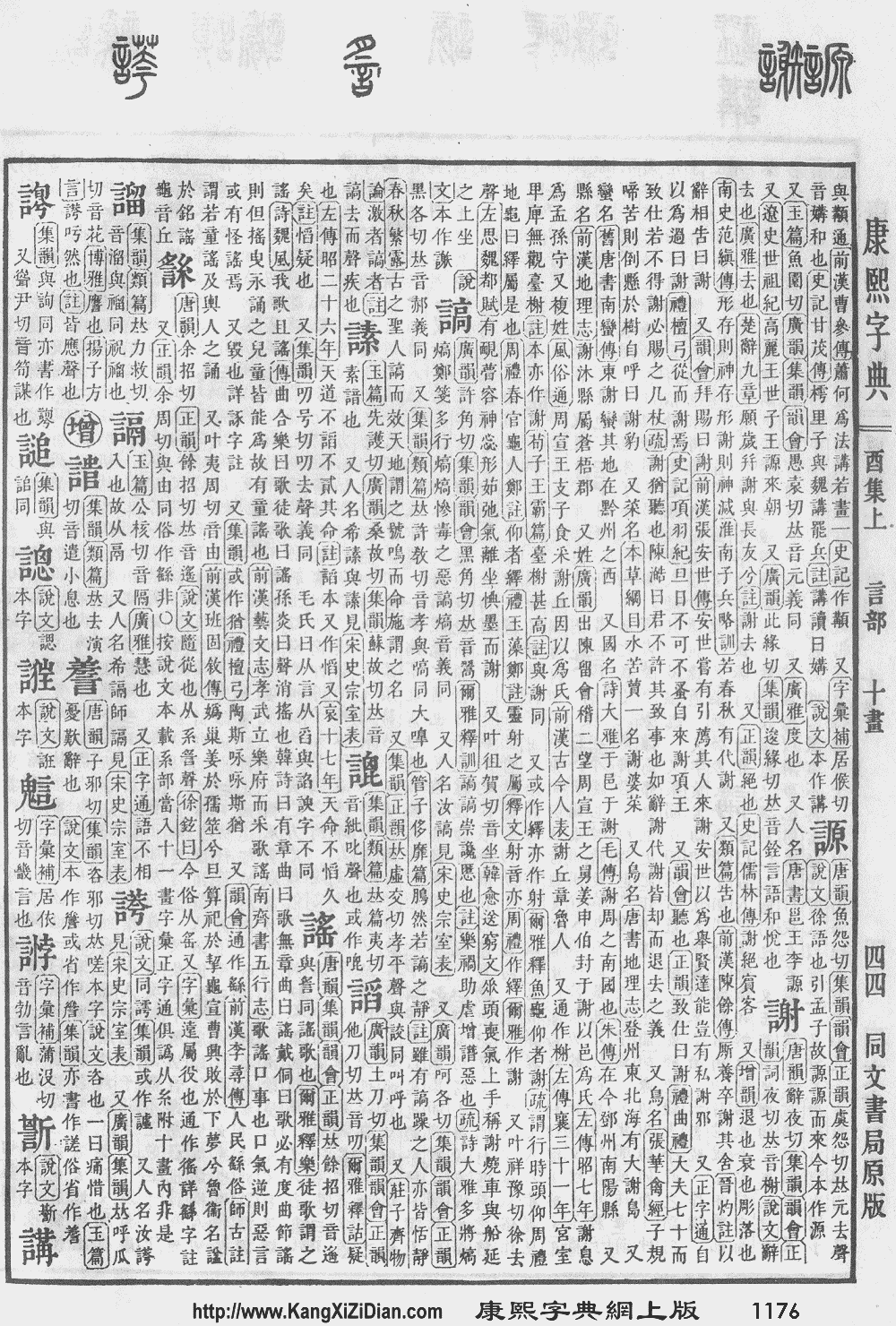
謠

See also: 谣 and 謡
謠 U+8B20, 謠
CJK UNIFIED IDEOGRAPH-8B20
← 謟
[U+8B1F]
CJK Unified Ideographs 謡 →
[U+8B21]

Translingual

Traditional 謠
Shinjitai 謡
Simplified 谣

Han character

謠 (Kangxi radical 149, 言+10, 17 strokes, cangjie input 卜口月人山 (YRBOU), four-corner 07672, composition ⿰訁⿱𱼀缶 or ⿰訁䍃)

References

  • KangXi: page 1176, character 7
  • Dai Kanwa Jiten: character 35832
  • Dae Jaweon: page 1641, character 5
  • Hanyu Da Zidian (first edition): not present, would follow volume 6, page 4007, character 13
  • Unihan data for U+8B20

Chinese

trad. 謠/謡
simp. 谣
2nd round simp. 𫍚

Glyph origin

Phono-semantic compound (形聲, OC *lew) : semantic 言 + phonetic 䍃 ().

Pronunciation


Note:
  • iao5 - Shantou;
  • iou5 - Chaozhou.

Rime
Character 謠
Reading # 1/1
Initial (聲) 以 (36)
Final (韻) 宵 (91)
Tone (調) Level (Ø)
Openness (開合) Open
Division (等) III
Fanqie 餘昭切
Reconstructions
Zhengzhang
Shangfang
/jiᴇu/
Pan
Wuyun
/jiɛu/
Shao
Rongfen
/jæu/
Edwin
Pulleyblank
/jiaw/
Li
Rong
/iɛu/
Wang
Li
/jĭɛu/
Bernard
Karlgren
/i̯ɛu/
Expected
Mandarin
Reflex
yáo
Expected
Cantonese
Reflex
jiu4
Baxter–Sagart system 1.1 (2014)
Character 謠
Reading # 1/1
Modern
Beijing
(Pinyin)
yáo
Middle
Chinese
‹ yew ›
Old
Chinese
/*law/
English sing; song

Notes for Old Chinese notations in the Baxter–Sagart system:

* Parentheses "()" indicate uncertain presence;
* Square brackets "[]" indicate uncertain identity, e.g. *[t] as coda may in fact be *-t or *-p;
* Angle brackets "<>" indicate infix;
* Hyphen "-" indicates morpheme boundary;

* Period "." indicates syllable boundary.
Zhengzhang system (2003)
Character 謠
Reading # 1/1
No. 14718
Phonetic
component
謠
Rime
group
宵
Rime
subdivision
3
Corresponding
MC rime
遙
Old
Chinese
/*lew/
Notes 說文言上從肉會意徒歌,
通作謠,肉非聲

Definitions

謠

  1. (alt. form 䚻, 繇, 猶/犹 (yóu)‡) to sing without instruments
  2. (alt. form 䚻, 繇) folk song; ballad
  3. fake circulating words; false rumour

Compounds

  • 歌謠/歌谣 (gēyáo)
  • 民謠/民谣 (mínyáo)
  • 民謠歌手/民谣歌手
  • 民謠歌曲/民谣歌曲
  • 民謠風/民谣风
  • 童謠/童谣 (tóngyáo)
  • 詬誶謠諑/诟谇谣诼

Japanese

Shinjitai

謡

Kyūjitai

謠

Kanji

謠

(“Jinmeiyō” kanji used for names, kyūjitai kanji, shinjitai form 謡)

  1. This term needs a translation to English. Please help out and add a translation, then remove the text {{rfdef}}.

Readings

  • On (unclassified): よう (yō)
  • Kun: うたう (utau, 謠う)

Korean

Hanja

謠 (eumhun 노래 요 (norae yo))

  1. Hanja form? of 요 (“a song”).

Compounds

Vietnamese

Han character

謠: Hán Nôm readings: dao

  1. This term needs a translation to English. Please help out and add a translation, then remove the text {{rfdef}}.
This article is issued from Wiktionary. The text is licensed under Creative Commons - Attribution - Sharealike. Additional terms may apply for the media files.