鬼
| ||||||||
| ||||||||
| ||||||||
Translingual
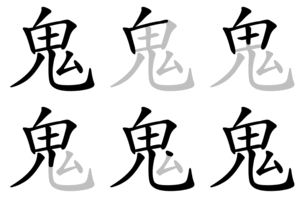
| Stroke order | |||
Mainland China | |||
| Stroke order | |||
|---|---|---|---|
 | |||
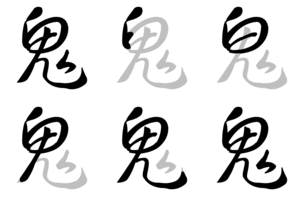
| Stroke order (cursive) | |||
|---|---|---|---|
 | |||
Han character
鬼 (Kangxi radical 194, 鬼+0, 10 strokes in traditional Chinese, Japanese and Korean, 9 strokes in mainland China, cangjie input 竹山戈 (HUI) or 竹戈 (HI) or 竹田竹戈 (HWHI), four-corner 26213 or 26513, composition ⿱甶⿺儿厶(HTJKV) or ⿸⿻白丿⿺乚厶(G))
- Kangxi radical #194, ⿁.
Derived characters
References
- KangXi: page 1460, character 30
- Dai Kanwa Jiten: character 45758
- Dae Jaweon: page 1993, character 19
- Hanyu Da Zidian (first edition): volume 7, page 4427, character 1
- Unihan data for U+9B3C
Chinese
| trad. | 鬼 | |
|---|---|---|
| simp. # | 鬼 | |
| 2nd round simp. | ⿸⿻丿日乚 | |
Glyph origin
| Historical forms of the character 鬼 | |||
|---|---|---|---|
| Shang | Western Zhou | Shuowen Jiezi (compiled in Han) | Liushutong (compiled in Ming) |
| Oracle bone script | Bronze inscriptions | Small seal script | Transcribed ancient scripts |
 |
 |
 |
 |
| Old Chinese | |
|---|---|
| 謉 | *tkuːlʔ, *krul |
| 瑰 | *kuːl, *ɡuːl |
| 傀 | *kuːl, *kʰuːlʔ |
| 藱 | *kuːl |
| 魁 | *kʰuːl |
| 磈 | *kʰuːlʔ, *qulʔ |
| 塊 | *kʰuːls, *kʰruːds |
| 嵬 | *ŋɡuːl, *ŋɡuːlʔ |
| 隗 | *ŋɡuːlʔ |
| 槐 | *ɡuːl, *ɡruːl |
| 瘣 | *ɡuːlʔ |
| 廆 | *ɡuːlʔ |
| 溾 | *ɡuːlʔ, *qruːl |
| 螝 | *ɡuːls, *krul |
| 褢 | *ɡruːl |
| 騩 | *krul, *kruls, *kul |
| 愧 | *kruls |
| 媿 | *kruls |
| 聭 | *kruls |
| 餽 | *ɡruls |
| 鬼 | *kulʔ |
| 魏 | *ŋɡuls |
| 巍 | *ŋul |
| 犩 | *ŋul, *ŋuls |
Pictogram (象形) – a man or figure with an ugly face and tail.
Compare 異 (“different, strange”), where the 田 also derives from a face.
It may not be clear from the character, but the lower right “dot” is a small 厶; it is a residual tail – compare 离.
Etymology
Unknown. May be related to 威 (OC *qul, “to overawe, to terrorise”) with k-nominalisation and endoactive tone B, lit. "the thing which is doing the overawing", or related to 歸 (OC *klul, “to return”). See also 詭 (OC *krolʔ, “to deceive; peculiar”).
Pronunciation
Definitions
鬼
- ghost; apparition; spirit (Classifier: 隻/只)
- 為之宗廟,以鬼享之。 [Classical Chinese, trad.]
- From: Classic of Filial Piety, circa 475 – 221 BCE
- Wèi zhī zōngmiào, yǐ guǐ xiǎng zhī. [Pinyin]
- They prepare the ancestral temple (to receive the tablet of the departed), and there they present offerings to the disembodied spirit.
为之宗庙,以鬼享之。 [Classical Chinese, simp.]
- devil; demon
- goblin
- stealthy; tricky; furtive
- sinister plot; dirty trick
- devilish; damned; ghastly
- (informal) clever; smart; quick
- (derogatory) fool; blockhead; guy; moral imbecile
- Derogatory name for people with a flaw or vice. -ard
- (intimate) imp; urchin
- (regional, usually in compounds) Caucasian or Western person
- (Cantonese) traitor; rat; mole
- 現場消息話,呢位便衣阿Sir,冇帶口罩噉混入示威者入面,係噉影人大頭,畀示威者發現係鬼[……[[#Chinese|]]] [Cantonese, trad.]
- From: 2019, 便衣警扮示威者偷拍人群, in Apple Daily
- jin6 coeng4 siu1 sik1 waa6, ni1 wai6 bin6 ji1 aa3 soe4, mou5 daai3 hau2 zaau3 gam2 wan6 jap6 si6 wai1 ze2 jap6 min6, hai6 gam2 jing2 jan4 daai6 tau4-2, bei2 si6 wai1 ze2 faat3 jin6 hai6 gwai2 [...... ] [Jyutping]
- according to those present, this plain-clothes officer mingled with protestors without wearing a gauze mask and took pictures of people, and was discovered to be a mole by protestors […]
现场消息话,呢位便衣阿Sir,冇带口罩噉混入示威者入面,系噉影人大头,畀示威者发现系鬼[……[[#Chinese|]]] [Cantonese, simp.]
- (Cantonese, ball games) opponent trying to steal the ball
- (Cantonese, inserted in certain adjectives) so; very
- (mildly vulgar) the hell
- 什麼鬼233/什么鬼233 ― shénme guǐ 233 ― what the hell LOL
- 我點鬼記得!/我点鬼记得! [Cantonese] ― ngo5 dim2 gwai2 gei3 dak1! [Jyutping] ― How the hell am I supposed to remember?!
- 你在搞什麼鬼?/你在搞什么鬼? ― Nǐ zài gǎo shénme guǐ? ― What the hell are you doing?
- 你搞乜鬼呀? [Cantonese] ― nei5 gaau2 mat1 gwai2 aa3? [Jyutping] ― What the hell are you doing?
- (mildly vulgar) who the hell; what the hell
- 鬼知道! ― Guǐ zhīdào! ― Devil knows!
- 有鬼人知咩! [Cantonese] ― jau5 gwai2 jan4 zi1 me1! [Jyutping] ― Who the hell knows!
- 鬼叫你…… [Cantonese] ― gwai2 giu3 nei5...... [Jyutping] ― Who the hell told you to... → No one told you to...
- 有鬼用 [Cantonese] ― jau5 gwai2 jung6 [Jyutping] ― has what use (what the hell use it has) → is damn worthless, is of damn-all use
Synonyms
- (ghost):
- (clever):
Compounds
|
|
|
References
- “鬼”, in 漢語多功能字庫 (Multi-function Chinese Character Database), 香港中文大學 (the Chinese University of Hong Kong), 2014–
Japanese
Readings
Compounds
- 隠れ鬼 (kakureoni): hide and seek
- 鬼哭 (kikoku): the wailing of a ghost, or the sound thereof
- 鬼神 (kijin)
- 鬼遊び (oniasobi): tag (game)
- 鬼神 (onigami)
- 鬼ごっこ (onigokko): tag (game)
- 鬼事 (onigoto): tag (game)
- 鬼天竺鼠 (onitenjikunezumi): capybara
- 鬼女 (kijo)
- 鬼籍 (kiseki)
- 鬼畜 (kichiku)
- 鬼面 (kimen)
- 鬼門 (kimon)
- 吸血鬼 (kyūketsuki): a vampire
- 鬼火 (onibi)
- 牛鬼 (ushioni)
Etymology

| Kanji in this term |
|---|
| 鬼 |
| おに Grade: S |
| kun’yomi |
From Old Japanese.[1]
Thought to be derived from 隠 (on, “to hide; hidden from sight”).[1][2][3]
Noun
鬼 • (oni)
- ghost
- 異国の鬼
- ikoku no oni
- a ghost of a foreign country
- 異国の鬼
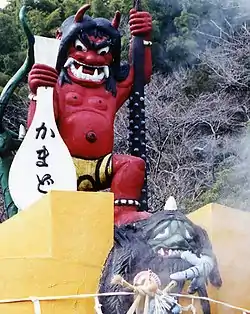
- evil spirit, demon, ogre
- 931–938, Minamoto no Shitagō, Wamyō Ruijushō (book 1, page 32)[6]
- 人神 周易云、人神曰鬼、居偉反、和名於邇、或説云、於邇者、隠音之訛也、鬼物隠而不欲顯形、故以稱也。
- (please add an English translation of this usage example)
- 931–938, Minamoto no Shitagō, Wamyō Ruijushō (book 1, page 32)[6]
- (figurative) someone of remarkable or diabolical energy or ability, a demon
- 彼女は仕事の鬼だ。
- Kanojo wa shigoto no oni da.
- She is a demon for work.
- 彼女は仕事の鬼だ。
- "it" in a game of tag/hide and seek (鬼ごっこ onigokko, "pretend spirits")
Synonyms
References
- 1988, 国語大辞典(新装版) (Kokugo Dai Jiten, Revised Edition) (in Japanese), Tōkyō: Shogakukan
- 1995, 大辞泉 (Daijisen) (in Japanese), Tōkyō: Shogakukan, →ISBN
- 2006, 大辞林 (Daijirin), Third Edition (in Japanese), Tōkyō: Sanseidō, →ISBN
- 1998, NHK日本語発音アクセント辞典 (NHK Japanese Pronunciation Accent Dictionary) (in Japanese), Tōkyō: NHK, →ISBN
- 1997, 新明解国語辞典 (Shin Meikai Kokugo Jiten), Fifth Edition (in Japanese), Tōkyō: Sanseidō, →ISBN
- Minamoto, Shitagō; Kyōto Daigaku Bungakubu Kokugogaku Kokubungaku Kenkyūshitu (931–938) Shohon Shūsei Wamyō Ruijushō: Honbunhen (in Japanese), Kyōto: Rinsen, published 1968, →ISBN.
Korean
Etymology
From Middle Chinese 鬼 (MC kʉiX). Recorded as Middle Korean 귀〯 (kwǔy) (Yale: kwǔy) in Hunmong Jahoe (訓蒙字會 / 훈몽자회), 1527.
Pronunciation
- (SK Standard/Seoul) IPA(key): [kɥi(ː)] ~ [ky(ː)]
- Phonetic hangul: [귀(ː)]
- Though still prescribed in Standard Korean, most speakers in both Koreas no longer distinguish vowel length.
Compounds
- 귀곡 (鬼哭, gwigok, “the wailing of a ghost”)
- 귀공 (鬼工, gwigong)
- 귀면 (鬼面, gwimyeon)
- 귀병 (鬼病, gwibyeong)
- 귀신 (鬼神, gwisin, “ghost; deity”)
- 귀재 (鬼才, gwijae)
- 귀접 (鬼接, gwijeop)
- 귀천 (鬼薦, gwicheon)
- 마귀 (魔鬼, magwi, “devil”)
- 신출귀몰 (神出鬼沒, sinchulgwimol)
- 악귀 (惡鬼, akgwi, “evil spirit; demon; devil”)
- 역귀 (疫鬼, yeokgwi)
- 적귀 (赤鬼, jeokgwi)