欠

See also: 缺
欠 U+6B20, 欠
CJK UNIFIED IDEOGRAPH-6B20
← 欟
[U+6B1F]
CJK Unified Ideographs 次 →
[U+6B21]
⽋ U+2F4B, ⽋
KANGXI RADICAL LACK
← ⽊
[U+2F4A]
Kangxi Radicals ⽌ →
[U+2F4C]

Translingual

Stroke order
4 strokes
Stroke order

Han character

欠 (Kangxi radical 76, 欠+0, 4 strokes, cangjie input 弓人 (NO), four-corner 27802, composition ⿱⺈人)

  1. Kangxi radical #76, ⽋.

Derived characters

References

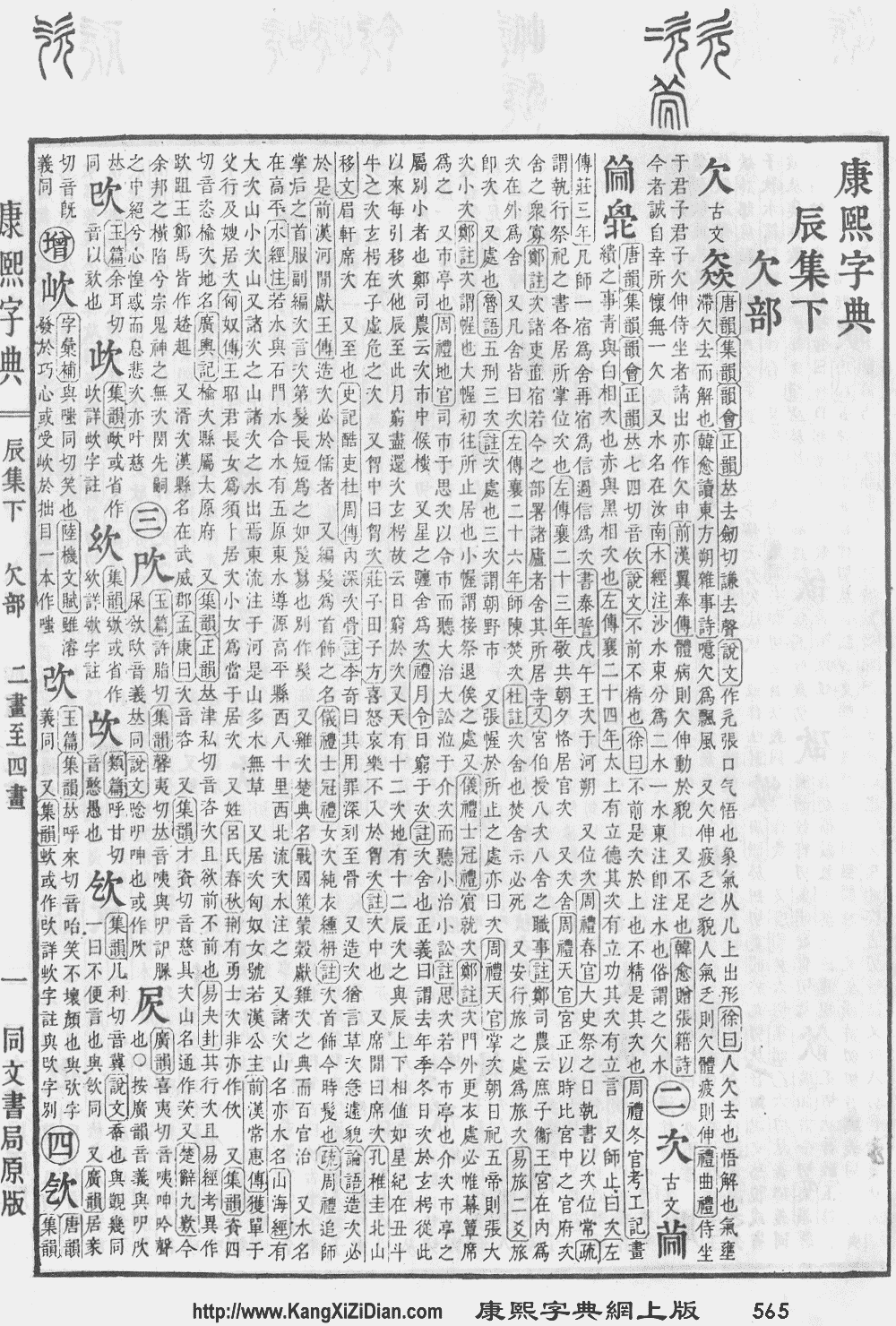
  • KangXi: page 565, character 1
  • Dai Kanwa Jiten: character 15991
  • Dae Jaweon: page 953, character 35
  • Hanyu Da Zidian (first edition): volume 3, page 2133, character 1
  • Unihan data for U+6B20

Chinese

simp. and trad.
欠
alternative forms 㐸

Glyph origin

Historical forms of the character 欠
Shang Shuowen Jiezi (compiled in Han) Liushutong (compiled in Ming)
Oracle bone script Small seal script Transcribed ancient scripts

Pictogram (象形) – a kneeling person with mouth open.

The reversed version of this character is 㒫 > 旡 (e.g. 既), which must not be confused with 无.

Pronunciation


Note:
  • kiam3 - Shantou, Chaoyang, Jieyang, Raoping;
  • kiêm3 - Chaozhou;
  • kiang3 - Chenghai.

Rime
Character 欠
Reading # 1/1
Initial (聲) 溪 (29)
Final (韻) 嚴 (145)
Tone (調) Departing (H)
Openness (開合) Open
Division (等) III
Fanqie 去劔切
Baxter khjaemH
Reconstructions
Zhengzhang
Shangfang
/kʰɨɐmH/
Pan
Wuyun
/kʰiɐmH/
Shao
Rongfen
/kʰiɐmH/
Edwin
Pulleyblank
/kʰɨamH/
Li
Rong
/kʰiɐmH/
Wang
Li
/kʰĭɐmH/
Bernard
Karlgren
/kʰi̯ɐmH/
Expected
Mandarin
Reflex
qiàn
Expected
Cantonese
Reflex
him3
Baxter–Sagart system 1.1 (2014)
Character 欠
Reading # 1/1
Modern
Beijing
(Pinyin)
qiàn
Middle
Chinese
‹ khjomH ›
Old
Chinese
/*[k]ʰ(r)om-s/
English yawn

Notes for Old Chinese notations in the Baxter–Sagart system:

* Parentheses "()" indicate uncertain presence;
* Square brackets "[]" indicate uncertain identity, e.g. *[t] as coda may in fact be *-t or *-p;
* Angle brackets "<>" indicate infix;
* Hyphen "-" indicates morpheme boundary;

* Period "." indicates syllable boundary.
Zhengzhang system (2003)
Character 欠
Reading # 1/1
No. 10274
Phonetic
component
欠
Rime
group
談
Rime
subdivision
3
Corresponding
MC rime
Old
Chinese
/*kʰoms/
Notes 原列梵韻依王韻改釅

Definitions

欠

  1. to yawn
  2. to lack; to be deficient
  3. to owe
  4. to ask for; to beg for
    欠揍  ―  qiànzòu  ―  asking for a beating
  5. (Wuhan) to miss somebody

Synonyms

  • (to lack):
  • (to owe):

Compounds

  • 只欠東風/只欠东风
  • 呵欠連天/呵欠连天
  • 懸欠/悬欠
  • 掛欠/挂欠
  • 欠債/欠债 (qiànzhài)
  • 欠債還錢/欠债还钱
  • 欠據/欠据 (qiànjù)
  • 欠條/欠条 (qiàntiáo)
  • 欠當/欠当
  • 欠稅/欠税
  • 欠繳/欠缴
  • 欠資/欠资 (qiànzī)
  • 欠資郵票/欠资邮票
  • 積欠/积欠
  • 落虧欠/落亏欠
  • 虧欠/亏欠 (kuīqiàn)
  • 賒欠/赊欠 (shēqiàn)
  • 風欠/风欠

Japanese

Shinjitai

欠

Kyūjitai

缺

Kanji

欠

(grade 4 “Kyōiku” kanji, shinjitai kanji, kyūjitai form 缺)

  1. lack, shortage
  2. to be absent
  3. vacancy

Usage notes

Readings

Compounds

Etymology

Kanji in this term
欠
あくび
Grade: 4
kun’yomi
For pronunciation and definitions of 欠 – see the following entry.
【あくび】
[noun] 欠, 欠伸: [from 901] a yawn, yawning
[noun] 欠: the 欠 element in kanji characters
[verb] to yawn
Alternative spellings
欠, 欠伸
(This term, 欠, is an alternative spelling of the above term.)

Korean

Hanja

欠 (eumhun 하품 흠 (hapum heum))

  1. Hanja form? of 흠 (“yawn”).

Compounds

Vietnamese

Han character

欠: Hán Nôm readings: khiếm

  1. This term needs a translation to English. Please help out and add a translation, then remove the text {{rfdef}}.
This article is issued from Wiktionary. The text is licensed under Creative Commons - Attribution - Sharealike. Additional terms may apply for the media files.