木
| ||||||||
| ||||||||
Translingual
| Stroke order | |||
|---|---|---|---|
 | |||
| Stroke order | |||
|---|---|---|---|
 | |||
Alternative forms
- In Hong Kong and Taiwan, when 木 is at the bottom of a character, it is written as 朩 without a hook instead of 木 itself.
Han character
木 (Kangxi radical 75, 木+0, 4 strokes, cangjie input 木 (D), four-corner 40900, composition ⿻十𠆢)
- Kangxi radical #75, ⽊.
Derived characters
- Appendix:Chinese radical/木
- 休, 㕲, 𡉿, 𡯐, 𫹎, 𪫟, 𢪮, 沐, 狇, 𫐠, 炑, 牀, 𭷉, 𤘬, 𬍓, 𦙣, 𠣛, 𬎳, 𤱃, 𤴷, 𪽻, 𥄢, 𪿈, 𥝰, 𠚐, 䊾, 𦐔, 蚞, 𮗼, 䝗, 𮠛, 鈢, 𩵦(𫠏)
- 禾, 米, 𠫡, 呆, 㚓, 宋, 𡭢, 𡵬, 床, 㦿, 𬇏, 𠕖, 采, 𦊋, 罙, 䂞, 穼, 䍒, 𬺜, 𦊧, 臬, 𠡷, 㕖, 集, 雬, 𡩎, 渠, 琹, 喿, 㮡, 髤, 䲷, 䴢, 燊, 築, 蘃, 蘖, 雧, 䯂
- 䢶, 相, 𡉣, 𪥄, 𢌶, 𢗦, 𤆰, 𤯃, 𦕂, 𧉓, 𧴿, 螙, 凩, 閑(闲), 困, 耒, 來, 𣸑, 𠎀, 𠍇, 𤨪, 𤚦, 鬱
Descendants
- Japanese: 𛀧 (Hentaigana)
References
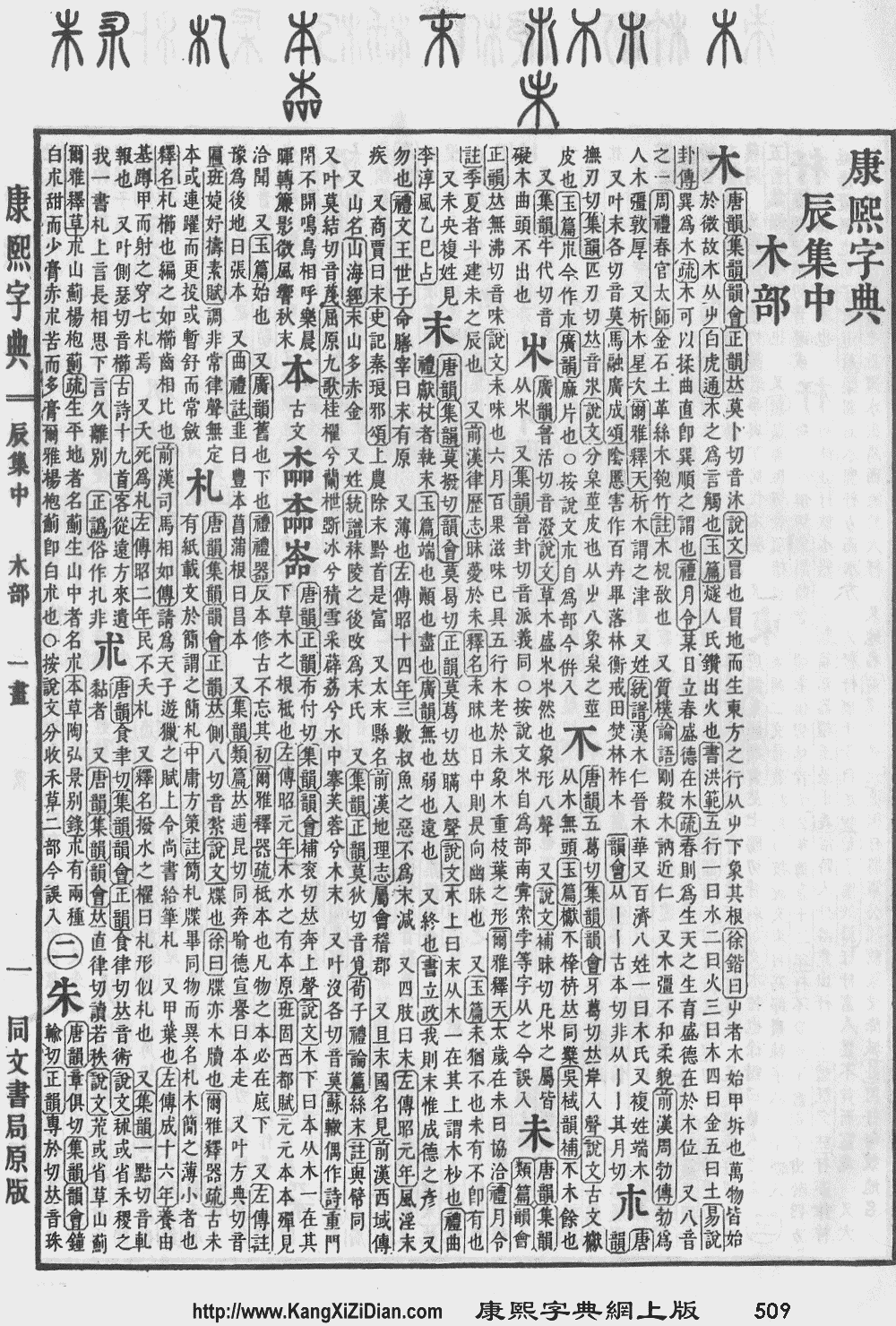
- KangXi: page 509, character 1
- Dai Kanwa Jiten: character 14415
- Dae Jaweon: page 888, character 13
- Hanyu Da Zidian (first edition): volume 2, page 1149, character 6
- Unihan data for U+6728
Chinese
| simp. and trad. |
木 | |
|---|---|---|
Glyph origin
| Historical forms of the character 木 | ||||
|---|---|---|---|---|
| Shang | Western Zhou | Warring States | Shuowen Jiezi (compiled in Han) | Liushutong (compiled in Ming) |
| Oracle bone script | Bronze inscriptions | Chu slip and silk script | Small seal script | Transcribed ancient scripts |
 |
 |
 |
 |
 |
Pictogram (象形) – a tree: branches on top, roots on the bottom (more visible in earlier forms).
Etymology
No known cognate exists. It can perhaps be compared with Proto-Karen *məŋᴮ (“trunk (of a tree); firewood”) (Starostin) or Proto-Lolo-Burmese *ʔmuk (“stump (of a tree)”) (Schuessler, 2007).
The common Sino-Tibetan root for “tree; wood” is *siŋ ~ sik, represented by 薪 (OC *siŋ, “firewood”).
Pronunciation
Definitions
木
Synonyms
- (tree):
- (wood):
| Variety | Location | Words |
|---|---|---|
| Formal (Written Standard Chinese) | 木頭 | |
| Mandarin | Beijing | 木頭 |
| Taiwan | 木頭 | |
| Jinan | 木頭 | |
| Xi'an | 木頭 | |
| Wuhan | 木頭 | |
| Chengdu | 木頭 | |
| Guilin | 木頭 | |
| Yangzhou | 木頭 | |
| Hefei | 木頭 | |
| Singapore | 木頭 | |
| Cantonese | Guangzhou | 木 |
| Hong Kong | 木 | |
| Yangjiang | 木頭 | |
| Gan | Nanchang | 木頭 |
| Hakka | Meixian | 樹料, 木頭 |
| Jin | Taiyuan | 木頭 |
| Min Bei | Jian'ou | 柴 |
| Min Dong | Fuzhou | 柴 |
| Min Nan | Xiamen | 柴 |
| Taipei (Wanhua) | 柴 | |
| Kaohsiung | 柴 | |
| Yilan | 柴 | |
| Changhua (Lukang) | 柴 | |
| Taichung | 柴 | |
| Taichung (Wuqi) | 柴 | |
| Tainan | 柴 | |
| Taitung | 柴 | |
| Hsinchu | 柴 | |
| Penghu (Magong) | 柴 | |
| Manila (Hokkien) | 柴 | |
| Chaozhou | 柴 | |
| Wu | Suzhou | 木頭 |
| Wenzhou | 木頭, 樹 log | |
| Xiang | Changsha | 木頭 |
| Shuangfeng | 樹 | |
- (coffin):
Compounds
|
|
|
Japanese
Readings
Etymology 1
| Kanji in this term |
|---|
| 木 |
| き Grade: 1 |
| kun’yomi |
| Alternative spelling |
|---|
| 樹 |
⟨ki2⟩ → */kɨ/ → /ki/
From Old Japanese 木 (ki2), from Proto-Japonic *kəy. Cognate with Proto-Ryukyuan *ke, whence Southern Amami-Oshima けぃー (kʰɨː), Okinawan きー (kiː), Kunigami きー (kʰiː), Miyako きー (kiː), Yaeyama きー (kiː) and Yonaguni きー (kʰiː).
Likely developed from fusion of older form 木 (ko, see below) + い (i, emphatic nominative particle), similar to the sound changes at work in 神 (kamu → kami, “Shinto deity”).[1]
Noun
木 • (ki)
Idioms
- 猿も木から落ちる (saru mo ki kara ochiru, “even monkeys fall from trees → nobody's perfect”)
Etymology 2
| Kanji in this term |
|---|
| 木 |
| こ Grade: 1 |
| kun’yomi |
⟨ko2⟩ → */kə/ → /ko/
From Old Japanese 木 (ko2), ultimately from Proto-Japonic *kə.
Likely the original form of ki above. Obsolete in modern Japanese, never found in isolation; only found in compounds and certain idioms.[1]
Pronunciation
- IPA(key): [ko̞]
Derived terms
Etymology 3
| Kanji in this term |
|---|
| 木 |
| もく Grade: 1 |
| goon |
From Middle Chinese 木 (MC muk̚). The 呉音 (goon, literally “Wu sound”) reading, so likely the original borrowing from Middle Chinese.
Alternative forms
- (wood grain): 杢
Derived terms
- 木綿 (momen)
Etymology 4
| Kanji in this term |
|---|
| 木 |
| ぼく Grade: 1 |
| kan’on |
From Middle Chinese 木 (MC muk̚). The 漢音 (kan'on, literally “Han sound”) reading, so likely a later borrowing from Middle Chinese.
Noun
木 • (boku)
Adjective
木 • (boku) -na (adnominal 木な (boku na), adverbial 木に (boku ni))
- (derogatory) wooden, as of a person's character or behavior
- (derogatory) wooden, as of a person's mental abilities: blockheaded, stupid, dimwitted
Inflection
| Stem forms | |||
|---|---|---|---|
| Imperfective (未然形) | 木だろ | ぼくだろ | boku daro |
| Continuative (連用形) | 木で | ぼくで | boku de |
| Terminal (終止形) | 木だ | ぼくだ | boku da |
| Attributive (連体形) | 木な | ぼくな | boku na |
| Hypothetical (仮定形) | 木なら | ぼくなら | boku nara |
| Imperative (命令形) | 木であれ | ぼくであれ | boku de are |
| Key constructions | |||
| Informal negative | 木ではない 木じゃない |
ぼくではない ぼくじゃない |
boku de wa nai boku ja nai |
| Informal past | 木だった | ぼくだった | boku datta |
| Informal negative past | 木ではなかった 木じゃなかった |
ぼくではなかった ぼくじゃなかった |
boku de wa nakatta boku ja nakatta |
| Formal | 木です | ぼくです | boku desu |
| Formal negative | 木ではありません 木じゃありません |
ぼくではありません ぼくじゃありません |
boku de wa arimasen boku ja arimasen |
| Formal past | 木でした | ぼくでした | boku deshita |
| Formal negative past | 木ではありませんでした 木じゃありませんでした |
ぼくではありませんでした ぼくじゃありませんでした |
boku de wa arimasen deshita boku ja arimasen deshita |
| Conjunctive | 木で | ぼくで | boku de |
| Conditional | 木なら(ば) | ぼくなら(ば) | boku nara (ba) |
| Provisional | 木だったら | ぼくだったら | boku dattara |
| Volitional | 木だろう | ぼくだろう | boku darō |
| Adverbial | 木に | ぼくに | boku ni |
| Degree | 木さ | ぼくさ | bokusa |
Korean
Etymology
From Middle Chinese 木 (MC muk̚).
| Historical Readings | ||
|---|---|---|
| Dongguk Jeongun Reading | ||
| Dongguk Jeongun, 1448 | 목〮 (Yale: mwók) | |
| Middle Korean | ||
| Text | Eumhun | |
| Gloss (hun) | Reading | |
| Hunmong Jahoe, 1527 | 나모 (Yale: nàmwò) | 목〮 (Yale: mwók) |
Pronunciation
- (SK Standard/Seoul) IPA(key): [mo̞k̚]
- Phonetic hangul: [목]
Compounds
- 각목 (刻木, gangmok)
- 고목 (古木, gomok)
- 관목 (灌木, gwanmok)
- 광목 (廣木, gwangmok)
- 교목 (喬木, gyomok)
- 모과 (木瓜, mogwa)
- 목간 (木簡, mokgan)
- 목검 (木劍, mokgeom)
- 목공 (木工, mokgong)
- 목관 (木管, mokgwan)
- 목기 (木器, mokgi)
- 목도 (木刀, mokdo)
- 목련 (木蓮, mongnyeon)
- 목마 (木馬, mongma)
- 목석 (木石, mokseok)
- 목성 (木星, mokseong)
- 목수 (木手, moksu)
- 목어 (木魚, mogeo)
- 목재 (木材, mokjae)
- 목조 (木造, mokjo)
- 목조 (木彫, mokjo)
- 목초 (木醋, mokcho)
- 목침 (木枕, mokchim)
- 목탁 (木鐸, moktak)
- 목탄 (木炭, moktan)
- 목탑 (木塔, moktap)
- 목화 (木花, mokhwa)
- 묘목 (苗木, myomok)
- 벌목 (伐木, beolmok)
- 비목 (碑木, bimok)
- 삽목 (揷木, sammok)
- 수목 (樹木, sumok)
- 식목 (植木, singmok)
- 신목 (神木, sinmok)
- 원목 (原木, wonmok)
- 접목 (接木, jeommok)
- 주목 (朱木, jumok)
- 취목 (取木, chwimok)
- 침목 (枕木, chimmok)
Old Japanese
Etymology 1
From Proto-Japonic *kəy. Compare the pronunciation of Middle Chinese 紀 (MC kɨX).
Likely developed from fusion of older form 木 (ko2, see below) + い (i(2), emphatic nominative particle), similar to the sound changes at work in 神 (kamu → kami2, “Shinto deity”).[1]
Descendants
- Japanese: 木 (ki)
Etymology 2
Ultimately from Proto-Japonic *kə. Compare the pronunciation of Middle Chinese 許 (MC hɨʌX).
Likely the original form of ⟨ki2⟩ above. Never found in isolation.[1]
Descendants
- Japanese: 木 (ko)
Etymology 3
May ultimately be from Proto-Japonic *kəy. Analysis in the Nihon Shoki (720 CE) shows that this variation of ⟨ki2⟩ is not limited to Eastern dialects.
Noun
木 (ke2) (kana け)
- (regional, Northern Eastern Old Japanese, Southern Eastern Old Japanese) Same as キ乙 (ki2) above
Derived terms
- 眞木 (make2)
- 御木 (Mi1ke2, a placename)
Vietnamese
Han character
木: Hán Việt readings: mộc (
木: Nôm readings: mọc[1][2][3][4][5], mốc[1][2][3][4][5], mộc[1][2][3][5], móc[1][3][4][5], mục[3][4][5], chúc[2]
Compounds
References
- Nguyễn (2014).
- Nguyễn et al. (2009).
- Trần (2004).
- Hồ (1976).
- Taberd & Pigneau de Béhaine (1838).