豆
| ||||||||
| ||||||||
Translingual
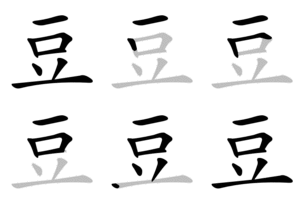
| Stroke order | |||
|---|---|---|---|
 | |||
Han character
豆 (Kangxi radical 151, 豆+0, 7 strokes, cangjie input 一口廿 (MRT), four-corner 10108, composition ⿱𠮛䒑)
- Kangxi radical #151, ⾖.
Derived characters
References
- KangXi: page 1191, character 14
- Dai Kanwa Jiten: character 36245
- Dae Jaweon: page 1654, character 12
- Hanyu Da Zidian (first edition): volume 6, page 3565, character 1
- Unihan data for U+8C46

Chinese
| simp. and trad. |
豆 | |
|---|---|---|
| alternative forms | 荳 | |
Glyph origin
| Historical forms of the character 豆 | |||
|---|---|---|---|
| Shang | Western Zhou | Shuowen Jiezi (compiled in Han) | Liushutong (compiled in Ming) |
| Oracle bone script | Bronze inscriptions | Small seal script | Transcribed ancient scripts |
 |
 |
 |
 |
Characters in the same phonetic series (豆) (Zhengzhang, 2003)
Pictogram (象形) – some kind of container. Borrowed phonetically for the plant name. Displaced Old Chinese 菽 (shū).
Etymology
Derived from 頭 (OC *doː), ultimately from Proto-Sino-Tibetan *du (“head”) (STEDT).
"Soybean > bean" is possibly the same word as "round vessel" (Unger, 1984)
Pronunciation
Definitions
豆
Compounds
Derived terms from 豆
|
|
|
References
- “豆”, in 漢語多功能字庫 (Multi-function Chinese Character Database), 香港中文大學 (the Chinese University of Hong Kong), 2014–
Japanese
Readings
Compounds
Noun
豆 • (mame)
- the pulses
- a bean
- 1988 July 30 [Jul 25 1984], Fujiko F. Fujio, “世界名作童話第5巻 ジャックと豆の木 [World’s Renowned Fairy Tales Book 5: Jack and the Beanstalk]”, in ポストの中の明日 [Post-Mid-Tomorrow] (藤子不二雄少年SF短編集; 2), volume 2 (fiction), 10th edition, Tokyo: Shogakukan, →ISBN, page 120:
- ジャックは豆の木をつたって、雲の上にのぼりました。
- Jakku wa mame no ki o tsutatte, kumo no ue ni noborimashita.
- Jack scrambled along the beanstalk, climbed up above the clouds.
-
- a pea
- a soybean
Idioms
- 豆を植えて稗を得る (mame o uete hie o eru, “to do something expecting good results, instead getting bad results”)
Korean
Etymology
From Middle Chinese 豆 (MC dəuH).
| Historical readings |
|---|
|
Pronunciation
- (SK Standard/Seoul) IPA(key): [tu]
- Phonetic hangul: [두]
Compounds
Vietnamese
References
- Trần (1999).
- Trần (2004).
Zhuang
This article is issued from Wiktionary. The text is licensed under Creative Commons - Attribution - Sharealike. Additional terms may apply for the media files.