谷

See also: 穀
谷 U+8C37, 谷
CJK UNIFIED IDEOGRAPH-8C37
← 谶
[U+8C36]
CJK Unified Ideographs 谸 →
[U+8C38]
⾕ U+2F95, ⾕
KANGXI RADICAL VALLEY
← ⾔
[U+2F94]
Kangxi Radicals ⾖ →
[U+2F96]

Translingual

Stroke order
7 strokes
Stroke order

Han character

谷 (Kangxi radical 150, 谷+0, 7 strokes, cangjie input 金人口 (COR), four-corner 80608, composition ⿳八人口)

  1. Kangxi radical #150, ⾕.

Derived characters

References

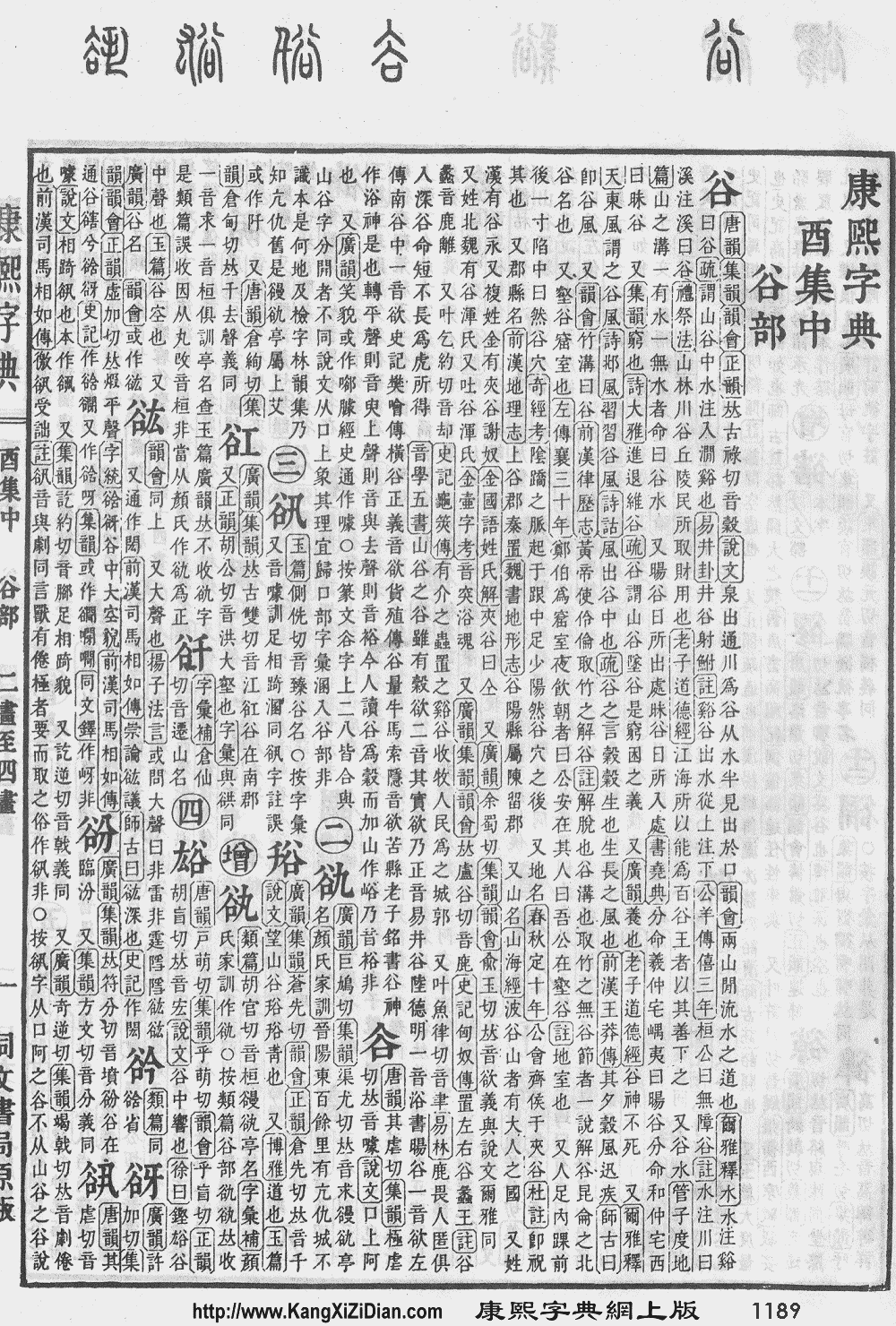
  • KangXi: page 1189, character 1
  • Dai Kanwa Jiten: character 36182
  • Dae Jaweon: page 1652, character 19
  • Hanyu Da Zidian (first edition): volume 6, page 3902, character 1
  • Unihan data for U+8C37

Chinese

Glyph origin

Historical forms of the character 谷
Shang Western Zhou Shuowen Jiezi (compiled in Han) Liushutong (compiled in Ming)
Oracle bone script Bronze inscriptions Small seal script Transcribed ancient scripts

Pictogram (象形) — valley (口) in between two mountains.

Etymology 1

simp. and trad.
谷

From Proto-Sino-Tibetan *kl(j)u(ŋ/k) (“river; gorge”). Cognate with Tibetan ལྗོངས (ljongs), Tibetan ཀླུང (klung) and Tibetan ལུང་པ (lung pa).

Pronunciation


Rime
Character 谷
Reading # 1/3
Initial (聲) 見 (28)
Final (韻) 東 (3)
Tone (調) Checked (Ø)
Openness (開合) Open
Division (等) I
Fanqie 古禄切
Baxter kuwk
Reconstructions
Zhengzhang
Shangfang
/kuk̚/
Pan
Wuyun
/kuk̚/
Shao
Rongfen
/kuk̚/
Edwin
Pulleyblank
/kəwk̚/
Li
Rong
/kuk̚/
Wang
Li
/kuk̚/
Bernard
Karlgren
/kuk̚/
Expected
Mandarin
Reflex
gu
Expected
Cantonese
Reflex
guk1
Baxter–Sagart system 1.1 (2014)
Character 谷
Reading # 1/1
Modern
Beijing
(Pinyin)
gǔ
Middle
Chinese
‹ kuwk ›
Old
Chinese
/*C.qˁok/
English valley

Notes for Old Chinese notations in the Baxter–Sagart system:

* Parentheses "()" indicate uncertain presence;
* Square brackets "[]" indicate uncertain identity, e.g. *[t] as coda may in fact be *-t or *-p;
* Angle brackets "<>" indicate infix;
* Hyphen "-" indicates morpheme boundary;

* Period "." indicates syllable boundary.
Zhengzhang system (2003)
Character 谷
Reading # 2/3
No. 4299
Phonetic
component
谷
Rime
group
屋
Rime
subdivision
0
Corresponding
MC rime
穀
Old
Chinese
/*kloːɡ/

Definitions

谷

  1. valley; gorge; ravine
  2. river or stream between two mountains; (in general) stream or river
  3. (figurative) difficult position; predicament
    進退維谷/进退维谷  ―  jìntuìwéigǔ  ―  to be caught between a rock and a hard place
  4. a surname
    谷愛凌/谷爱凌  ―  Gǔ Àilíng  ―  Eileen Gu

Compounds

Etymology 2

simp. and trad.
谷
alternative forms 唂
䏱

Pronunciation

Definitions

谷 (Cantonese)

  1. to pressure
  2. to hasten; to boost
  3. to cause to swell by pressuring
Derived terms
  • 催谷 (cuīgǔ)
  • 力谷
  • 谷奶
  • 谷爆
  • 谷住度氣/谷住度气
  • 谷氣/谷气

Etymology 3

simp. and trad.
谷

From English group. Doublet of group.

Pronunciation

Definitions

谷

  1. (Hong Kong Cantonese, social media, Internet slang) group (Classifier: 個/个 c)
Compounds

Etymology 4

simp. and trad.
谷

Pronunciation


Rime
Character 谷
Reading # 3/3
Initial (聲) 以 (36)
Final (韻) 鍾 (8)
Tone (調) Checked (Ø)
Openness (開合) Open
Division (等) III
Fanqie 余蜀切
Baxter yowk
Reconstructions
Zhengzhang
Shangfang
/jɨok̚/
Pan
Wuyun
/jiok̚/
Shao
Rongfen
/iok̚/
Edwin
Pulleyblank
/juawk̚/
Li
Rong
/iok̚/
Wang
Li
/jĭwok̚/
Bernard
Karlgren
/i̯wok̚/
Expected
Mandarin
Reflex
wù
Expected
Cantonese
Reflex
juk6
Zhengzhang system (2003)
Character 谷
Reading # 3/3
No. 4310
Phonetic
component
谷
Rime
group
屋
Rime
subdivision
0
Corresponding
MC rime
欲
Old
Chinese
/*ɡ·loːɡ/

Definitions

谷

  1. Only used in 吐谷渾/吐谷浑 (tǔyùhún, “Tuyuhun: name of an ancient nomadic people in northwestern China”) and 谷渾/谷浑 (yùhún, “surname”).

Etymology 5

simp. and trad.
谷

Pronunciation


Rime
Character 谷
Reading # 2/3
Initial (聲) 來 (37)
Final (韻) 東 (3)
Tone (調) Checked (Ø)
Openness (開合) Open
Division (等) I
Fanqie 盧谷切
Baxter luwk
Reconstructions
Zhengzhang
Shangfang
/luk̚/
Pan
Wuyun
/luk̚/
Shao
Rongfen
/luk̚/
Edwin
Pulleyblank
/ləwk̚/
Li
Rong
/luk̚/
Wang
Li
/luk̚/
Bernard
Karlgren
/luk̚/
Expected
Mandarin
Reflex
lù
Expected
Cantonese
Reflex
luk6
Zhengzhang system (2003)
Character 谷
Reading # 1/3
No. 4298
Phonetic
component
谷
Rime
group
屋
Rime
subdivision
0
Corresponding
MC rime
禄
Old
Chinese
/*ɦkroːɡ/
Notes 見史記

Definitions

谷

  1. Only used in 谷蠡王 (lùlíwáng) and 谷蠡 (lùlí, “title for Xiongnu officials”).

Etymology 6

For pronunciation and definitions of 谷 – see 穀 (“corn; grain; cereal; foxtail millet; etc.”).
(This character, 谷, is the simplified form of 穀.)
Notes:

Japanese

Kanji

谷

(grade 2 “Kyōiku” kanji)

  1. valley
  2. lowland, plain

Readings

From Middle Chinese 谷 (MC kuk̚, “valley, gorge”):

From Middle Chinese 谷 (MC jɨok̚), as in 吐谷渾 (Toyokukon, “Tuyuhun”):

From Middle Chinese 谷 (MC luk̚), as in 谷蠡 (Rokuri):

Compounds

Etymology 1

Kanji in this term
谷
たに
Grade: 2
kun’yomi

From Old Japanese.

Alternative forms

Pronunciation

  • (Tokyo) たに​ [tàníꜜ] (Odaka – [2])[1]
  • IPA(key): [ta̠ɲ̟i]

Noun

谷(たに) • (tani) 

  1. a valley (elongated depression between hills or mountains)
  2. a trough (low portion of a wave cycle)
  3. an intersection of two receding roof slopes
Derived terms

Proper noun

谷(たに) • (Tani) 

  1. a surname

Etymology 2

Kanji in this term
谷
やつ
Grade: 2
kun’yomi

Possibly from Ainu [Term?].

Alternative forms

  • 谷津

Noun

谷(やつ) • (yatsu) 

  1. a low-lying wetland
  2. a valley
Derived terms

Etymology 3

Kanji in this term
谷
や
Grade: 2
kun’yomi

Possibly a shift from yatsu above.

Noun

谷(や) • (ya) 

  1. a valley
Derived terms

Etymology 4

Kanji in this term
谷
やち
Grade: 2
irregular

Variant shift from yatsu above.

Alternative forms

Noun

谷(やち) • (yachi) 

  1. (regional) Same as やつ (yatsu) above

Etymology 5

Kanji in this term
谷
やと
Grade: 2
irregular

Another variant shift from yatsu above.

Alternative forms

  • 谷戸

Noun

谷(やと) • (yato) 

  1. Same as やつ (yatsu) above

Etymology 6

Kanji in this term
谷
Grade: 2
irregular

(This etymology is missing or incomplete. Please add to it, or discuss it at the Etymology scriptorium.)

Alternative forms

Noun

谷(さこ) • (sako) 

  1. (regional, especially Kansai) a small valley

References

  1. 2006, 大辞林 (Daijirin), Third Edition (in Japanese), Tōkyō: Sanseidō, →ISBN

Korean

Etymology 1

From Middle Chinese 谷 (MC kuk̚). Recorded as Middle Korean 곡 (kwok) (Yale: kwok) in Hunmong Jahoe (訓蒙字會 / 훈몽자회), 1527.

Hanja

Wikisource 谷 (eumhun 골 곡 (gol gok))

  1. Hanja form? of 곡 (“valley”).

Compounds

Etymology 2

From Middle Chinese 谷 (MC jɨok̚). Recorded as Middle Korean 욕〮 (yók) (Yale: yok) in Hunmong Jahoe (訓蒙字會 / 훈몽자회), 1527.

Hanja

谷 (eumhun 나라 이름 욕 (nara ireum yok))

  1. (historical) Hanja form? of 욕 (“Only used in 토욕혼 (吐谷渾, toyokhon, “Tuyuhun: name of an ancient nomadic people in northwestern China”)”).

Etymology 3

From Middle Chinese 谷 (MC luk̚). Recorded as Middle Korean 록〮 (Yale: lwok) in Dongguk Jeongun (東國正韻 / 동국정운), 1448.

Hanja

谷 (eumhun 벼슬 이름 록 (byeoseul ireum rok), South Korea 벼슬 이름 녹 (byeoseul ireum nok))

  1. (historical) Hanja form? of 록/녹 (“Only used in 녹려 (谷蠡, nongnyeo, title for Xiongnu officials)”).

References

  • 국제퇴계학회 대구경북지부 (國際退溪學會 大邱慶北支部) (2007). Digital Hanja Dictionary, 전자사전/電子字典.

Vietnamese

Han character

谷: Hán Nôm readings: cốc, góc, hốc, dục, thung, lủng

  1. This term needs a translation to English. Please help out and add a translation, then remove the text {{rfdef}}.
This article is issued from Wiktionary. The text is licensed under Creative Commons - Attribution - Sharealike. Additional terms may apply for the media files.