推

See also: 稚
推 U+63A8, 推
CJK UNIFIED IDEOGRAPH-63A8
← 控
[U+63A7]
CJK Unified Ideographs 掩 →
[U+63A9]

Translingual

Han character

推 (Kangxi radical 64, 手+8, 11 strokes, cangjie input 手人土 (QOG), four-corner 50014, composition ⿰扌隹)

References

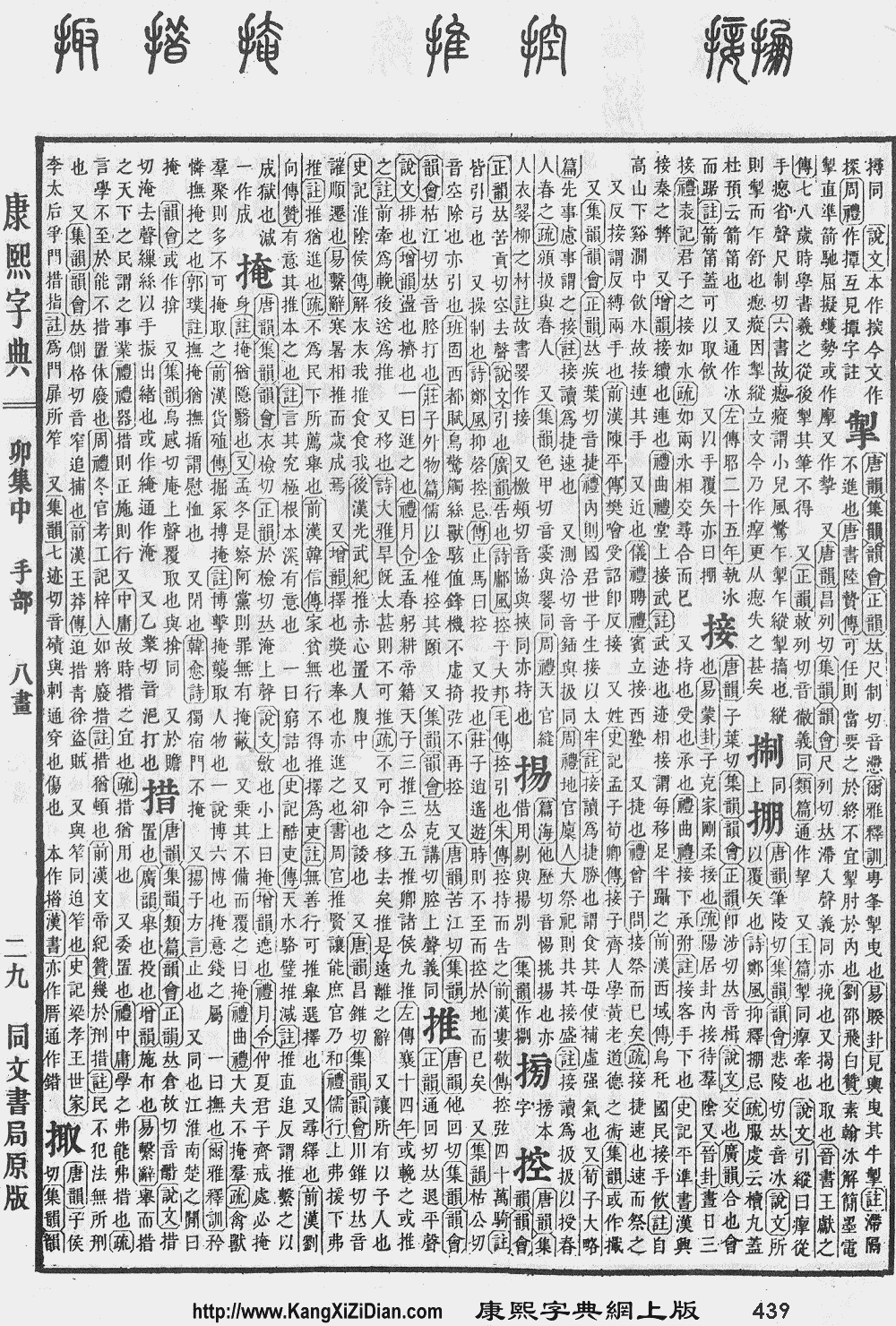
  • KangXi: page 439, character 8
  • Dai Kanwa Jiten: character 12284
  • Dae Jaweon: page 790, character 1
  • Hanyu Da Zidian (first edition): volume 3, page 1898, character 7
  • Unihan data for U+63A8

Chinese

simp. and trad.
推

Glyph origin

Phono-semantic compound (形聲, OC *tʰuːl, *tʰjul) : semantic 扌 (“hand”) + phonetic 隹 (OC *tjul) – push with the hand.

Etymology

Middle Chinese distinguishes 推 (MC tʰuʌi, “to push”) and 推 (MC t͡ʃʰiuɪ, “to proceed; to promote; to deduce”).

Older Mandarin dictionaries[n 1] give chuī (the Mandarin reflex of 推 (MC t͡ʃʰiuɪ)) as a variant reading for all senses, while Cantonese dictionaries[n 2] only assign ceoi1 to the "to deduce" sense (e.g. in 推測 (“to surmise”)). Most modern Sinitic varieties use the reflexes of 推 (MC tʰuʌi) for all meanings, while Sino-Xenic use the reflexes of 推 (MC t͡ʃʰiuɪ) (in Korean, however, the reflex of 推 (MC tʰuʌi) is also used in a few words). Some varieties (including certain Hakka, Min, and sometimes Yue dialects) preserve both readings, but not necessarily disambiguate them by meaning.

See also 揣 (MC t͡ʃʰˠiuᴇX, tuɑX).

“to support”
Orthographic borrowing from Japanese 推(お)し (oshi).

Pronunciation


Note: thôi - “to put aside”.
Note:
  • thui/chhui - literary;
  • ther/the/tu - vernacular.

  • Dialectal data
Variety Location 推
Mandarin Beijing /tʰuei⁵⁵/
Harbin /tʰuei⁴⁴/
Tianjin /tʰuei²¹/
Jinan /tʰuei²¹³/
Qingdao /tʰue²¹³/
Zhengzhou /tʰuei²⁴/
Xi'an /tʰuei²¹/
Xining /tʰuɨ⁴⁴/
Yinchuan /tʰuei⁴⁴/
Lanzhou /tʰuei³¹/
Ürümqi /tʰuei⁴⁴/
Wuhan /tʰei⁵⁵/
Chengdu /tʰuei⁵⁵/
Guiyang /tʰuei⁵⁵/
Kunming /tʰuei⁴⁴/
Nanjing /tʰuəi³¹/
Hefei /tʰe²¹/
Jin Taiyuan /tʰuei¹¹/
Pingyao /tʰuæ¹³/
Hohhot /tʰuei³¹/
Wu Shanghai /tʰe⁵³/
Suzhou /tʰe̞⁵⁵/
Hangzhou /tʰui³³/
Wenzhou /tʰai³³/
Hui Shexian /tʰɛ³¹/
Tunxi /tʰə¹¹/
Xiang Changsha /tʰei³³/
Xiangtan /tʰəi³³/
Gan Nanchang /tʰui⁴²/
Hakka Meixian /tʰui⁴⁴/
Taoyuan
Cantonese Guangzhou /tʰøy⁵³/
Nanning /tʰui⁵⁵/
Hong Kong /tʰøy⁵⁵/
Min Xiamen (Min Nan) /tʰui⁵⁵/
/tu⁵⁵/
Fuzhou (Min Dong) /tʰøy⁴⁴/
Jian'ou (Min Bei) /tʰo⁵⁴/
Shantou (Min Nan) /t͡sʰui³³/
Haikou (Min Nan) /sui²³/
/he²³/

Rime
Character 推 推
Reading # 1/2 2/2
Initial (聲) 初 (19) 透 (6)
Final (韻) 脂 (16) 灰 (42)
Tone (調) Level (Ø) Level (Ø)
Openness (開合) Closed Closed
Division (等) III I
Fanqie 叉隹切 他回切
Baxter tsrhjwij thwoj
Reconstructions
Zhengzhang
Shangfang
/t͡ʃʰiuɪ/ /tʰuʌi/
Pan
Wuyun
/ʈ͡ʂʰʷi/ /tʰuoi/
Shao
Rongfen
/t͡ʃʰjuɪ/ /tʰuɒi/
Edwin
Pulleyblank
/ʈ͡ʂʰwi/ /tʰwəj/
Li
Rong
/t͡ʃʰui/ /tʰuᴀi/
Wang
Li
/t͡ʃʰwi/ /tʰuɒi/
Bernard
Karlgren
/ʈ͡ʂʰwi/ /tʰuɑ̆i/
Expected
Mandarin
Reflex
chuāi tuī
Expected
Cantonese
Reflex
ceoi1 teoi1
Baxter–Sagart system 1.1 (2014)
Character 推
Reading # 1/1
Modern
Beijing
(Pinyin)
tuī
Middle
Chinese
‹ thwoj ›
Old
Chinese
/*tʰˁuj/
English push away

Notes for Old Chinese notations in the Baxter–Sagart system:

* Parentheses "()" indicate uncertain presence;
* Square brackets "[]" indicate uncertain identity, e.g. *[t] as coda may in fact be *-t or *-p;
* Angle brackets "<>" indicate infix;
* Hyphen "-" indicates morpheme boundary;

* Period "." indicates syllable boundary.
Zhengzhang system (2003)
Character 推 推
Reading # 1/2 2/2
No. 17708 17724
Phonetic
component
隹 隹
Rime
group
微 微
Rime
subdivision
2 2
Corresponding
MC rime
𨌴
Old
Chinese
/*tʰuːl/ /*tʰjul/
Notes 由叉隹切校正

Definitions

推

  1. to push
    手推車/手推车  ―  shǒutuīchē  ―  pushcart
    推開窗/推开窗  ―  tuī kāi chuāng  ―  to push the windows open
  2. to postpone; to delay
    推遲/推迟  ―  tuīchí  ―  to postpone
  3. (figurative) to put aside; to push away; to dismiss; to explain away
    推諉/推诿  ―  tuīwěi  ―  to pass the buck
    推辭/推辞  ―  tuīcí  ―  to decline with an excuse
    推掉聚會、推掉採訪、推掉責任 [MSC, trad.]
    推掉聚会、推掉采访、推掉责任 [MSC, simp.]
    tuīdiào jùhuì, tuīdiào cǎifǎng, tuīdiào zérèn [Pinyin]
    to decline a gathering, to decline interviews, to decline responsibility
  4. to prompt; to propel
    推進/推进  ―  tuījìn  ―  to propel; to push forward
    推波助瀾/推波助澜  ―  tuībōzhùlán  ―  "to drive the billowing waves"; to add fuel to fire
  5. to promote; to advertise; to advocate
    推廣/推广  ―  tuīguǎng  ―  to promote; to popularize
    推出  ―  tuīchū  ―  to present
  6. to nominate; to recommend
    推薦/推荐  ―  tuījiàn  ―  to recommend
    推選/推选  ―  tuīxuǎn  ―  to nominate
    唐代詩人首推李杜。 [MSC, trad.]
    唐代诗人首推李杜。 [MSC, simp.]
    Tángdài shīrén shǒutuī lǐdù. [Pinyin]
    Li Bai and Du Fu are ranked the top among the Tang-era poets.
  7. to generalize; to broaden
    推己及人  ―  tuījǐjírén  ―  to put oneself in someone's shoes
  8. to infer; to deduce
    推測/推测  ―  tuīcè  ―  to estimate; to infer
    類推/类推  ―  lèituī  ―  to infer by analogy
  9. to derive; to reason; to compute
    推導/推导  ―  tuīdǎo  ―  to derive
    推論/推论  ―  tuīlùn  ―  corollary
  10. to proceed; to succeed; to form a procession
    推移  ―  tuīyí  ―  to proceed (in time)
  11. (Hong Kong, Internet slang) to bump a thread in support; to "push"
    Synonym: push
    Antonyms: 拉, pull
  12. (ACG or fandom slang) being a devoted fan of [someone]; to support [someone] (in an idol group; etc.)
    前田敦子推  ―  Qiántián Dūnzǐ tuī  ―  a person supporting Atsuko Maeda
    一生推  ―  yīshēng tuī  ―  to support [someone or a particular group] for life
    首推  ―  shǒu tuī  ―  member that someone like most in an idol group

Synonyms

Compounds

References

Notes

  1. Samuel Wells Williams, 1874; Herbert Allen Giles, 1892
  2. John Chalmers, 1855; Samuel Wells Williams, 1856; 廣話國語一貫未定稿, 1916

Japanese

Kanji

推

(grade 6 “Kyōiku” kanji)

  1. conjecture

Readings

Compounds

Korean

Hanja

推 • (chu, toe) (hangeul 추, 퇴)

  1. This term needs a translation to English. Please help out and add a translation, then remove the text {{rfdef}}.

Vietnamese

Han character

推: Hán Nôm readings: suy, chui, thoi, thòi, thôi, tòi, thối

  1. This term needs a translation to English. Please help out and add a translation, then remove the text {{rfdef}}.
This article is issued from Wiktionary. The text is licensed under Creative Commons - Attribution - Sharealike. Additional terms may apply for the media files.