管
| ||||||||
Translingual
| Stroke order | |||
|---|---|---|---|
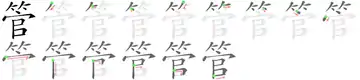 | |||
Han character
管 (Kangxi radical 118, 竹+8, 14 strokes, cangjie input 竹十口口 (HJRR), four-corner 88777, composition ⿱𥫗官)
References
- KangXi: page 889, character 6
- Dai Kanwa Jiten: character 26162
- Dae Jaweon: page 1316, character 12
- Hanyu Da Zidian (first edition): volume 5, page 2986, character 5
- Unihan data for U+7BA1

Chinese
| trad. | 管 | |
|---|---|---|
| simp. # | 管 | |
Glyph origin
Characters in the same phonetic series (官) (Zhengzhang, 2003)
Phono-semantic compound (形聲, OC *koːnʔ) : semantic 竹 (“bamboo”) + phonetic 官 (OC *koːn).
Pronunciation
Definitions
管
- (music) a cylindrical double-reed woodwind instrument made of bamboo or wood
- (music, by extension) any wind instrument
- (by extension) slender tubular hollow object; pipe; tube; duct; canal; valve; fistula
- 吸管 ― xīguǎn ― straw
- (literary) calligraphy brush; inkbrush
- Classifier for tube-shaped objects.
- to administer; to manage; to control; to be in charge
- 管理 ― guǎnlǐ ― to manage
- to subject someone to discipline; to discipline
- to concern oneself with; to interfere with
- 你管他作甚! [Written Vernacular Chinese, trad. and simp.]
- From: Various editors. c. 13th century. A Collection of Conversations of Master Zhu (《朱子語類》)
- Nǐ guǎn tā zuòshèn! [Pinyin]
- Why mind them at all!
- to be responsible for the provision of; to provide; to supply
- to assure; to guarantee; to ensure; to keep
- despite; regardless of; irrespective of
- (colloquial) used in the pattern 管……叫…… (“to call (someone/something the name of)”), where 管 is followed by the entity that is being called a name
- (dialectal, colloquial) indicates the object of an action: to
- (Sichuanese) to be worth
- a surname
Synonyms
- (writing brush):
Dialectal synonyms of 毛筆 (“calligraphy brush; inkbrush”) [map]
- (to concern oneself with):
Dialectal synonyms of 理 (“to be concerned with; to pay attention to”) [map]
| Variety | Location | Words |
|---|---|---|
| Formal (Written Standard Chinese) | 理, 管, 睬, 理睬, 理會 | |
| Mandarin | Beijing | 理, 搭理, 搭咯 |
| Taiwan | 理, 管 | |
| Jinan | 理, 搭理 | |
| Xi'an | 招, 理 | |
| Wuhan | 邇, 理, 睬 | |
| Chengdu | 理, 睬 | |
| Yangzhou | 睬 | |
| Hefei | 理, 睬 | |
| Singapore | 理, 管 | |
| Cantonese | Guangzhou | 睬, 理, 騷 |
| Hong Kong | 睬, 理, 騷 | |
| Yangjiang | 理, 睬 | |
| Singapore (Guangfu) | 理 | |
| Gan | Nanchang | 理, 搭 |
| Hakka | Meixian | 睬, 唰 |
| Jin | Taiyuan | 理, 理睬 |
| Min Bei | Jian'ou | 理 |
| Min Dong | Fuzhou | 叕, 插 |
| Min Nan | Xiamen | 插, 插唆, 插潲, 插管, 管待 |
| Quanzhou | 插, 插唆, 插潲 | |
| Zhangzhou | 插, 插潲, 插管, 管待 | |
| Tainan | 插, 管, 管待 | |
| Penang (Hokkien) | 插潲 | |
| Singapore (Hokkien) | 插, 插潲, 管, 插管, 甩 | |
| Chaozhou | 睬 | |
| Shantou | 理 | |
| Singapore (Teochew) | 插 | |
| Wu | Suzhou | 理, 睬 |
| Wenzhou | 朝, 理 | |
| Xiang | Changsha | 齒 |
| Shuangfeng | 齒, 搭, 邇 | |
- (to assure):
Compounds
Derived terms from 管
|
|
|
Descendants
References
- “管”, in 漢語多功能字庫 (Multi-function Chinese Character Database), 香港中文大學 (the Chinese University of Hong Kong), 2014–
Japanese
Readings
Etymology 2
| Kanji in this term |
|---|
| 管 |
| くだ Grade: 4 |
| kun’yomi |
From Old Japanese 管 (kuda, “pipe, tube”).[2][1][3]
Alternative forms
- 莩 (rare)
Noun
管 • (kuda)
- a pipe or tube, such as that made of bamboo, wood, metal, or rubber
- a shuttle for weaving with a loom (from the way the earliest shuttles were made from bamboo tubes)
- the central axis of a spindle for winding the thread
- short for 管の笛 (kuda no fue), a kind of small pipe or flute used for signalling during a battle, similar to a fife
- an agricultural tool, used to gather up cut rice stalks
- short for 管狐 (kudagitsune), a kind of mythical fox roughly the size of a weasel, that would live in bamboo stalks and make prophecies of the future
References
- 2006, 大辞林 (Daijirin), Third Edition (in Japanese), Tōkyō: Sanseidō, →ISBN
- 1988, 国語大辞典(新装版) (Kokugo Dai Jiten, Revised Edition) (in Japanese), Tōkyō: Shogakukan
- 1995, 大辞泉 (Daijisen) (in Japanese), Tōkyō: Shogakukan, →ISBN
Korean
Vietnamese
This article is issued from Wiktionary. The text is licensed under Creative Commons - Attribution - Sharealike. Additional terms may apply for the media files.