甩
| ||||||||
Translingual
Han character
甩 (Kangxi radical 101, 用+0, 5 strokes, cangjie input 月手山 (BQU), four-corner 77212, composition ⿻月乚(GHTK) or ⿻⿵冂𠄠乚(J))
Derived characters
- 𫝺
References
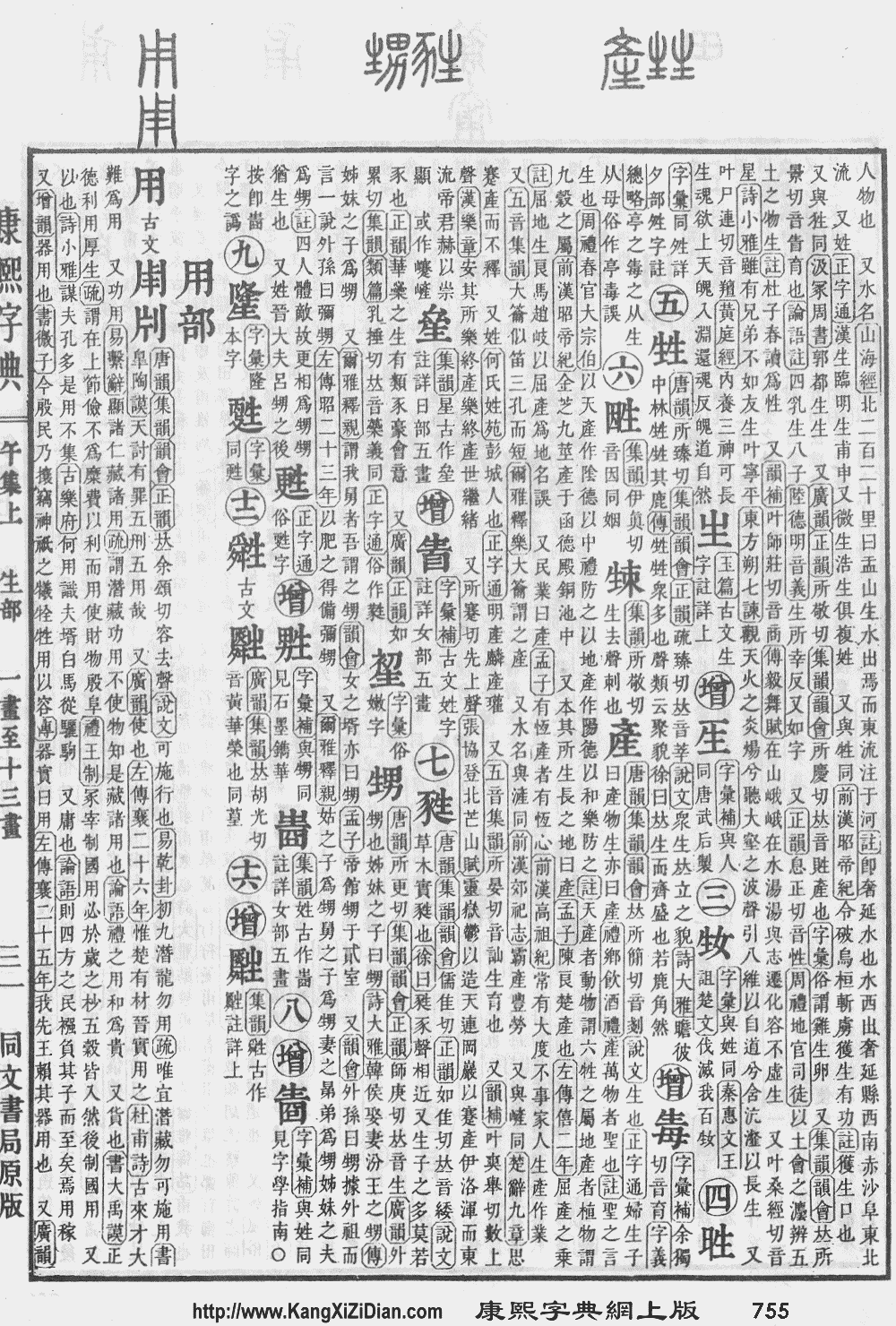
- KangXi: not present, would follow page 755, character 25
- Dai Kanwa Jiten: character 21704
- Dae Jaweon: page 1166, character 2
- Hanyu Da Zidian (first edition): volume 1, page 99, character 2
- Unihan data for U+7529
Chinese
| simp. and trad. |
甩 | |
|---|---|---|
| alternative forms | 𫝺 Hokkien 溴 Hokkien | |
Etymology
This is a late character, and the divergent readings in various topolects may or may not be cognate.
The Mandarin reading came from 摔 (shuāi, “to fling, to throw, to fall down”), which can be traced to *srut in Old Chinese. It can be compared with Tibetan རུད (rud, “slip, that which has slipped down, falling mass, landslides”), རུད་རུད་པོ (rud rud po, “loosened, disintegrated, rough”).
The Cantonese reading is probably unrelated, though it may reflect a descendant of the archaic pronunciation *rut and hence be cognate with Mandarin. Either way, it is evidently from the same source as Min Nan 甪 (lut, “to come off, to slip loose”), Zhuang lot (“to come loose and drop off (due to loose tying)”), and Vietnamese lột (“to peel, to strip off”). May be compared with Tibetan ལོད་པོ (lod po, “relaxed, careless”), ལྷོད་པོ (lhod po, “relaxed, loose, lax”), and the Chinese word family of 兌 (*lot, > 脫 (“to come off”), 蛻 (“exuviae”)). Unlikely to be related to 落 (luò, “to fall, to drop off”).
Pronunciation
Definitions
甩
- (Mandarin, Hokkien, Wu) to toss; to throw; to fling
- (Mandarin) to throw away; to discard
- (Mandarin) to brush off; to abandon
- (Mandarin) to swing
- 甩尾巴 ― shuǎi wěiba ― to wag one's tail
- (dialectal Mandarin) to take off; to remove
- (dialectal Mandarin) to heed; to take notice of
- (dialectal Mandarin, of insects, zoology, etc.) to lay (eggs)
- (Beijing) to play (cards)
- (Beijing) Short for 甩賣/甩卖 (shuǎimài, “to sell at cheap prices”).
- (Beijing) to scold
- (Sichuanese) perturbed; uneasy
- (Cantonese) to come loose; to come off
- (Cantonese) to sense by touch
- (dialectal Cantonese) to fall down
- (Wu) to strike; to box (about the ears)
- (Wu) to shake off; to escape
- (Wu) to wave; to rock
- (Hokkien) to sprinkle; to spray
- (Hokkien, vulgar) to heed; to pay attention to
Synonyms
- (to throw):
| Variety | Location | Words |
|---|---|---|
| Classical Chinese | 投 | |
| Formal (Written Standard Chinese) | 扔, 丟, 拋, 擲1, 摔 | |
| Mandarin | Beijing | 扔, 溜, 拽, 砍 |
| Taiwan | 扔, 丟 | |
| Jinan | 扔, 拽 | |
| Xi'an | 撂, 丟 | |
| Wuhan | 丟, 掟 | |
| Chengdu | 甩, 丟, 掟 | |
| Guilin | 丟 | |
| Yangzhou | 摔 | |
| Hefei | 甩 | |
| Malaysia | 丟 | |
| Singapore | 丟 | |
| Cantonese | Guangzhou | 掟, 抌, 掉 |
| Hong Kong | 掟, 抌, 掉 | |
| Gan | Nanchang | 拋, 釘 |
| Hakka | Meixian | 㧒, 撜, 擲4 |
| Miaoli (N. Sixian) | 擲4 | |
| Pingtung (Neipu; S. Sixian) | 擳 | |
| Hsinchu County (Zhudong; Hailu) | 擲4 | |
| Taichung (Dongshi; Dabu) | 擲4 | |
| Hsinchu County (Qionglin; Raoping) | 擲4 | |
| Yunlin (Lunbei; Zhao'an) | 擊 | |
| Jin | Taiyuan | 砍, 給, 蠻 |
| Min Bei | Jian'ou | 射 |
| Min Dong | Fuzhou | 挌, 抾, 轆, 獻 |
| Min Nan | Xiamen | 挕, 揕, 擲2, 練, 捔 |
| Quanzhou | 挕, 揕, 擲2 | |
| Jinjiang | 挕, 揕, 擲2 | |
| Zhangzhou | 挕, 揕, 捔 | |
| Tainan | 挕, 揕, 掔 | |
| Penang (Hokkien) | 揕 | |
| Singapore (Hokkien) | 挕, 揕, 擲2, 捔 | |
| Manila (Hokkien) | 挕, 揕, 擲2 | |
| Chaozhou | 捔, 撾, 挒, 標 | |
| Jieyang | 捔, 撾, 挒, 標, 打, 擲3 | |
| Wu | Suzhou | 厾, 真 |
| Wenzhou | 𪜃, 甩, 拌 | |
| Xiang | Changsha | 射, 釘 |
| Shuangfeng | 亞, 打 | |
- (to heed):
| Variety | Location | Words |
|---|---|---|
| Formal (Written Standard Chinese) | 理, 管, 睬, 理睬, 理會 | |
| Mandarin | Beijing | 理, 搭理, 搭咯 |
| Taiwan | 理, 管 | |
| Jinan | 理, 搭理 | |
| Xi'an | 招, 理 | |
| Wuhan | 邇, 理, 睬 | |
| Chengdu | 理, 睬 | |
| Yangzhou | 睬 | |
| Hefei | 理, 睬 | |
| Singapore | 理, 管 | |
| Cantonese | Guangzhou | 睬, 理, 騷 |
| Hong Kong | 睬, 理, 騷 | |
| Yangjiang | 理, 睬 | |
| Singapore (Guangfu) | 理 | |
| Gan | Nanchang | 理, 搭 |
| Hakka | Meixian | 睬, 唰 |
| Jin | Taiyuan | 理, 理睬 |
| Min Bei | Jian'ou | 理 |
| Min Dong | Fuzhou | 叕, 插 |
| Min Nan | Xiamen | 插, 插唆, 插潲, 插管, 管待 |
| Quanzhou | 插, 插唆, 插潲 | |
| Zhangzhou | 插, 插潲, 插管, 管待 | |
| Tainan | 插, 管, 管待 | |
| Penang (Hokkien) | 插潲 | |
| Singapore (Hokkien) | 插, 插潲, 管, 插管, 甩 | |
| Chaozhou | 睬 | |
| Shantou | 理 | |
| Singapore (Teochew) | 插 | |
| Wu | Suzhou | 理, 睬 |
| Wenzhou | 朝, 理 | |
| Xiang | Changsha | 齒 |
| Shuangfeng | 齒, 搭, 邇 | |
Compounds
Japanese
Kanji
- This term needs a translation to English. Please help out and add a translation, then remove the text
{{rfdef}}.
Vietnamese
Han character
甩: Hán Nôm readings: soải, súy/suý
- This term needs a translation to English. Please help out and add a translation, then remove the text
{{rfdef}}.