滿
| ||||||||
Translingual
| Traditional | 滿 |
|---|---|
| Shinjitai | 満 |
| Simplified | 满 |
Han character
滿 (Kangxi radical 85, 水+11, 14 strokes, cangjie input 水廿中月 (ETLB), four-corner 34127, composition ⿰氵㒼)
References
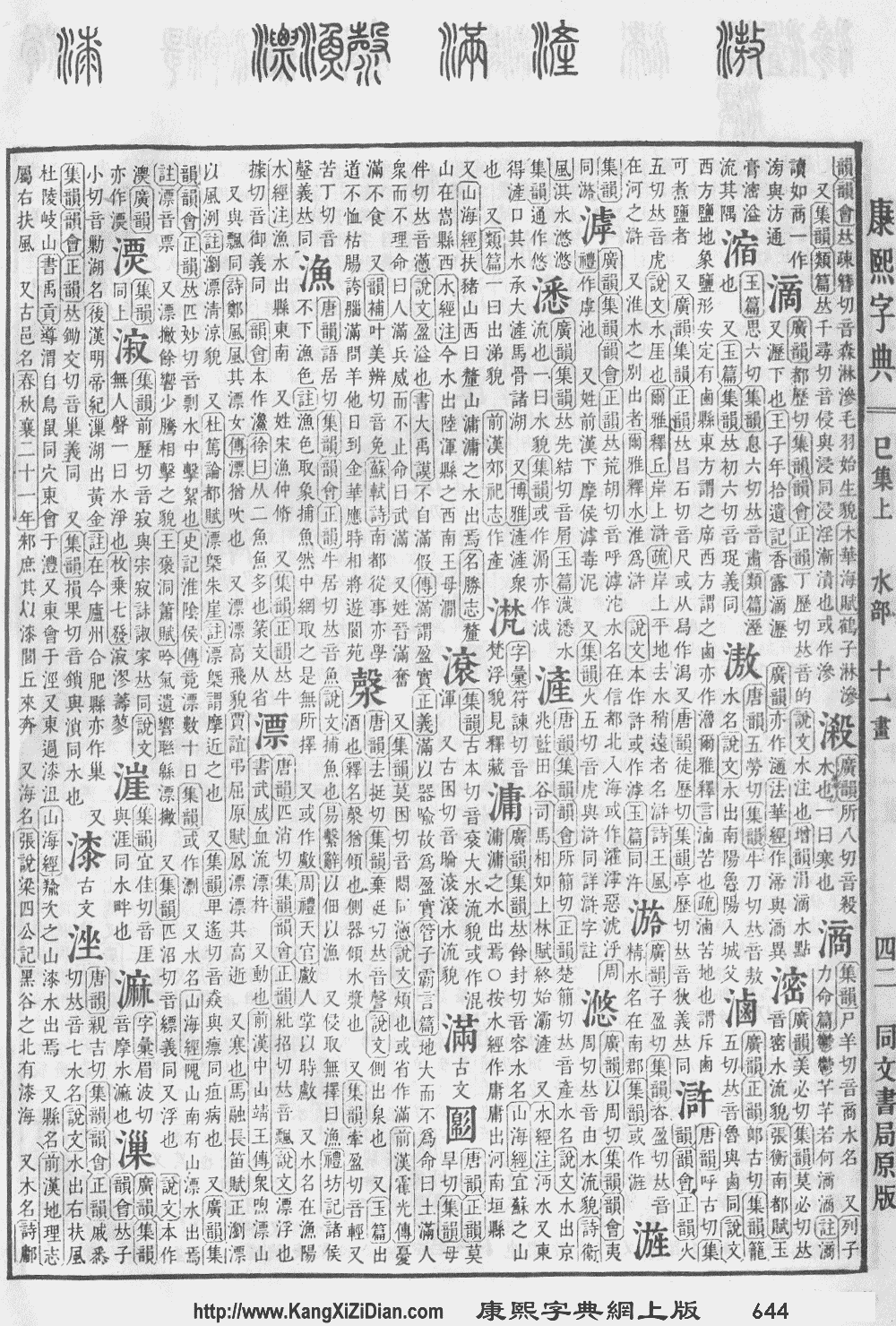
- KangXi: page 644, character 18
- Dai Kanwa Jiten: character 18099
- Dae Jaweon: page 1052, character 3
- Hanyu Da Zidian (first edition): volume 3, page 1714, character 1
- Unihan data for U+6EFF
Chinese
| trad. | 滿 | |
|---|---|---|
| simp. | 满 | |
Glyph origin
Characters in the same phonetic series (芇) (Zhengzhang, 2003)
Phono-semantic compound (形聲, OC *moːnʔ) : semantic 水 (“water”) + phonetic 㒼 ().
Etymology

Pronunciation
Definitions
滿
Synonyms
Synonyms of 滿
- (full):
Synonyms of 滿
Dialectal synonyms of 滿 (“full”) [map]
| Variety | Location | Words |
|---|---|---|
| Formal (Written Standard Chinese) | 滿 | |
| Mandarin | Beijing | 滿 |
| Taiwan | 滿 | |
| Jinan | 滿 | |
| Xi'an | 滿 | |
| Wuhan | 滿 | |
| Chengdu | 滿 | |
| Yangzhou | 滿 | |
| Hefei | 滿 | |
| Cantonese | Guangzhou | 滿 |
| Hong Kong | 滿 | |
| Yangjiang | 瀰 | |
| Gan | Nanchang | 滿 |
| Hakka | Meixian | 滿 |
| Jin | Taiyuan | 滿 |
| Min Bei | Jian'ou | 滿 |
| Min Dong | Fuzhou | 滿, 滇 |
| Min Nan | Xiamen | 滿, 滇 |
| Quanzhou | 滇 | |
| Zhangzhou | 滇 | |
| Taipei | 滇, 滿 | |
| New Taipei (Sanxia) | 滇, 滿 | |
| Kaohsiung | 滇, 滿 | |
| Yilan | 滇, 滿 | |
| Changhua (Lukang) | 滇, 滿 | |
| Taichung | 滇 | |
| Tainan | 滇, 滿 | |
| Hsinchu | 滇 | |
| Kinmen | 滇 | |
| Penghu (Magong) | 滇 | |
| Singapore (Hokkien) | 滇, 滿 | |
| Chaozhou | 滿, 滇 | |
| Wu | Suzhou | 滿 |
| Wenzhou | 滿 | |
| Xiang | Changsha | 滿 |
| Shuangfeng | 滿 | |
- (to satisfy):
Compounds
Derived terms from 滿
|
|
|
References
- “滿”, in 漢語多功能字庫 (Multi-function Chinese Character Database), 香港中文大學 (the Chinese University of Hong Kong), 2014–
Japanese
| 満 | |
| 滿 |
Korean
Compounds
- 만주 (滿洲, ^manju, “Manchuria”)
- 만끽 (滿喫, mankkik, “enjoy fully”)
- 만료 (滿了, mallyo, “expiration”)
- 만천하 (滿天下, mancheonha, “the whole world”)
- 만월 (滿月, manwol, “full moon”)
- 만점 (滿點, manjeom, “perfect score”)
- 만조 (滿潮, manjo, “high water”)
- 불만 (不滿, bulman, “dissatisfaction”)
- 비만 (肥滿, biman, “fatness, obesity”)
- 포만 (飽滿, poman, “satiety, surfeit”)
Vietnamese
This article is issued from Wiktionary. The text is licensed under Creative Commons - Attribution - Sharealike. Additional terms may apply for the media files.